Lin Ying, Kang Qi, Liu Yijie, Zhu Yingke, Jiang Pingkai, Mai Yiu-Wing, Huang Xingyi
Shanghai Key Laboratory of Electrical Insulation and Thermal Ageing, Department of Polymer Science and Engineering, the State Key Laboratory of Metal Matrix Composites, Shanghai Jiao Tong University, Shanghai, 200240, People's Republic of China.
Centre for Advanced Materials Technology (CAMT), School of Aerospace, Mechanical and Mechatronic Engineering J07, The University of Sydney, Sydney, NSW, 2006, Australia.
Nanomicro Lett. 2023 Jan 9;15(1):31. doi: 10.1007/s40820-022-01003-3.
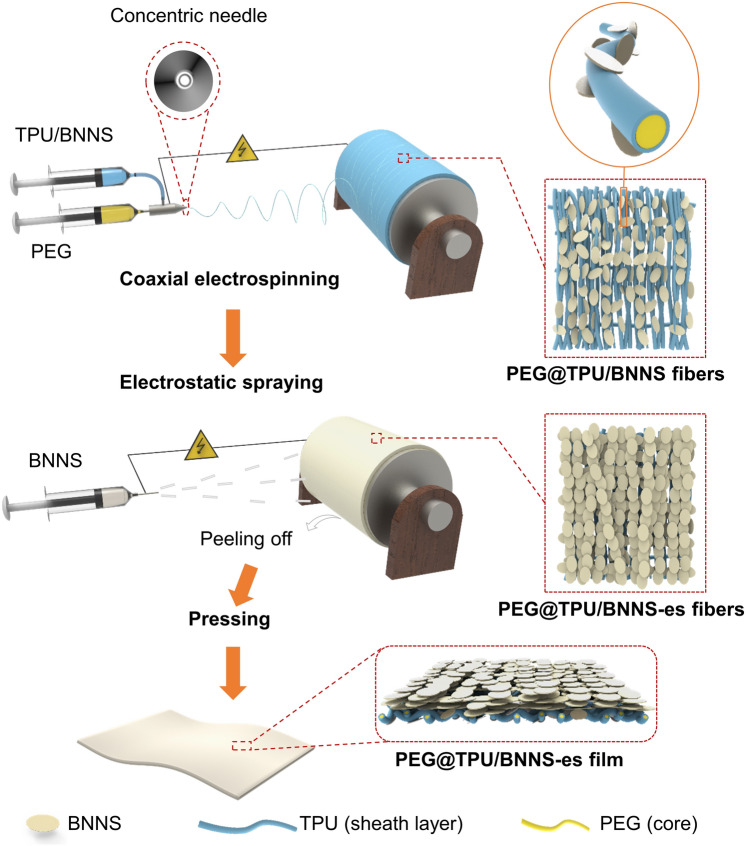
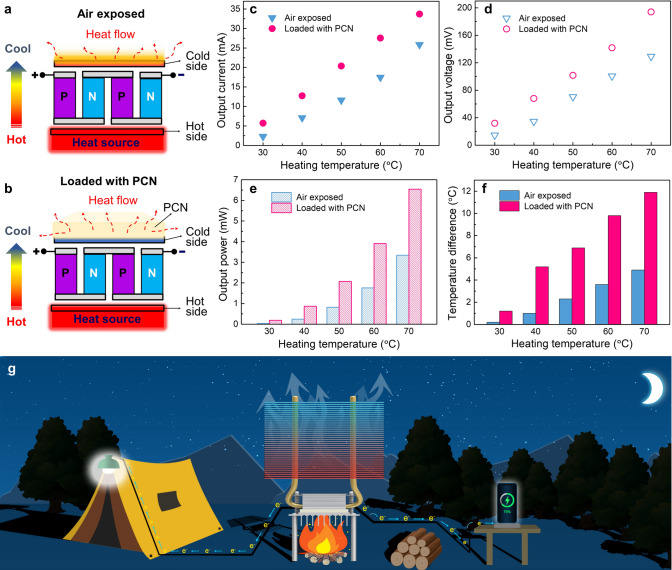
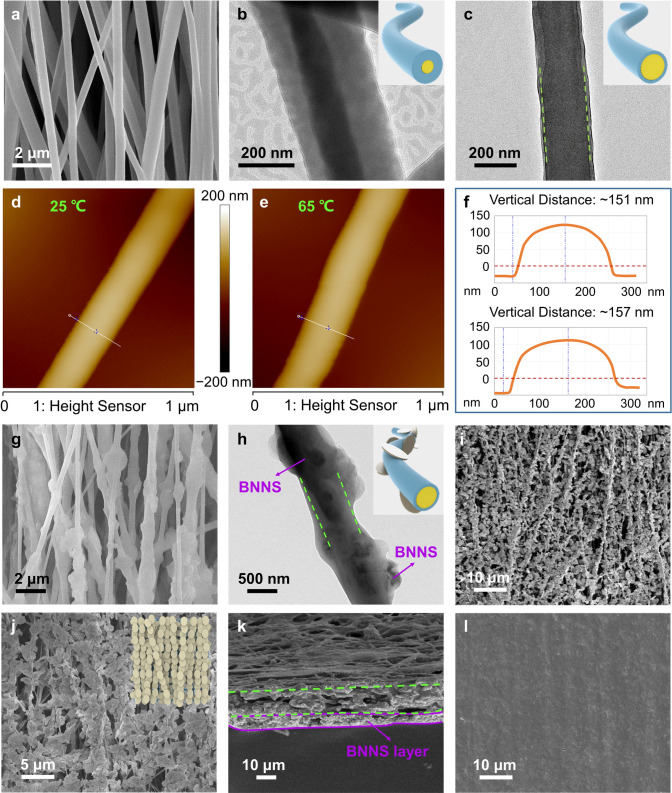
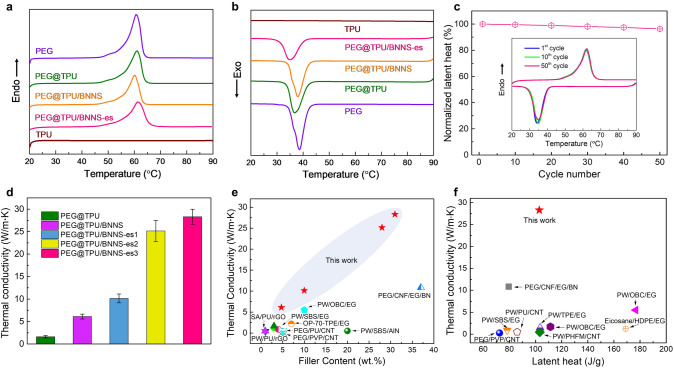
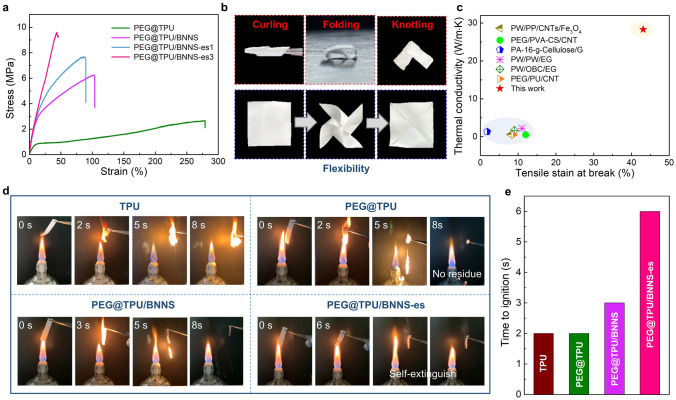
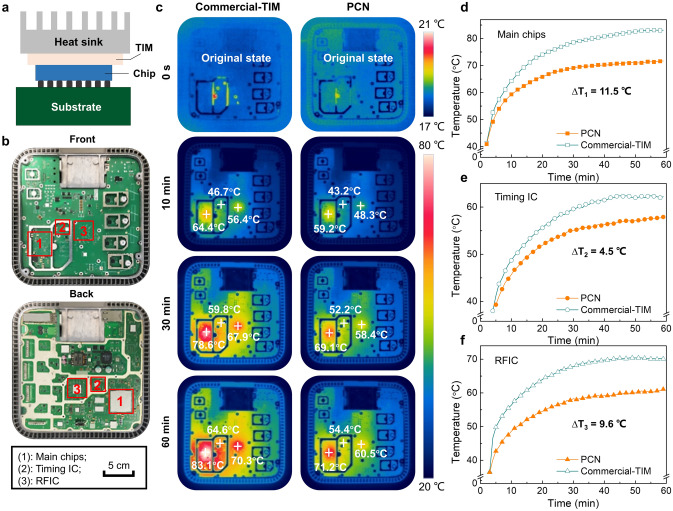
Thermal management has become a crucial problem for high-power-density equipment and devices. Phase change materials (PCMs) have great prospects in thermal management applications because of their large capacity of heat storage and isothermal behavior during phase transition. However, low intrinsic thermal conductivity, ease of leakage, and lack of flexibility severely limit their applications. Solving one of these problems often comes at the expense of other performance of the PCMs. In this work, we report core-sheath structured phase change nanocomposites (PCNs) with an aligned and interconnected boron nitride nanosheet network by combining coaxial electrospinning, electrostatic spraying, and hot-pressing. The advanced PCN films exhibit an ultrahigh thermal conductivity of 28.3 W m K at a low BNNS loading (i.e., 32 wt%), which thereby endows the PCNs with high enthalpy (> 101 J g), outstanding ductility (> 40%) and improved fire retardancy. Therefore, our core-sheath strategies successfully balance the trade-off between thermal conductivity, flexibility, and phase change enthalpy of PCMs. Further, the PCNs provide powerful cooling solutions on 5G base station chips and thermoelectric generators, displaying promising thermal management applications on high-power-density equipment and thermoelectric conversion devices.
热管理已成为高功率密度设备和器件面临的关键问题。相变材料(PCM)因其在相变过程中具有大容量储热和等温行为,在热管理应用中具有广阔前景。然而,其固有的低导热率、易泄漏以及缺乏柔韧性严重限制了它们的应用。解决这些问题中的一个往往是以牺牲PCM的其他性能为代价。在这项工作中,我们通过结合同轴静电纺丝、静电喷涂和热压,报道了具有排列整齐且相互连接的氮化硼纳米片网络的核壳结构相变纳米复合材料(PCN)。先进的PCN薄膜在低BNNS负载量(即32 wt%)下表现出28.3 W m⁻¹ K⁻¹的超高热导率,从而赋予PCN高焓(>101 J g⁻¹)、出色的延展性(>40%)和改进的阻燃性。因此,我们的核壳策略成功地平衡了PCM在导热率、柔韧性和相变焓之间的权衡。此外,PCN为5G基站芯片和热电发电机提供了强大的冷却解决方案,在高功率密度设备和热电转换器件上显示出有前景的热管理应用。