Hall C, Lowndes C M, Leung T K, Cooper D N, Goate A M, Lim L
Department of Neurochemistry, Institute of Neurology, London, U.K.
Biochem J. 1987 Jun 1;244(2):359-66. doi: 10.1042/bj2440359.
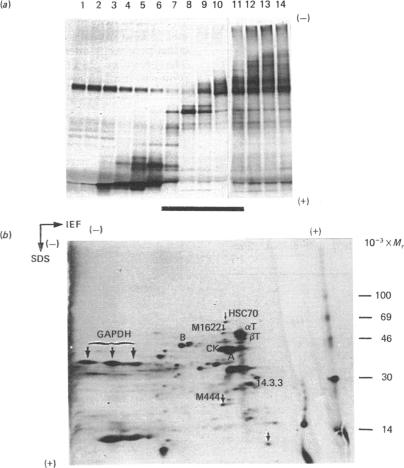
Translation in vitro of membrane-bound polyribosomal mRNAs from rat brain has shown several to be developmentally regulated [Hall & Lim (1981) Biochem. J. 196, 327-336]. Here we describe the isolation and characterization of cDNAs corresponding to two such brain mRNAs. One cDNA (M444) hybrid-selected a 0.95 kb mRNA directing the synthesis in vitro of a 21 kDa pI-6.3 polypeptide, which was processed in vitro by microsomal membranes. A second cDNA (M1622) hybridized to a 2.2 kb mRNA directing the synthesis of a 55 kDa pI-5.8 polypeptide. Both mRNAs were specific to membrane-bound polyribosomes. Restriction maps of the corresponding genomic DNA sequences are consistent with both being single copy. The two mRNAs were present in astrocytic and neuronal cultures, but not in liver or spleen or in neuroblastoma or glioma cells. The two mRNAs were differently regulated during brain development. In the developing forebrain there was a gradual and sustained increase in M444 mRNA during the first 3 weeks post partum, whereas M1622 mRNA appeared earlier and showed no further increase after day 10. In the cerebellum the developmental increase in M444 mRNA was biphasic. After a small initial increase there was a decrease in this mRNA at day 10, coincident with high amounts of M1622 mRNA. This was followed by a second, larger, increase in M444 mRNA, when amounts of M1622 mRNA were constant. The contrasting changes in these two mRNAs in the developing cerebellum are of particular interest, since they occur during an intensive period of cell proliferation, migration and altering neural connectivity. As these mRNAs are specific to differentiated neural tissue, they represent useful molecular markers for studying brain differentiation.
大鼠脑膜结合多核糖体mRNA的体外翻译表明,其中有几种在发育过程中受到调控[Hall与Lim(1981年),《生物化学杂志》196卷,327 - 336页]。在此,我们描述了与两种此类脑mRNA相对应的cDNA的分离与特性鉴定。一种cDNA(M444)杂交选择出一个0.95 kb的mRNA,该mRNA在体外指导合成一种21 kDa、pI为6.3的多肽,此多肽在体外经微粒体膜加工。第二种cDNA(M1622)与一个2.2 kb的mRNA杂交,该mRNA指导合成一种55 kDa、pI为5.8的多肽。两种mRNA都特异地存在于膜结合多核糖体中。相应基因组DNA序列的限制性图谱表明二者均为单拷贝。这两种mRNA存在于星形胶质细胞和神经元培养物中,但不存在于肝脏、脾脏、神经母细胞瘤或胶质瘤细胞中。这两种mRNA在脑发育过程中受到不同的调控。在发育中的前脑,产后前3周M444 mRNA逐渐且持续增加,而M1622 mRNA出现得较早,在第10天后不再增加。在小脑中,M444 mRNA的发育性增加是双相的。在最初少量增加后,该mRNA在第10天减少,此时M1622 mRNA含量很高。随后,当M1622 mRNA含量恒定时,M444 mRNA出现第二次更大幅度的增加。在发育中的小脑中这两种mRNA的对比性变化特别令人感兴趣,因为它们发生在细胞增殖、迁移以及神经连接改变的活跃时期。由于这些mRNA特异地存在于分化的神经组织中,它们是研究脑分化的有用分子标记。