Tilahun Mihret, Gebretsadik Daniel, Seid Abdurahaman, Gedefie Alemu, Belete Melaku Ashagrie, Tesfaye Melkam, Kebede Edosa, Shibabaw Agumas
Department of Medical Laboratory Sciences, College of Medicine and Health Science, Wollo University, Dessie, Ethiopia.
Department of Medical Laboratory Sciences, College of Medicine and Health Science, Ambo University, Ambo, Ethiopia.
SAGE Open Med. 2023 Jan 2;11:20503121221145569. doi: 10.1177/20503121221145569. eCollection 2023.
Pneumonia is an opportunistic infection and it is a major cause of mortality and morbidity among human immunodeficiency virus/acquired immune deficiency syndrome-positive patients. Previous studies have shown the dominant pathogens bacterial isolates were 27.0%, 20.8%, 18.8% and 8.3%. This study aimed to determine bacteriology of community-acquired pneumonia, antimicrobial susceptibility pattern and associated risk factors among human immunodeficiency virus patients in the Northeast Ethiopia: cross-sectional study.
A health facility-based cross-sectional study was conducted from January to April 2021 at six health facilities in Dessie Town. A total of 378 community-acquired pneumonia patients suspected to be human immunodeficiency virus-positive were recruited using a consecutive sampling technique. Sociodemographic and clinical data were collected using a structured questionnaire. A two-milliliter sputum specimen was collected aseptically from each study participant. Samples were cultivated on blood agar, chocolate agar and MacConkey agar to isolate bacterial pathogens. To identify bacteria pathogens Gram stain, colony morphology and biochemical tests were performed. The Kirby-Bauer Disc Diffusion method was used to perform the antimicrobial susceptibility test. Descriptive statistics, logistic regression analysis was carried out using Statistical package for social science version 25 software. -value < 0.05 with a corresponding 95% confidence interval (CI) was considered for statistical significance.
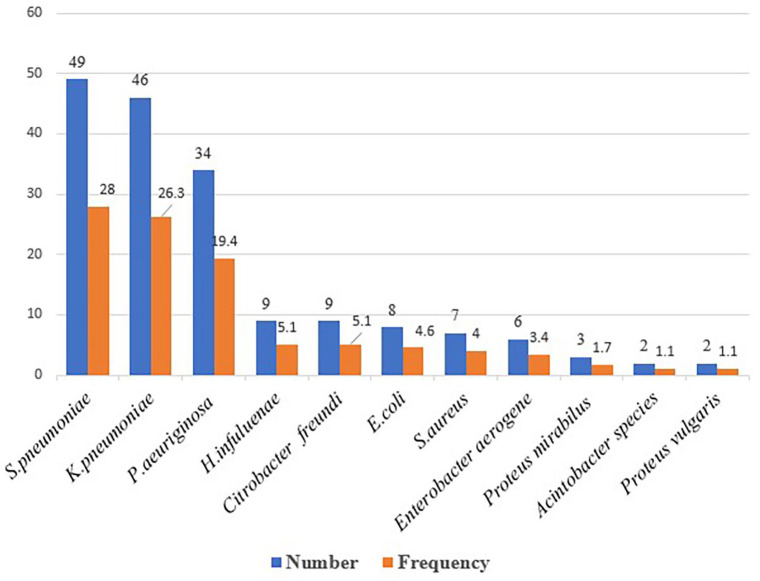
The overall prevalence of bacterial pneumonia was 175 (46.3%). Gram-negative bacteria accounted for 119 (68%) and the predominant isolates identified were 49 (28%) followed by 46 (26.3%), 34 (19.4%). There were 148 (84.6%) multidrug-resistant bacteria overall. Statistically significant factors included viral load, cigarette smoking, cluster of differentiation 4 count, alcohol use, World Health Organization clinical stages III and IV and low white blood cell count.
The study found that both multidrug resistance and bacterial pneumonia were high. Thus, bacterial culture and antimicrobial susceptibility tests should be routinely performed in health facilities in order to prevent and control the spread of bacterial infection and concurrent drug resistance.
肺炎是一种机会性感染,是人类免疫缺陷病毒/获得性免疫缺陷综合征阳性患者死亡和发病的主要原因。先前的研究表明,主要病原体细菌分离株分别为27.0%、20.8%、18.8%和8.3%。本研究旨在确定埃塞俄比亚东北部人类免疫缺陷病毒患者社区获得性肺炎的细菌学、抗菌药物敏感性模式及相关危险因素:横断面研究。
2021年1月至4月,在德西镇的6家医疗机构开展了一项基于医疗机构的横断面研究。采用连续抽样技术,共招募了378例疑似人类免疫缺陷病毒阳性的社区获得性肺炎患者。使用结构化问卷收集社会人口学和临床数据。从每位研究参与者身上无菌采集2毫升痰标本。将样本接种于血琼脂、巧克力琼脂和麦康凯琼脂上以分离细菌病原体。通过革兰氏染色、菌落形态和生化试验鉴定细菌病原体。采用 Kirby-Bauer 纸片扩散法进行抗菌药物敏感性试验。使用社会科学统计软件包第25版软件进行描述性统计和逻辑回归分析。P值<0.05及相应的95%置信区间(CI)被视为具有统计学意义。
细菌性肺炎的总体患病率为175例(46.3%)。革兰氏阴性菌占119例(68%),鉴定出的主要分离株为肺炎克雷伯菌49例(28%),其次是大肠埃希菌46例(26.3%)、铜绿假单胞菌34例(19.4%)。总体共有148例(84.6%)多重耐药菌。具有统计学意义的因素包括病毒载量、吸烟、CD4细胞计数、饮酒、世界卫生组织临床分期III和IV以及低白细胞计数。
研究发现多重耐药和细菌性肺炎的发生率都很高。因此,医疗机构应常规进行细菌培养和抗菌药物敏感性试验,以预防和控制细菌感染及同时出现的耐药性的传播。