Mortera C, Rissech M, Payola M, Miro C, Perich R
Cardiologia Pediatrica, Hospital Infantil San Juan de Dios, Barcelona, Spain.
Br Heart J. 1987 Sep;58(3):267-73. doi: 10.1136/hrt.58.3.267.
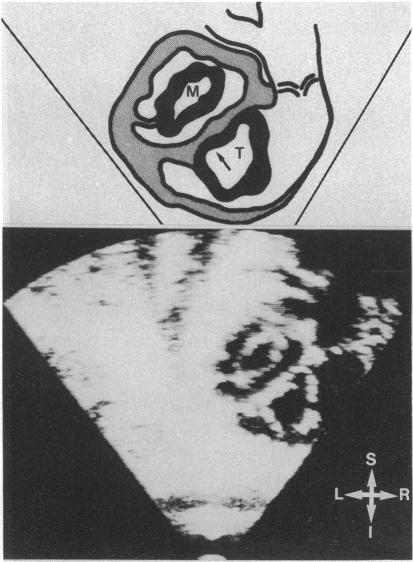
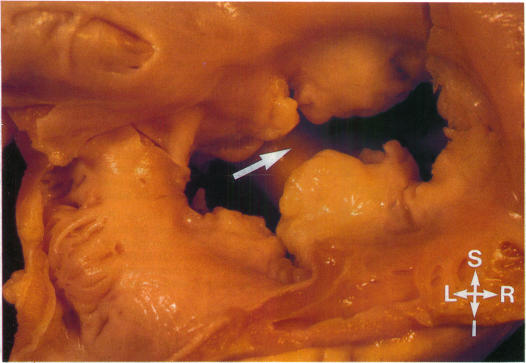
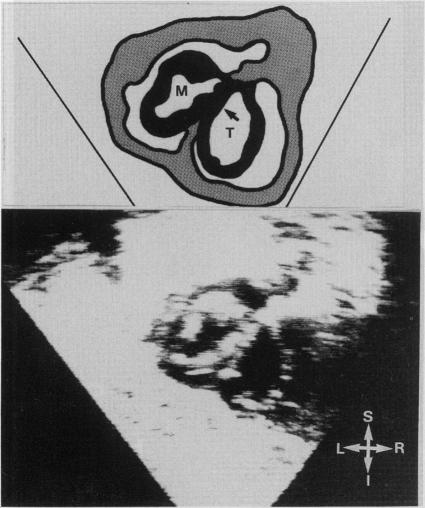
A short axis echocardiographic cut of the heart from the subcostal approach was used to study the atrioventricular junction in 47 infants and children with congenital heart disease and 20 with normal hearts. Examination of the diastolic openings of both atrioventricular valves was able to establish normal developments of the valves and annuli even when this was found in cases of complex congenital heart disease. In 30 patients with atrioventricular septal defects the technique distinguished between a partial defect (when the two atrioventricular valves were linked transseptally) and a complete defect (when there was only one atrioventricular valve). A range of atrioventricular attachments was seen in these patients. Short axis echocardiography from the subcostal approach reliably identifies different forms of atrioventricular septal defects by defining the anatomy of the atrioventricular valves during maximal diastolic expansion.
采用经肋下途径的心脏短轴超声心动图切面,对47例先天性心脏病患儿及20例心脏正常的婴幼儿的房室交界区进行研究。即使在复杂先天性心脏病病例中,对两个房室瓣舒张期开口的检查也能够确定瓣膜和瓣环的正常发育情况。在30例房室间隔缺损患者中,该技术能够区分部分缺损(两个房室瓣经间隔相连时)和完全缺损(只有一个房室瓣时)。在这些患者中观察到一系列房室连接情况。经肋下途径的短轴超声心动图通过在最大舒张期扩张时确定房室瓣的解剖结构,可靠地识别出不同形式的房室间隔缺损。