Cikes Alec, Kadri Fayssal, van Rooij Floris, Lädermann Alexandre
Synergy Medical Centre, Medbase Group, Lausanne, Switzerland.
Hirslanden, Bois Cerf Clinic, Lausanne, Switzerland.
J Exp Orthop. 2023 Jan 13;10(1):2. doi: 10.1186/s40634-022-00554-z.
To compare the clinical and functional outcomes of arthroscopic rotator cuff repair over a period of 2 years using three postoperative rehabilitation modalities: aquatic therapy, land-based therapy, and self-rehabilitation therapy. The null hypothesis was that aquatic therapy would provide no difference in Constant score compared to land-based therapy and self-rehabilitation therapy.
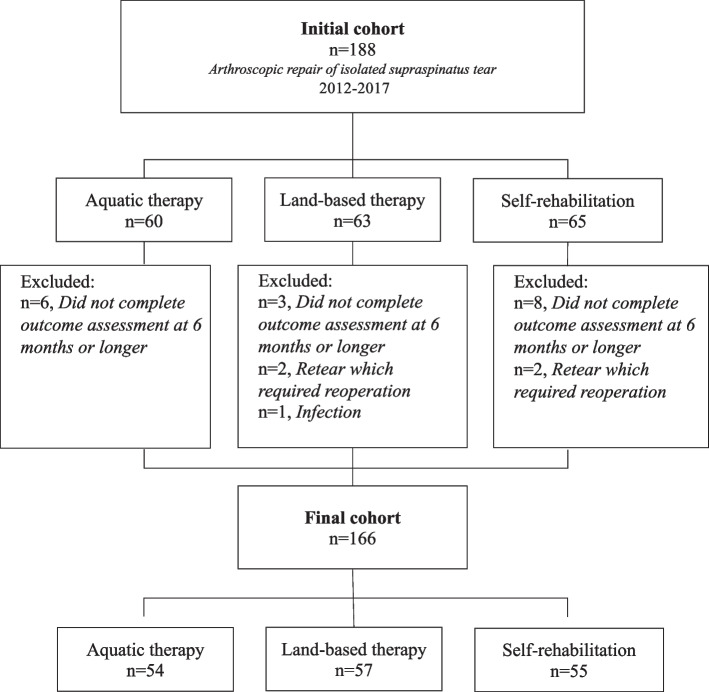
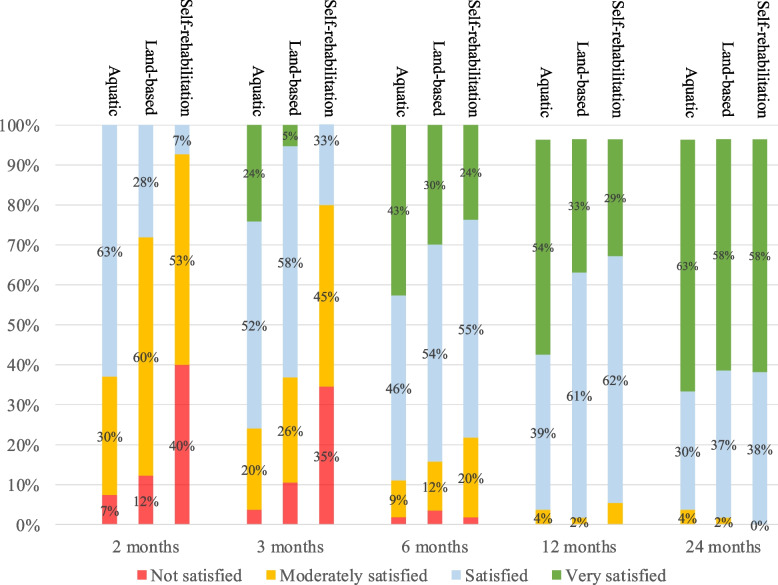
A prospective study was performed on subjects scheduled for arthroscopic rotator cuff repair between 2012 and 2017 that complied with the following criteria: (i) small to medium sized symptomatic supraspinatus and/or infraspinatus tendon tears, (ii) low to moderate tendon retraction according to Patte, and (iii) fatty infiltration stage ≤2. Patients were allocated to perform either aquatic therapy, land-based therapy, or self-rehabilitation therapy for 2-4 months. Independent observers blinded to the study design collected Constant score, SSV, and patient satisfaction at 2 months, 3 months, 6 months, 1 year and 2 years.
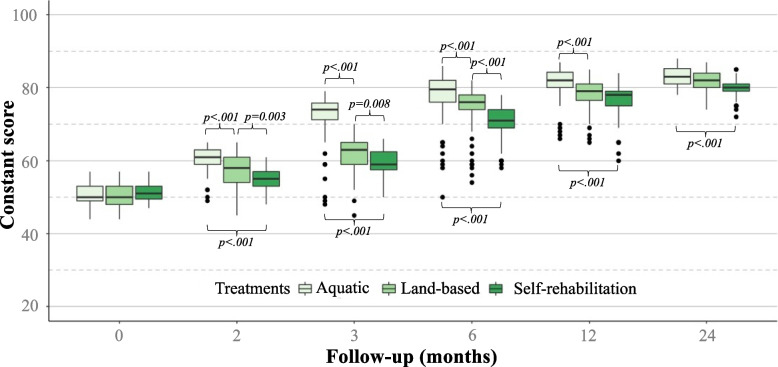
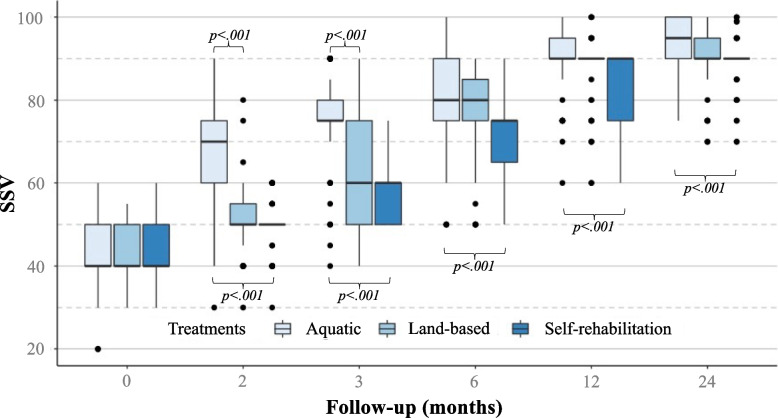
Level III, cohort study RESULTS: At 2 months follow-up, patients performing aquatic therapy had significantly higher Constant scores (p < 0.001) and SSV (p < 0.001) compared to those performing land-based therapy or self-rehabilitation therapy. At 3 months follow-up, patients performing aquatic therapy had significantly higher Constant scores (p < 0.001), and SSV (p < 0.001), both of which exceeded the respective minimal clinically important differences (MCIDs) of 10.4 and 12. Patients performing aquatic therapy continued to have significantly higher Constant scores and SSV at 6 months, 1 year, and 2 years.
Aquatic therapy has a very limited positive effect on clinical outcomes at 3 months after surgery, but yields no relevant improvements on function or satisfaction at 1 to 2 years follow-up.
比较采用三种术后康复方式(水疗、陆地疗法和自我康复疗法)进行为期2年的关节镜下肩袖修复的临床和功能结果。原假设是,与陆地疗法和自我康复疗法相比,水疗在Constant评分上不会有差异。
对2012年至2017年间计划进行关节镜下肩袖修复的受试者进行了一项前瞻性研究,这些受试者符合以下标准:(i)中小型有症状的冈上肌和/或冈下肌腱撕裂,(ii)根据Patte分级为低至中度肌腱回缩,(iii)脂肪浸润阶段≤2。患者被分配进行2至4个月的水疗、陆地疗法或自我康复疗法。对研究设计不知情的独立观察者在2个月、3个月、6个月、1年和2年时收集Constant评分、肩峰下间隙体积(SSV)和患者满意度。
III级队列研究结果:在2个月的随访中,与进行陆地疗法或自我康复疗法的患者相比,进行水疗的患者的Constant评分(p < 0.001)和SSV(p < 0.001)显著更高。在3个月的随访中,进行水疗的患者的Constant评分(p < 0.001)和SSV(p < 0.001)显著更高,两者均超过了各自10.4和12的最小临床重要差异(MCID)。在6个月、1年和2年时,进行水疗的患者的Constant评分和SSV仍然显著更高。
水疗在术后3个月对临床结果有非常有限的积极影响,但在1至2年的随访中,在功能或满意度方面没有产生相关改善。