Department of Biomedical Sciences, Seoul National University Graduate School, Seoul, Republic of Korea.
Genomic Medicine Institute, Medical Research Center, Seoul National University, Seoul, Republic of Korea.
Sci Rep. 2023 Jan 13;13(1):682. doi: 10.1038/s41598-022-26636-7.
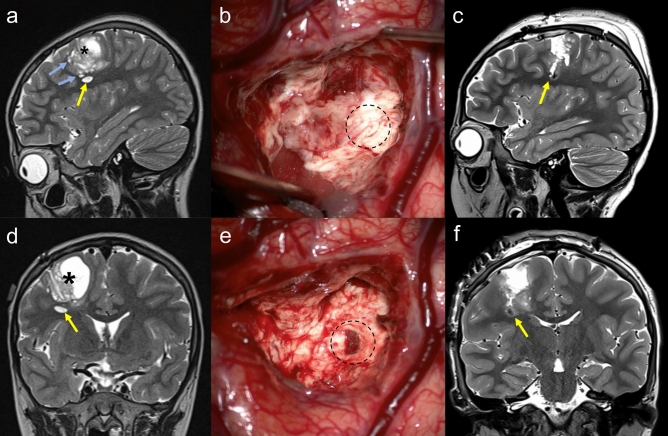
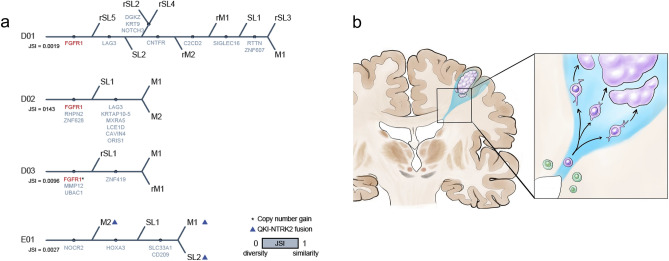
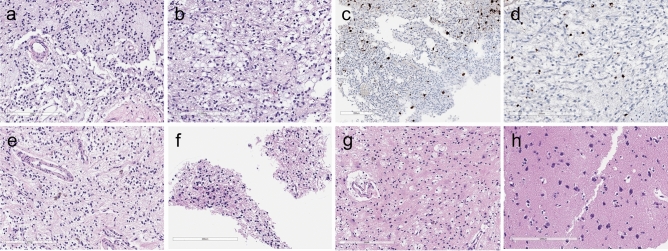
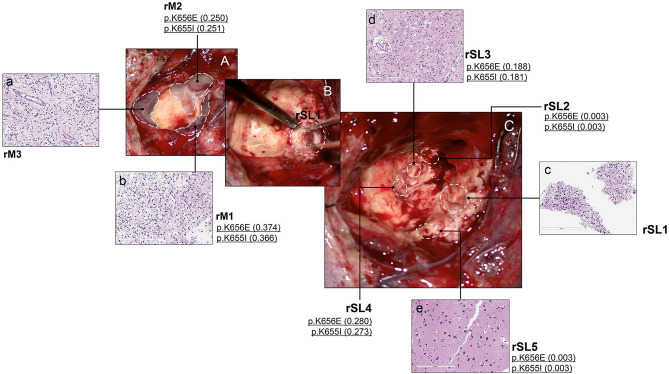
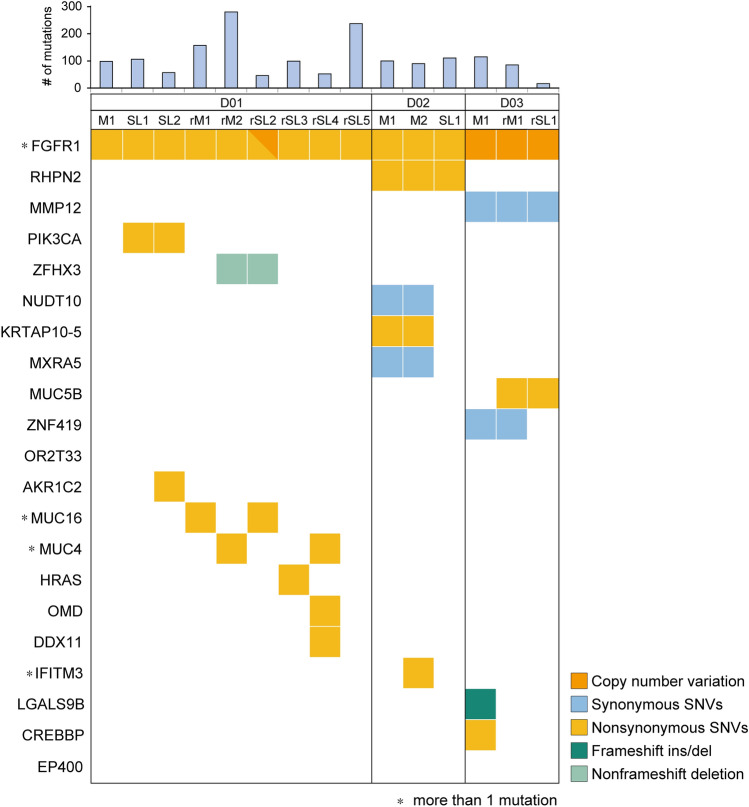
Dysembryoplastic neuroepithelial tumor (DNET) is a low-grade brain tumor commonly associated with drug-resistant epilepsy. About half of DNETs are accompanied by tiny nodular lesions separated from the main mass. The existence of these satellite lesions (SLs) has shown a strong association with tumor recurrence, suggesting that they are true tumors. However, it is not known whether SLs represent multiple foci of progenitor tumor cell extension and migration or a multifocal development of the main DNET. This study was designed to elucidate the histopathology and pathogenesis of SLs in DNETs. Separate biopsies from the main masses and SLs with DNET were analyzed. We performed comparative lesion sequencing and phylogenetic analysis. FGFR1 K656E and K655I mutations or duplication of the tyrosine kinase domain was found in all 3 DNET patients and the main masses and their SLs shared the same FGFR1 alterations. The phylogenic analysis revealed that the SLs developed independently from their main masses. It is possible that the main mass and its SLs were separated at an early stage in oncogenesis with shared FGFR1 alterations, and then they further expanded in different places. SLs of DNET are true tumors sharing pathogenic mutations with the main masses. It is plausible that multifocal tumor development takes place in the dysplastic cortex containing cells with a pathogenic genetic alteration.
胚胎发育不良性神经上皮肿瘤 (DNET) 是一种常见的与耐药性癫痫相关的低级别脑肿瘤。大约一半的 DNET 伴有与主肿瘤团块分离的微小结节性病变。这些卫星病变 (SL) 的存在与肿瘤复发密切相关,提示它们是真正的肿瘤。然而,尚不清楚 SL 是否代表祖细胞肿瘤细胞延伸和迁移的多个焦点,还是 DNET 主要病变的多灶性发展。本研究旨在阐明 DNET 中 SL 的组织病理学和发病机制。对 DNET 的主病灶和 SL 进行了单独的活检,并进行了对比性病变测序和系统发生分析。在所有 3 名 DNET 患者的肿瘤中均发现了 FGFR1 K656E 和 K655I 突变或酪氨酸激酶结构域的重复,并且主病灶及其 SL 具有相同的 FGFR1 改变。系统发生分析表明,SL 是独立于其主病灶发展而来的。有可能是主病灶及其 SL 是在致癌作用的早期就已经分离,并且随后在不同部位进一步扩展,它们都具有 FGFR1 改变。DNET 的 SL 是真正的肿瘤,与主病灶共享致病性突变。多灶性肿瘤发展可能发生在含有具有致病性遗传改变的细胞的发育不良皮质中。