Institute of Sport Sciences, University of Lausanne, Lausanne, Switzerland.
Department of Biomedical Sciences, University of Lausanne, Lausanne, Switzerland.
Aging Cell. 2023 Feb;22(2):e13770. doi: 10.1111/acel.13770. Epub 2023 Jan 15.
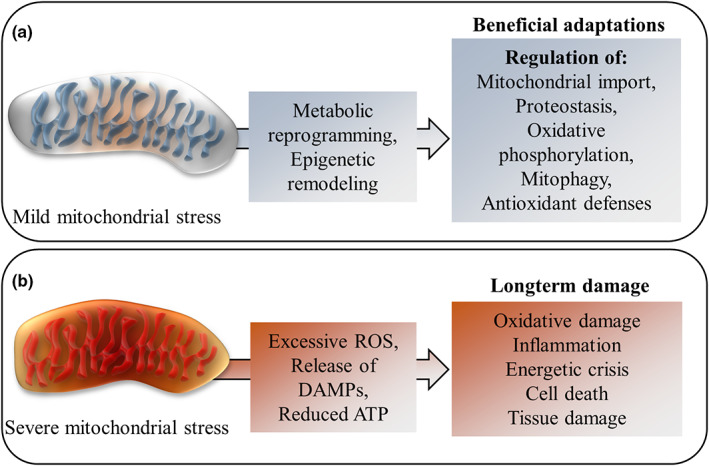
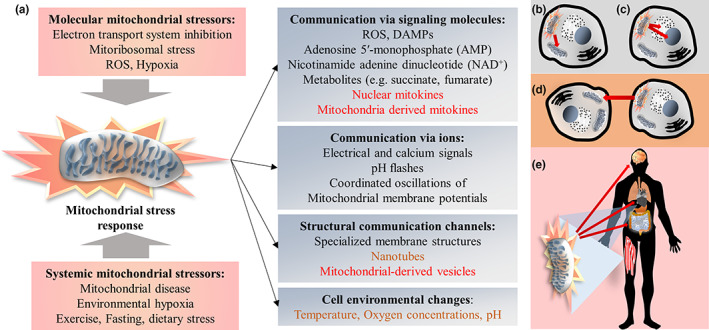
Mitokines are signaling molecules that enable communication of local mitochondrial stress to other mitochondria in distant cells and tissues. Among those molecules are FGF21, GDF15 (both expressed in the nucleus) and several mitochondrial-derived peptides, including humanin. Their responsiveness to mitochondrial stress induces mitokine-signaling in response for example to exercise, following mitochondrial challenges in skeletal muscle. Such signaling is emerging as an important mediator of exercise-derived and dietary strategy-related molecular and systemic health benefits, including healthy aging. A compensatory increase in mitokine synthesis and secretion could preserve mitochondrial function and overall cellular vitality. Conversely, resistance against mitokine actions may also develop. Alterations of mitokine-levels, and therefore of mitokine-related inter-tissue cross talk, are associated with general aging processes and could influence the development of age-related chronic metabolic, cardiovascular and neurological diseases; whether these changes contribute to aging or represent "rescue factors" remains to be conclusively shown. The aim of the present review is to summarize the expanding knowledge on mitokines, the potential to modulate them by lifestyle and their involvement in aging and age-related diseases. We highlight the importance of well-balanced mitokine-levels, the preventive and therapeutic properties of maintaining mitokine homeostasis and sensitivity of mitokine signaling but also the risks arising from the dysregulation of mitokines. While reduced mitokine levels may impair inter-organ crosstalk, also excessive mitokine concentrations can have deleterious consequences and are associated with conditions such as cancer and heart failure. Preservation of healthy mitokine signaling levels can be achieved by regular exercise and is associated with an increased lifespan.
细胞线粒体衍生因子是一种信号分子,能够实现局部线粒体应激向远处细胞和组织中线粒体的通讯。其中包括 FGF21、GDF15(均在核内表达)和几种线粒体衍生肽,如人源素。它们对线粒体应激的反应诱导了线粒体信号的产生,例如在运动时,骨骼肌中的线粒体受到挑战后就会产生这种信号。这种信号的出现是运动和饮食策略相关的分子和系统健康益处的重要介导者,包括健康衰老。线粒体合成和分泌的代偿性增加可以维持线粒体功能和整体细胞活力。相反,也可能产生对线粒体作用的抵抗。线粒体因子水平的改变,以及因此产生的线粒体相关组织间的交叉对话,与一般衰老过程有关,并可能影响与年龄相关的慢性代谢、心血管和神经疾病的发展;这些变化是否导致衰老或代表“挽救因素”仍有待定论。本综述的目的是总结细胞线粒体衍生因子的知识扩展,以及通过生活方式调节它们的潜力,以及它们在衰老和与年龄相关的疾病中的作用。我们强调了平衡的线粒体因子水平的重要性、维持线粒体动态平衡和线粒体信号敏感性的预防和治疗特性,但也强调了线粒体因子失调带来的风险。虽然降低线粒体因子水平可能会损害器官间的交叉对话,但过高的线粒体因子浓度也会产生有害影响,并与癌症和心力衰竭等疾病有关。通过定期运动可以保持健康的线粒体信号水平,从而延长寿命。