Sagana M, Jain Ravindra Kumar, Prasad Arya S
Department of Orthodontics and Dentofacial Orthopaedics, Saveetha Dental College and Hospitals, Saveetha Institute of Medical and Technical Sciences, Saveetha University, Chennai, Tamil Nadu, India.
J Adv Pharm Technol Res. 2022 Nov;13(Suppl 1):S40-S44. doi: 10.4103/japtr.japtr_120_22. Epub 2022 Nov 30.
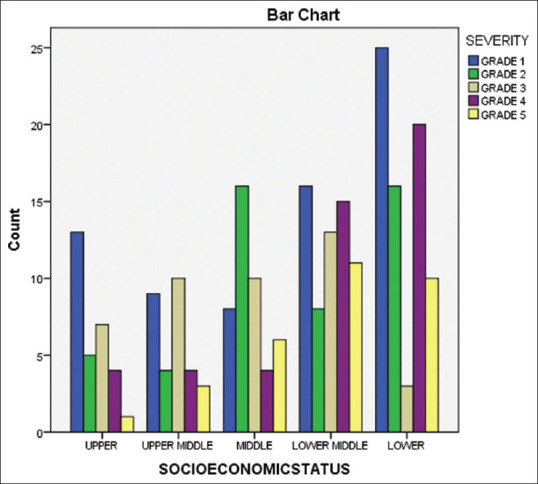
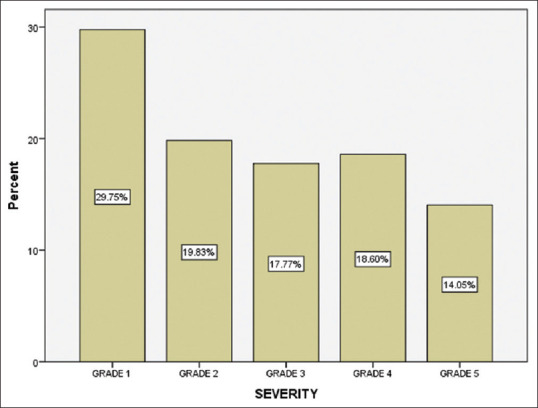
Malocclusion has been linked to various factors out of which certain dietary patterns and unhealthy habits are the most overlooked. The dietary patterns and unhealthy habits vary according to socioeconomic status. The present research was aimed to perform an association of malocclusion severity with socioeconomic status. This study was done in a retrospective manner and was conducted at Saveetha Dental College. A total of 241 clinical case records of the participants with malocclusion reporting for orthodontic therapy were selected and enrolled for the study. Data on the socioeconomic status and the severity of malocclusion as assessed with the Index of Orthodontic Treatment Needs (IOTNs) index were noted. All these records were collected and entered into Excel and then analyzed through statistics. Descriptive statistics and nonparametric Chi-square tests were performed. From the analysis, the proportion of IOTN Grade 1 malocclusion (30%) was found to be the highest. The highest number of patients with Grade 1 malocclusion belonged to the lower socioeconomic class. Socioeconomic status and the severity of malocclusion were significantly associated with each other. Malocclusion prevalence and severity were more among participants belonging to lower socioeconomic groups.
错颌畸形与多种因素有关,其中某些饮食模式和不健康习惯最容易被忽视。饮食模式和不健康习惯因社会经济地位而异。本研究旨在探讨错颌畸形严重程度与社会经济地位之间的关联。本研究采用回顾性研究方法,在萨维塔牙科学院开展。共选取了241例前来接受正畸治疗的错颌畸形患者的临床病例记录并纳入研究。记录了社会经济地位数据以及使用正畸治疗需求指数(IOTNs)评估的错颌畸形严重程度数据。所有这些记录均收集并录入Excel,然后进行统计分析。进行了描述性统计和非参数卡方检验。分析发现,IOTN 1级错颌畸形的比例(30%)最高。1级错颌畸形患者人数最多的是社会经济地位较低的阶层。社会经济地位与错颌畸形严重程度之间存在显著关联。社会经济地位较低群体的参与者中错颌畸形的患病率和严重程度更高。