Park Sugeon, Lee Seung Hun, Shin Doosup, Hong David, Joh Hyun Sung, Choi Ki Hong, Kim Hyun Kuk, Ha Sang Jin, Park Taek Kyu, Yang Jeong Hoon, Song Young Bin, Hahn Joo-Yong, Choi Seung-Hyuk, Gwon Hyeon-Cheol, Lee Joo Myung
Division of Cardiology, Department of Internal Medicine, Heart Vascular Stroke Institute, Samsung Medical Center, Sungkyunkwan University School of Medicine, Seoul, Republic of Korea.
Department of Internal Medicine and Cardiovascular Center, Chonnam National University Hospital, Chonnam National University Medical School, Gwangju, Republic of Korea.
Kidney Int Rep. 2022 Oct 8;8(1):64-74. doi: 10.1016/j.ekir.2022.10.003. eCollection 2023 Jan.
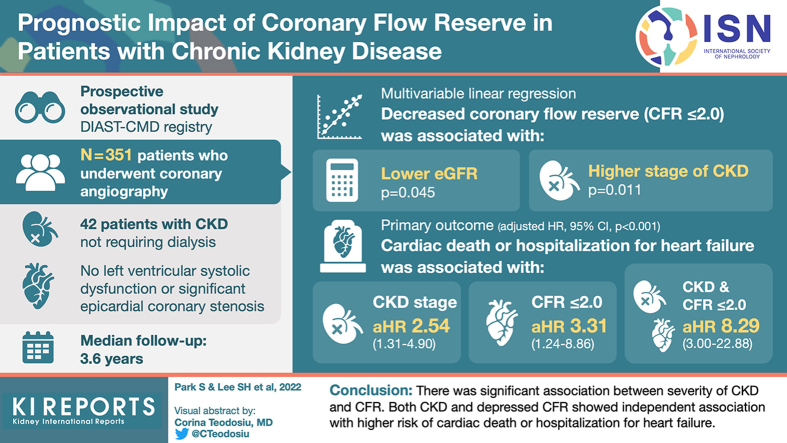
Both coronary flow reserve (CFR) and chronic kidney disease (CKD) are known to be associated with adverse cardiac events. However, it is unclear how these prognostic factors are interrelated. This study evaluated the association between intracoronary physiologic indexes and CKD and their prognostic implications.
A total of 351 patients without left ventricular systolic dysfunction (ejection fraction ≥ 40%) and not on dialysis whose revascularization was deferred based on fractional flow reserve (FFR) > 0.80 were analyzed. Depressed CFR was defined as CFR ≤ 2.0. The primary outcome was a composite of cardiac death or hospitalization for heart failure at 3 years.
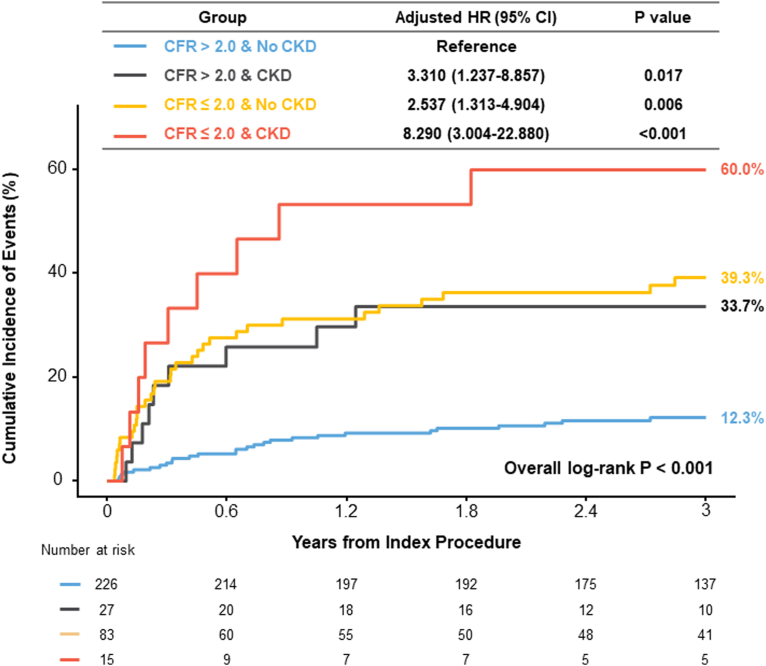
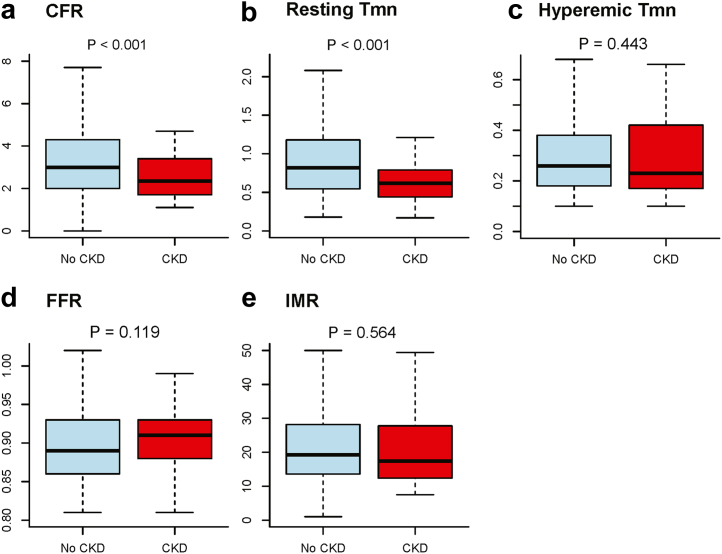
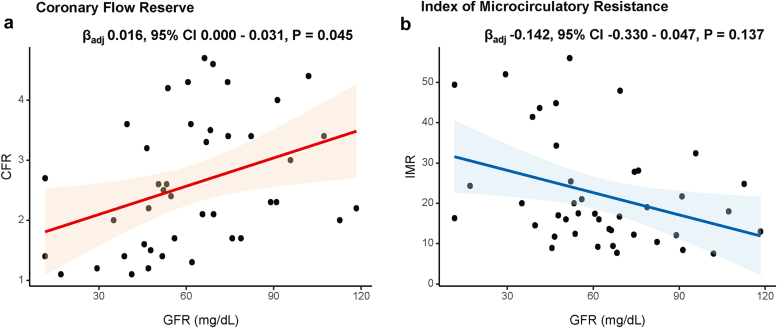
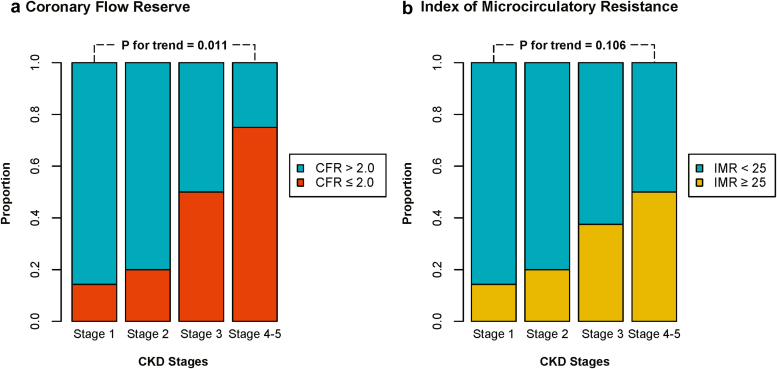
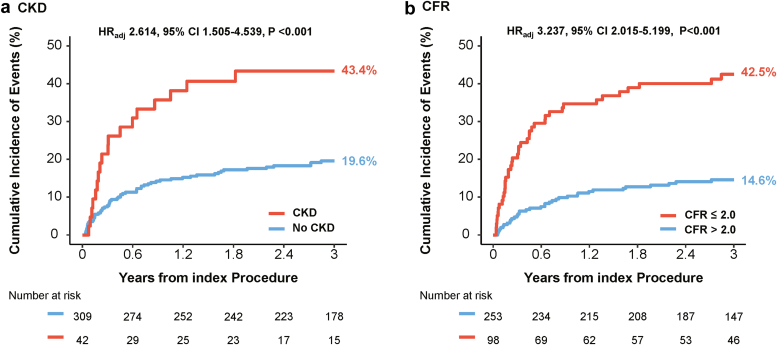
Patients with CKD showed lower CFR than the non-CKD population (3.28 ± 1.77 vs. 2.60 ± 1.09, < 0.001), mainly driven by increased resting coronary flow. There was no significant difference in hyperemic coronary flow, FFR, and index of microvascular resistance between the 2 groups. CFR was significantly associated with estimated glomerular filtration rate (eGFR) ( = 0.045), and the proportion of depressed CFR was significantly increased with higher CKD stages ( = 0.011). The risk of cardiac death or hospitalization for heart failure was the lowest in the non-CKD and preserved CFR group (11.9%) and the highest in the CKD and depressed CFR group (60.0%, overall log rank < 0.001). Both CKD (adjusted hazard ratio [HR] 2.614, 95% confidence interval [CI] 1.505-4.539, < 0.001) and depressed CFR (HR 3.237, 95% CI 2.015-5.199, < 0.001) were independently associated with the risk of the primary outcome.
There was a significant association between severity of CKD and CFR. Both CKD and depressed CFR showed independent association with higher risk of cardiac death or hospitalization for heart failure.
已知冠状动脉血流储备(CFR)和慢性肾脏病(CKD)均与不良心脏事件相关。然而,尚不清楚这些预后因素之间是如何相互关联的。本研究评估了冠状动脉内生理指标与CKD之间的关联及其预后意义。
共分析了351例无左心室收缩功能障碍(射血分数≥40%)且未接受透析治疗、基于血流储备分数(FFR)>0.80而延迟血运重建的患者。CFR降低定义为CFR≤2.0。主要结局是3年内心脏性死亡或因心力衰竭住院的复合终点。
CKD患者的CFR低于非CKD人群(3.28±1.77对2.60±1.09,<0.001),主要是由于静息冠状动脉血流增加所致。两组之间充血冠状动脉血流、FFR和微血管阻力指数无显著差异。CFR与估计肾小球滤过率(eGFR)显著相关(=0.045),且CFR降低的比例随CKD分期升高而显著增加(=0.011)。非CKD且CFR保留组心脏性死亡或因心力衰竭住院的风险最低(11.9%),而CKD且CFR降低组最高(60.0%,总体对数秩检验<0.001)。CKD(校正风险比[HR]2.614,95%置信区间[CI]1.505 - 4.539,<0.001)和CFR降低(HR 3.237,95%CI 2.015 - 5.199,<0.001)均与主要结局风险独立相关。
CKD严重程度与CFR之间存在显著关联。CKD和CFR降低均与心脏性死亡或因心力衰竭住院的较高风险独立相关。