Ghiglioni Daniele Giovanni, Cozzi Et Laura, Castagnoli Riccardo, Bruschi Gaia, Maffeis Laura, Marchisio Paola Giovanna, Marseglia Gian Luigi, Licari Amelia
Fondazione IRCCS Ca' Granda Ospedale Maggiore Policlinico, SC Pediatria Pneumoinfettivologia, Milan, Italy.
University of Milan, Milan, Italy.
World Allergy Organ J. 2023 Feb;16(2):100741. doi: 10.1016/j.waojou.2023.100741. Epub 2023 Jan 9.
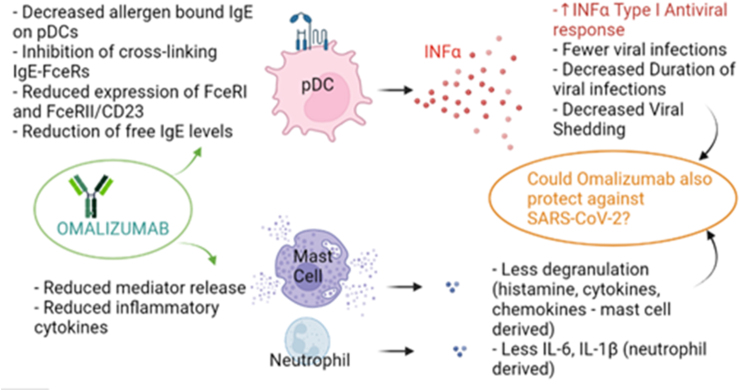
Omalizumab which downregulates the immunoglobulin E (IgE) receptor site on plasmacytoid dendritic cells and thereby increases interferon-α (INF-α) production, may shorten the duration of viral infections by enhancing the antiviral immunity. A systematic review was conducted to investigate whether previous anti-IgE treatment with omalizumab could protect against SARS-CoV-2 disease ("COVID-19") (infection, disease duration, and severity), and whether IFN-α upregulation could be involved. The research included articles published from March 2020 to January 2022. An accurate search was performed on bibliographic biomedical database (MEDLINE - Pubmed, SCOPUS, EMBASE, BIOMED CENTRAL, Google scholar, COCHRANE LIBRARY, ClinicalTrial.gov) including cohorts, case reports and reviews. Different methods were used, based on the study design, to assess the quality of eligible studies. Several authors link omalizumab to a possible protection against viruses, but they often refer to studies carried out before the pandemic and with viruses other than SARS-CoV-2 (severe acute respiratory syndrome coronavirus 2) (eg, rhinoviruses -RV). Few cases of COVID-19 patients treated with omalizumab have been recorded, and, in most of them, no increased susceptibility to severe disease was observed. According to these data, the current indication is to continue omalizumab therapy during the pandemic. Moreover, although omalizumab may enhance the antiviral immune response even for SARS-CoV-2, further studies are needed to confirm this hypothesis. It would be helpful to establish a registry of omalizumab-treated (or in treatment) patients who have developed COVID-19. Finally, randomized controlled trials could be able to demonstrate the effect of omalizumab in protecting against severe SARS-CoV-2, through IFN-α upregulation or other immunological pathways.
奥马珠单抗可下调浆细胞样树突状细胞上的免疫球蛋白E(IgE)受体位点,从而增加干扰素-α(INF-α)的产生,它可能通过增强抗病毒免疫力来缩短病毒感染的持续时间。本研究进行了一项系统评价,以调查既往使用奥马珠单抗进行抗IgE治疗是否可以预防新型冠状病毒肺炎(COVID-19)(感染、病程和严重程度),以及是否涉及INF-α上调。研究纳入了2020年3月至2022年1月发表的文章。在生物医学文献数据库(MEDLINE - Pubmed、SCOPUS、EMBASE、BIOMED CENTRAL、谷歌学术、Cochrane图书馆、ClinicalTrial.gov)上进行了精确检索,包括队列研究、病例报告和综述。根据研究设计,采用不同方法评估符合条件的研究质量。几位作者将奥马珠单抗与对病毒的可能保护作用联系起来,但他们经常提及大流行之前针对除严重急性呼吸综合征冠状病毒2(SARS-CoV-2)之外的其他病毒(例如鼻病毒-RV)开展的研究。接受奥马珠单抗治疗的COVID-19患者记录较少,并且在大多数病例中,未观察到对严重疾病的易感性增加。根据这些数据,目前的指征是在大流行期间继续使用奥马珠单抗治疗。此外,尽管奥马珠单抗即使对SARS-CoV-2也可能增强抗病毒免疫反应,但仍需要进一步研究来证实这一假设。建立一个已发生COVID-19的接受奥马珠单抗治疗(或正在治疗)患者的登记册将很有帮助。最后,随机对照试验或许能够通过INF-α上调或其他免疫途径来证明奥马珠单抗在预防严重SARS-CoV-2方面的作用。