Intensive Care Department, Bellvitge University Hospital, C/ Feixa Llarga s/n, 08907, Hospitalet de Llobregat, Barcelona, Spain.
Biostatistics Department, Universitat de Barcelona, Campus Bellvitge, Av. Mare de Déu de Bellvitge, 3, 08907, Hospitalet de Llobregat, Barcelona, Spain.
J Cardiothorac Surg. 2023 Jan 17;18(1):32. doi: 10.1186/s13019-023-02128-1.
Less invasive monitoring, such as radial arterial pulse contour analysis (ProAQT® sensor), represents an alternative when hemodynamic monitoring is necessary to guide postoperative management and invasive monitoring is not technically feasible. The aim of the study is to evaluate the accuracy of the ProAQT® sensor cardiac output measurements in comparison with Pulmonary Artery Catheter (PAC) during the postoperative course of patients who underwent cardiac surgery with cardiopulmonary bypass.
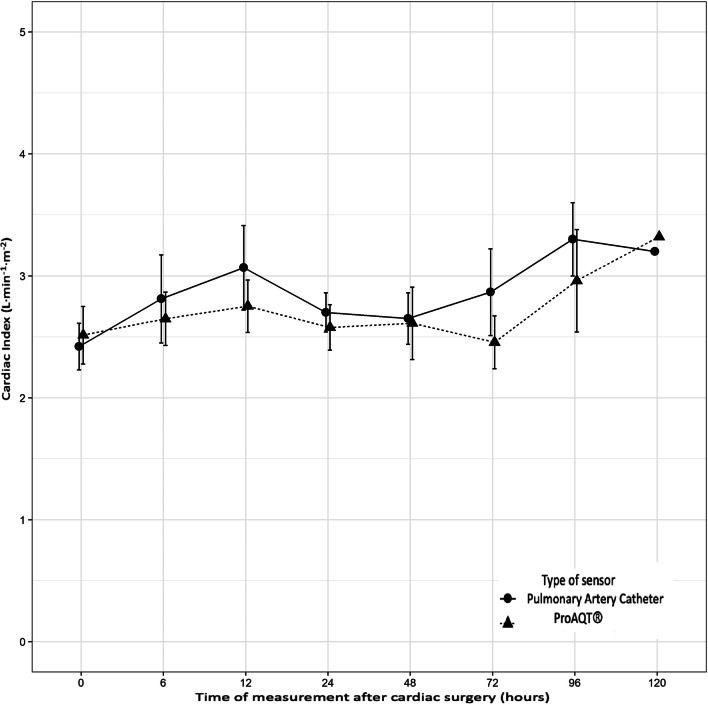
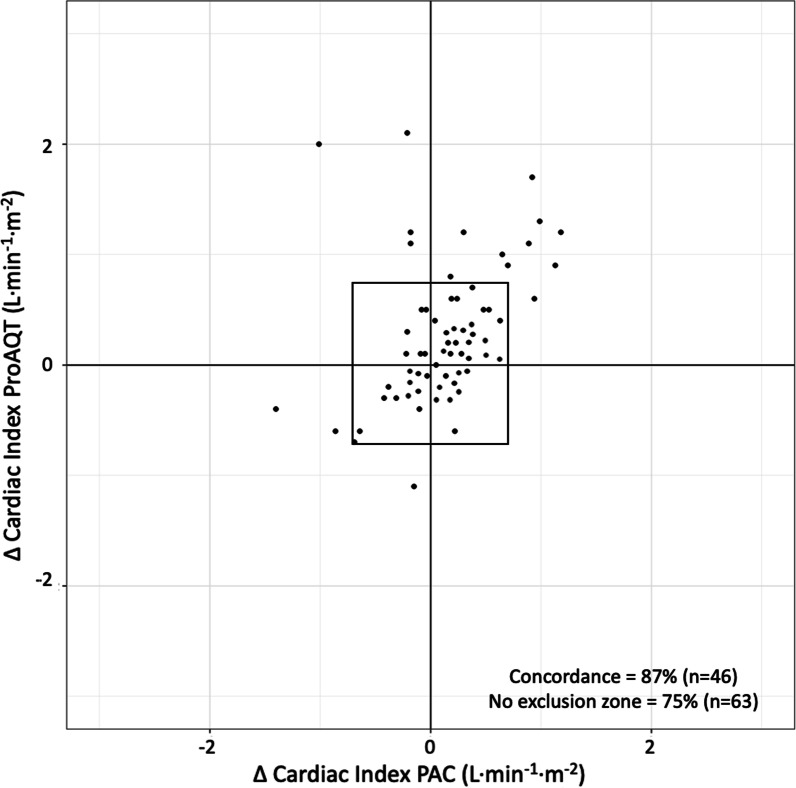
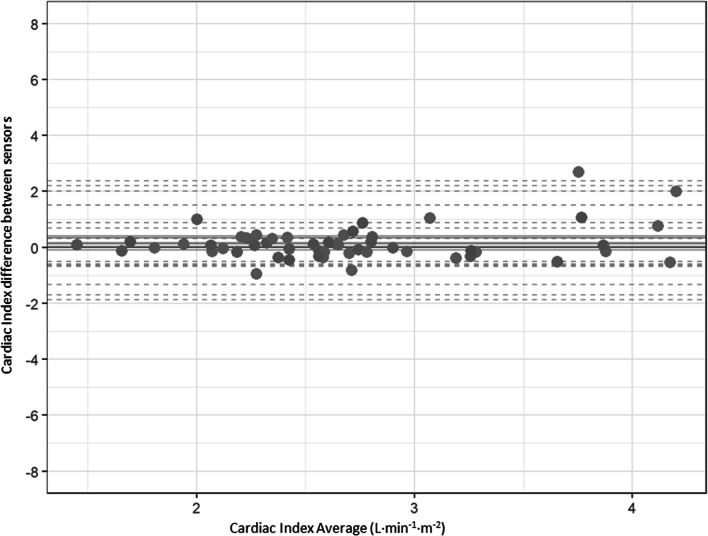
Prospective observational study in a Surgical Intensive Care Unit of a tertiary university hospital. Ten patients with a mean age of 73.5 years were included. The main comorbidities were hypertension, diabetes, dyslipidemia and the preoperative left ejection fraction was 43.8 ± 14.5%. Regarding the type of surgery, six patients underwent valve surgery, two underwent coronary artery bypass grafting and two underwent aortic surgery. The cardiac index measured simultaneously by the ProAQT® sensor was compared with the PAC. The parameters were evaluated at predefined time points during the early postoperative courses (6 h, 12 h, 24 h, 48 h and 72 h). The degree of agreement with the cardiac index between the PAC and the ProAQT® sensor along the time points was measured using the concordance correlation coefficient, Bland-Altman analysis, and four-quadrant plot. Sixty-three pairs of measurements were analyzed. We showed that measurements of cardiac index were slightly higher with PAC (β ̂ = - 0.146, p-value = 0.094). The concordance correlation coefficient for the additive model of cardiac index was 0.64 (95% Confidence Interval: 0.36, 0.82), indicating a high concordance between both sensors. Bland-Altmann analysis showed a mean bias of 0.45 L·min·m, limits of agreement from - 1.65 to 2.3 L·min·m, and percentage of error was 82.5%. Four-quadrant plot of changes in cardiac index showed a good concordance rate (75%), which increases after applying the exclusion zone (87%).
In patients undergoing cardiac surgery, the ProAQT® sensor may be useful to monitor cardiac index during the postoperative period, especially when more invasive monitoring is not possible.
当需要进行血流动力学监测以指导术后管理且无法进行有创监测时,桡动脉脉搏轮廓分析(ProAQT®传感器)等微创监测方法是一种替代方案。本研究旨在评估 ProAQT®传感器心输出量测量值在与肺动脉导管(PAC)比较时的准确性,用于监测体外循环心脏手术后患者的术后过程。
这是一项在一家三级大学医院的外科重症监护病房进行的前瞻性观察性研究。纳入了 10 名平均年龄为 73.5 岁的患者。主要合并症为高血压、糖尿病、血脂异常,术前左心室射血分数为 43.8±14.5%。就手术类型而言,6 例患者接受瓣膜手术,2 例患者接受冠状动脉旁路移植术,2 例患者接受主动脉手术。同时使用 ProAQT®传感器测量心指数,并与 PAC 进行比较。在术后早期(6 小时、12 小时、24 小时、48 小时和 72 小时)的预定时间点评估参数。使用一致性相关系数、Bland-Altman 分析和四象限图评估 PAC 和 ProAQT®传感器在时间点上的心脏指数的一致性程度。共分析了 63 对测量值。我们发现,PAC 测量的心脏指数略高(β ̂= -0.146,p 值= 0.094)。心指数相加模型的一致性相关系数为 0.64(95%置信区间:0.36,0.82),表明两种传感器具有高度一致性。Bland-Altman 分析显示平均偏差为 0.45 L·min·m,一致性界限为-1.65 至 2.3 L·min·m,误差百分比为 82.5%。心指数变化的四象限图显示出较好的一致性率(75%),应用排除区后(87%)一致性率增加。
在接受心脏手术的患者中,ProAQT®传感器可用于监测术后期间的心指数,特别是在无法进行更有创监测时。