Institute of Engineering in Life Sciences, Section IV: Biomolecular Separation Engineering, Karlsruhe Institute of Technology (KIT), Karlsruhe, Germany.
Hoffmann-La Roche AG, Basel, Switzerland.
Anal Bioanal Chem. 2023 Feb;415(5):841-854. doi: 10.1007/s00216-022-04477-7. Epub 2023 Jan 18.
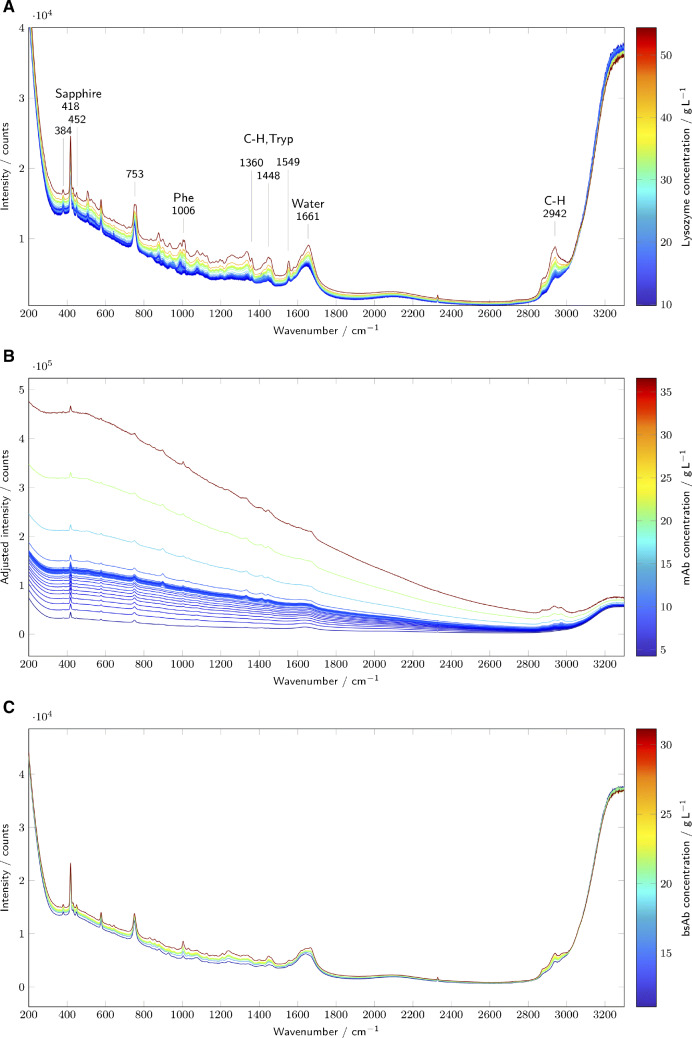
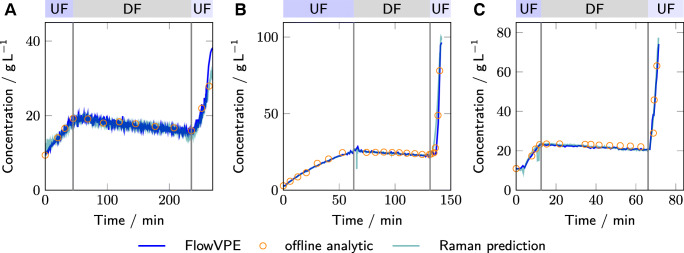
Monitoring the protein concentration and buffer composition during the Ultrafiltration/Diafiltration (UF/DF) step enables the further automation of biopharmaceutical production and supports Real-time Release Testing (RTRT). Previously, in-line Ultraviolet (UV) and Infrared (IR) measurements have been used to successfully monitor the protein concentration over a large range. The progress of the diafiltration step has been monitored with density measurements and Infrared Spectroscopy (IR). Raman spectroscopy is capable of measuring both the protein and excipient concentration while being more robust and suitable for production measurements in comparison to Infrared Spectroscopy (IR). Regardless of the spectroscopic sensor used, the low concentration of excipients poses a challenge for the sensors. By combining sensor measurements with a semi-mechanistic model through an Extended Kalman Filter (EKF), the sensitivity to determine the progress of the diafiltration can be improved. In this study, Raman measurements are combined with an EKF for three case studies. The advantages of Kalman-filtered Raman measurements for excipient monitoring are shown in comparison to density measurements. Furthermore, Raman measurements showed a higher measurement speed in comparison to Variable Pathlength (VP) UV measurement at the trade-off of a slightly worse prediction accuracy for the protein concentration. However, the Raman-based protein concentration measurements relied mostly on an increase in the background signal during the process and not on proteinaceous features, which could pose a challenge due to the potential influence of batch variability on the background signal. Overall, the combination of Raman spectroscopy and EKF is a promising tool for monitoring the UF/DF step and enables process automation by using adaptive process control.
在超滤/渗滤(UF/DF)步骤中监测蛋白质浓度和缓冲液组成,可实现生物制药生产的进一步自动化,并支持实时放行检测(RTRT)。以前,在线紫外(UV)和红外(IR)测量已成功用于在较大范围内监测蛋白质浓度。通过密度测量和红外光谱(IR)监测渗滤步骤的进展。与红外光谱(IR)相比,拉曼光谱能够同时测量蛋白质和赋形剂的浓度,并且更稳健,更适合生产测量。无论使用哪种光谱传感器,赋形剂的低浓度都会对传感器构成挑战。通过将传感器测量值与通过扩展卡尔曼滤波器(EKF)的半机理模型相结合,可以提高确定渗滤进度的灵敏度。在这项研究中,拉曼测量值与 EKF 结合用于三个案例研究。与密度测量相比,拉曼测量值在用于赋形剂监测时的卡尔曼滤波优势得到了证明。此外,与可变光程(VP)UV 测量相比,拉曼测量值的测量速度更高,但其蛋白质浓度的预测准确性略差。然而,基于拉曼的蛋白质浓度测量主要依赖于过程中背景信号的增加,而不是蛋白质特征,由于背景信号可能受到批次变化的潜在影响,这可能构成挑战。总体而言,拉曼光谱和 EKF 的组合是监测 UF/DF 步骤的有前途的工具,并通过使用自适应过程控制实现过程自动化。