Kok Lisa, Taverne Laura F, Verbeek Eva C, van de Wetering Machiel, Voogel Albertus J, Oosterom Liane, Herrman Jean-Paul R, Kuipers Remko S
Cardiology, Onze Lieve Vrouwe Gasthuis, Amsterdam, NLD.
Cardiothoracic Surgery, Onze Lieve Vrouwe Gasthuis, Amsterdam, NLD.
Cureus. 2022 Dec 17;14(12):e32638. doi: 10.7759/cureus.32638. eCollection 2022 Dec.
In patients under <40 years, traditional cardiovascular (CV)-risk factors are a less likely cause of acute coronary syndromes (ACS) compared to older counterparts.
To estimate the prevalence of essential thrombocytosis (ET), a hematological disorder and less-prevalent risk factor, in young patients presenting with ACS.
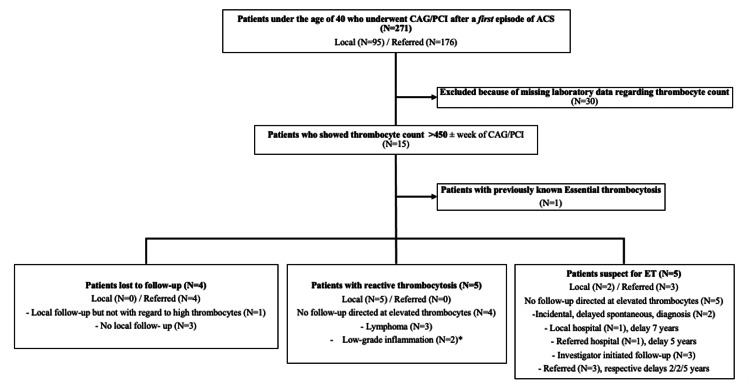
We constructed a retrospective database of all patients <40 years (n=271) that had consecutively undergone coronary angiography (CAG) after their ACS within our hospital within the last ten years (2010-2020) and had known thrombocyte counts (n=241). Patients with thrombocytes >450x10*9/L were screened for this hematological disorder.
In our database, we identified 15 subjects with thrombocytosis. One was previously known as ET. Of the remaining 14 patients, five were considered reactive/secondary thrombocytosis, and four were lost to follow-up, four were eventually diagnosed with ET, one remains uncertain. The diagnosis was newly established before the initiation of this study in two patients (average delay: six years). Two patients were identified as a result of this study. Conclusion: With a prevalence of at least 2.1%, ET appears not uncommon in patients <40 years with ACS. Moreover, screening patients with ACS elevated thrombocytes yielded a novel diagnosis of ET in 27% of patients. The diagnosis was initially missed in all cases. Since the timing of revascularization should be adjusted to thrombocyte count/initiation of ET therapy to prevent thrombotic complications, cardiologists should know, recognize and screen for this pathology in ACS-patients, notably in those with absent traditional CV-risk factors: an 'ACS-protocol' aimed at less-prevalent risk factors could support this.
与老年患者相比,40岁以下患者中,传统心血管(CV)危险因素导致急性冠状动脉综合征(ACS)的可能性较小。
评估原发性血小板增多症(ET)在年轻ACS患者中的患病率,ET是一种血液系统疾病,也是一种较罕见的危险因素。
我们建立了一个回顾性数据库,纳入过去十年(2010 - 2020年)内在我院因ACS连续接受冠状动脉造影(CAG)且已知血小板计数(n = 241)的所有40岁以下患者(n = 271)。对血小板计数>450×10⁹/L的患者进行该血液系统疾病筛查。
在我们的数据库中,我们识别出15例血小板增多症患者。其中1例之前已知患有ET。其余14例患者中,5例被认为是反应性/继发性血小板增多症,4例失访,4例最终被诊断为ET,1例仍不确定。在本研究开始前,有2例患者(平均延迟时间:6年)新确诊。另有2例患者是本研究的结果。结论:在40岁以下的ACS患者中,ET的患病率至少为2.1%,似乎并不罕见。此外,对ACS患者血小板升高进行筛查,在27%的患者中发现了新的ET诊断。所有病例最初均漏诊。由于血运重建的时机应根据血小板计数/ET治疗的启动情况进行调整,以预防血栓并发症,心脏病专家应了解、识别并在ACS患者中筛查这种病理情况,特别是在那些没有传统CV危险因素的患者中:针对较罕见危险因素的“ACS方案”可能会有所帮助。