Department of Ophthalmology, Linkou Chang Gung Memorial Hospital, and College of Medicine, Chang Gung University, Taoyuan, Taiwan.
Department of Ophthalmology and Visual Sciences, Princess Margaret Cancer Centre, University Health Network, Ocular Oncology Service, University of Toronto, Toronto, Ontario, Canada.
Invest Ophthalmol Vis Sci. 2023 Jan 3;64(1):15. doi: 10.1167/iovs.64.1.15.
Choroidal melanoma (CM) and ciliary body melanoma (CBM) are the two most common subtypes of uveal melanoma. Starting from the observation that CBM tends to have a higher metastatic potential than CM, we hypothesized that specific cytogenetic abnormalities could be associated with tumor location - reflecting distinct genetic signatures that would drive the risk of distant spread.
Chromosomal alterations were investigated by molecular cytogenetic techniques in 217 and 97 patients with CM and CBM, respectively. Cox proportional hazards regression analysis was used to identify the independent predictors of distant metastasis.
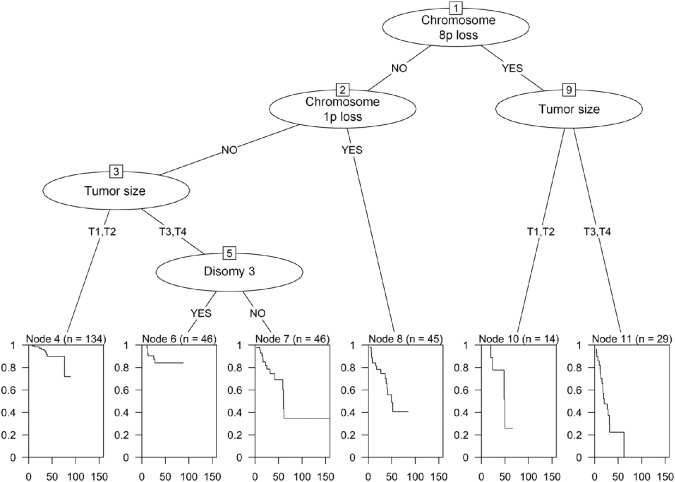
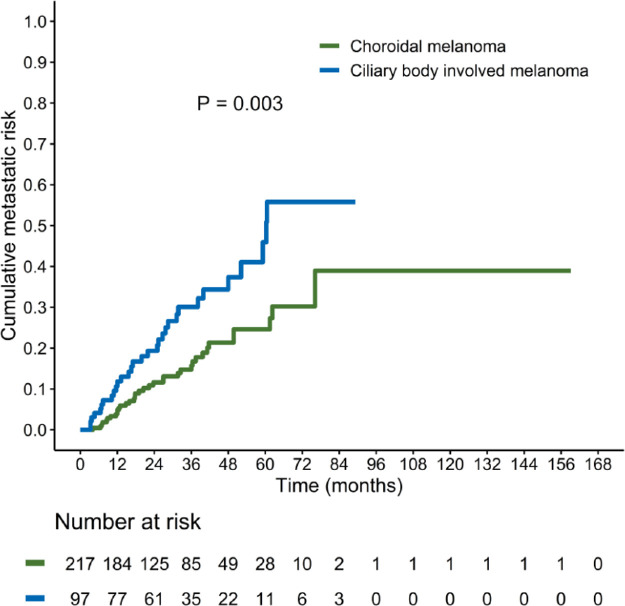
Patients with CBM had larger tumor sizes (P < 0.001), higher disease stages (P < 0.001), and more frequently showed distant metastasis (P = 0.002) than those with CM. On analyzing the entire study cohort, we found that specific chromosomal alterations - including chromosome 8p loss (P < 0.001), 1p loss (P < 0.001), and monosomy 3 (P < 0.005) - were independent predictors of distant metastasis. Based on a decision-tree learning algorithm, we identified three specific subgroups of patients with uveal melanoma at high risk of distant spread. Monosomy 3 occurred significantly more frequently in patients with T3 CBM tumors.
Specific cytogenetic abnormalities - including chromosome 8p loss, 1p loss, and monosomy 3 - are independent risk factors for distant metastasis in uveal melanoma. Larger tumor size at presentation and monosomy 3 contribute to a higher metastatic risk in patients with CBM.
脉络膜黑色素瘤(CM)和睫状体黑色素瘤(CBM)是葡萄膜黑色素瘤的两种最常见亚型。从 CBM 倾向于具有比 CM 更高的转移潜能的观察出发,我们假设特定的细胞遗传学异常可能与肿瘤位置相关 - 反映出不同的遗传特征,从而增加远处扩散的风险。
通过分子细胞遗传学技术分别对 217 例 CM 和 97 例 CBM 患者进行染色体改变的研究。使用 Cox 比例风险回归分析来确定远处转移的独立预测因子。
与 CM 患者相比,CBM 患者的肿瘤体积更大(P < 0.001)、疾病分期更高(P < 0.001),并且更频繁地出现远处转移(P = 0.002)。在分析整个研究队列时,我们发现特定的染色体改变 - 包括 8p 染色体缺失(P < 0.001)、1p 染色体缺失(P < 0.001)和单体 3(P < 0.005) - 是远处转移的独立预测因子。基于决策树学习算法,我们确定了三个具有高远处扩散风险的葡萄膜黑色素瘤患者的特定亚组。单体 3 在 T3 CBM 肿瘤患者中更频繁地发生。
特定的细胞遗传学异常 - 包括 8p 染色体缺失、1p 染色体缺失和单体 3 - 是葡萄膜黑色素瘤远处转移的独立危险因素。较大的肿瘤体积和单体 3 在 CBM 患者中增加了更高的转移风险。