Clinical and Translational Epidemiology Unit, Massachusetts General Hospital and Harvard Medical School, Boston, Mass; Division of Gastroenterology, Massachusetts General Hospital and Harvard Medical School, Boston, Mass.
Simmons University, Boston, Mass.
Am J Med. 2023 Jun;136(6):568-576.e3. doi: 10.1016/j.amjmed.2022.12.029. Epub 2023 Jan 16.
Data on the associations of prepandemic physical activity and sedentary behavior with severe acute respiratory syndrome coronavirus 2 (SARS-CoV-2) infection and coronavirus disease 2019 (COVID-19) severity, particularly milder illness, have been limited.
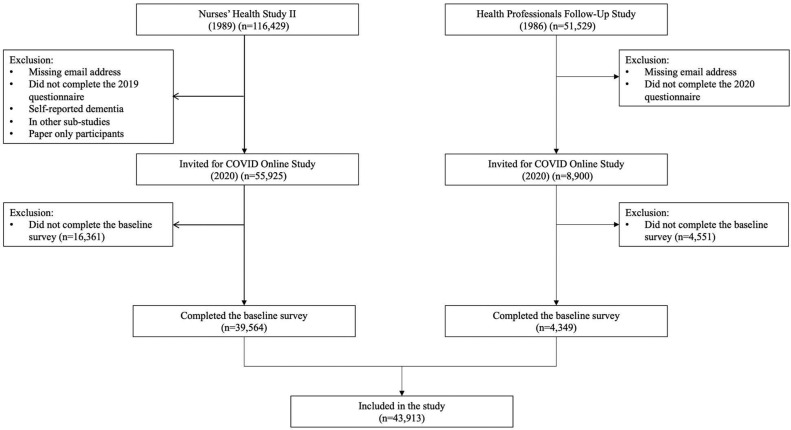
We used data from 43,913 participants within the Nurses' Health Study II and Health Professionals Follow-Up Study who responded to periodic COVID-related surveys from May 2020 through March 2021. History of physical activity from the prepandemic period was assessed as the metabolic equivalents of task (MET)-hours per week of various activities of different intensity and sedentary behavior assessed from reports of time spent sitting from questionnaires completed 2016-2017. Multivariable logistic regression models were fitted to calculate the odds ratios (ORs) and 95% confidence intervals (CIs) for risk of SARS-CoV-2 infection and COVID-19 severity, as well as predicted COVID-19 defined using a validated symptom-based algorithm.
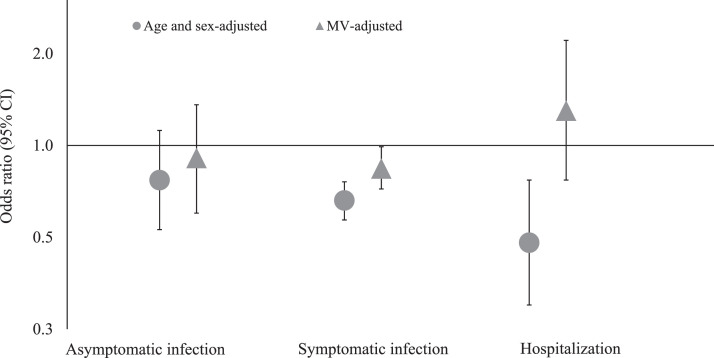
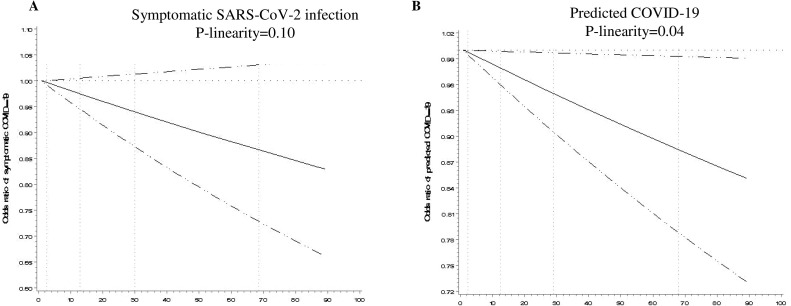
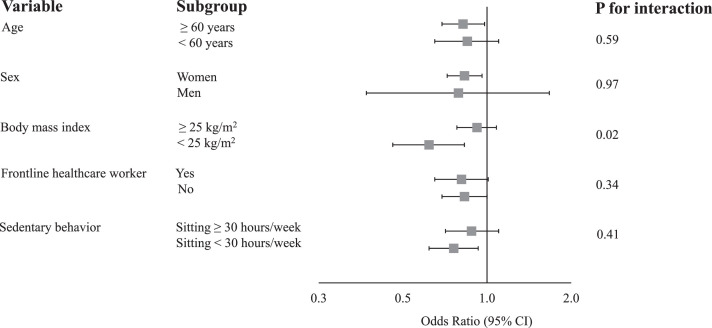
Higher levels of prepandemic physical activity were associated with a lower risk for SARS-CoV-2 infection. Compared to participants with <3 MET-hours per week, the multivariable-adjusted OR was 0.86 (95% CI: 0.74, 0.99; P trend =.07) for those with ≥27 MET-hours per week. Higher physical activity levels were also associated with lower risk of symptomatic SARS-CoV-2 infection (OR: 0.84; 95% CI: 0.72, 0.99; P trend = .05) and predicted COVID-19 (OR: 0.87; 95% CI: 0.78, 0.97; P trend = .01). Longer time sitting at home watching TV (OR: 0.85; 95% CI: 0.73, 0.97) or for other tasks (OR: 0.78; 95% CI: 0.66, 0.92) was associated with a lower risk of SARS-CoV-2 infection.
Our findings support a protective association between prepandemic physical activity and lower risk and severity of COVID-19.
有关大流行前体力活动和久坐行为与严重急性呼吸综合征冠状病毒 2(SARS-CoV-2)感染和 2019 年冠状病毒病(COVID-19)严重程度之间关联的数据,尤其是轻度疾病的数据有限。
我们使用了参加护士健康研究 II (Nurses' Health Study II)和健康专业人员随访研究(Health Professionals Follow-Up Study)的 43913 名参与者的数据,这些参与者在 2020 年 5 月至 2021 年 3 月期间对与 COVID 相关的定期调查做出了回应。大流行前体力活动史通过不同强度的各种活动的代谢当量(MET)-小时/周来评估,而久坐行为则通过 2016-2017 年完成的问卷中报告的久坐时间来评估。使用多变量逻辑回归模型计算 SARS-CoV-2 感染和 COVID-19 严重程度的风险比(OR)和 95%置信区间(CI),以及使用经过验证的基于症状的算法定义的预测 COVID-19。
较高水平的大流行前体力活动与 SARS-CoV-2 感染风险降低有关。与每周体力活动<3 MET 小时的参与者相比,每周体力活动≥27 MET 小时的参与者的多变量校正 OR 为 0.86(95%CI:0.74,0.99;P 趋势=.07)。较高的体力活动水平也与症状性 SARS-CoV-2 感染(OR:0.84;95%CI:0.72,0.99;P 趋势=.05)和预测 COVID-19(OR:0.87;95%CI:0.78,0.97;P 趋势=.01)的风险降低有关。在家看电视(OR:0.85;95%CI:0.73,0.97)或其他任务(OR:0.78;95%CI:0.66,0.92)的久坐时间较长与 SARS-CoV-2 感染的风险降低有关。
我们的研究结果支持大流行前体力活动与 COVID-19 风险和严重程度降低之间存在保护关联。