Núñez-Seisdedos Maria Natividad, Valcárcel-Linares David, Gómez-González María Teresa, Lázaro-Navas Irene, López-González Luís, Pecos-Martín Daniel, Rodríguez-Costa Isabel
Physiotherapy Department, Ramón y Cajal University Hospital, Madrid, Spain.
Department of Physiotherapy, University of Alcalá, Madrid, Spain.
ERJ Open Res. 2023 Jan 16;9(1). doi: 10.1183/23120541.00329-2022. eCollection 2023 Jan.
Knowledge regarding the long-term impact of invasive mechanical ventilation on the inspiratory muscles and functional outcomes in COVID-19 survivors is limited.
In this single-centre prospective cohort study, we evaluated invasively ventilated patients with COVID-19 pneumonia 3 and 6 months post-intensive care unit (ICU) discharge. Outcomes included: maximal inspiratory pressure (MIP), ultrasound parameters for diaphragm function, 6-min walk distance (6MWD), dyspnoea and quality of life. We evaluated associations between MIP and duration of mechanical ventilation with follow-up outcomes.
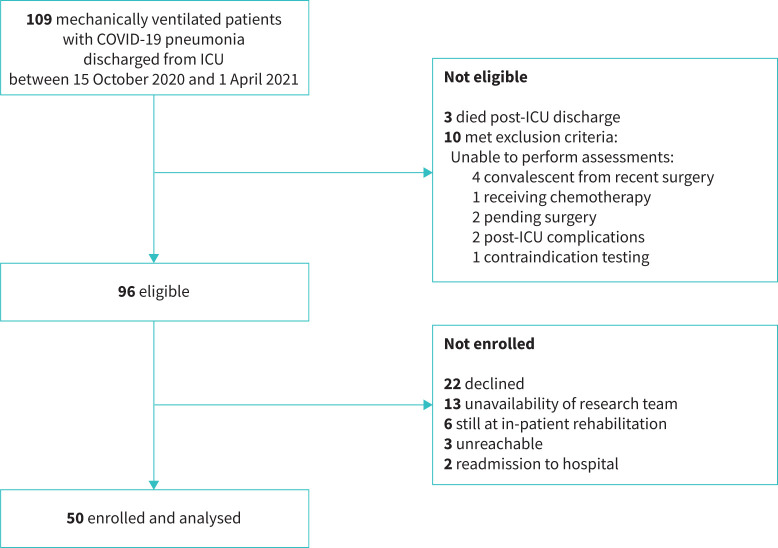
50 COVID-19 survivors discharged from ICU between 15 October 2020 and 1 April 2021 were enrolled. Overall, survivors showed a recovery trajectory over time. However, impaired MIP remained in 24 (48%) and 12 (24%) at 3 and 6 months, respectively. Diaphragm dysfunction was not observed. At 3 months, 23 (46%) had impaired functional capacity 10 (20%) at 6 months. Dyspnoea persisted in 44 (88%) patients at 3 months and 38 (76%) at 6 months. Quality of life was slightly decreased at 3 months with further improvements at 6 months. MIP was correlated to 6MWD, 6MWD % predicted, dyspnoea across follow-up, and quality of life at 3 months. The duration of invasive ventilation was correlated with 6MWD and 6MWD % predicted.
In invasively ventilated COVID-19 survivors, inspiratory muscle strength impairments persisted 6 months after ICU discharge, while maintaining normal diaphragm function. Decreased functional capacity, dyspnoea and slightly reduced health status were observed. Early screening of survivors is of utmost importance to identify those with impairments and at risk of delayed or incomplete recovery.
关于有创机械通气对新型冠状病毒肺炎(COVID-19)幸存者吸气肌和功能结局的长期影响的知识有限。
在这项单中心前瞻性队列研究中,我们评估了重症监护病房(ICU)出院3个月和6个月的COVID-19肺炎有创通气患者。结局包括:最大吸气压力(MIP)、膈肌功能的超声参数、6分钟步行距离(6MWD)、呼吸困难和生活质量。我们评估了MIP和机械通气持续时间与随访结局之间的关联。
纳入了2020年10月15日至2021年4月1日期间从ICU出院的50名COVID-19幸存者。总体而言,幸存者随时间呈现恢复轨迹。然而,分别在3个月和6个月时,仍有24例(48%)和12例(24%)的MIP受损。未观察到膈肌功能障碍。在3个月时,23例(46%)患者功能能力受损,在6个月时为10例(20%)。3个月时44例(88%)患者持续存在呼吸困难,6个月时为38例(76%)。生活质量在3个月时略有下降,在6个月时进一步改善。MIP与6MWD、预测的6MWD%、随访期间的呼吸困难以及3个月时的生活质量相关。有创通气持续时间与6MWD和预测的6MWD%相关。
在有创通气的COVID-19幸存者中,ICU出院6个月后吸气肌力量损害仍然存在,同时膈肌功能保持正常。观察到功能能力下降、呼吸困难和健康状况略有降低。对幸存者进行早期筛查对于识别那些有损害以及有延迟或不完全恢复风险的人至关重要。