Department of Orthopaedics, Sun Yat-sen Memorial Hospital, Sun Yat-sen University, Guangzhou, China.
Department of Radiology, Sun Yat-sen Memorial Hospital, Sun Yat-sen University, Guangzhou, China.
Orthop Surg. 2023 Aug;15(8):2052-2061. doi: 10.1111/os.13652. Epub 2023 Jan 20.
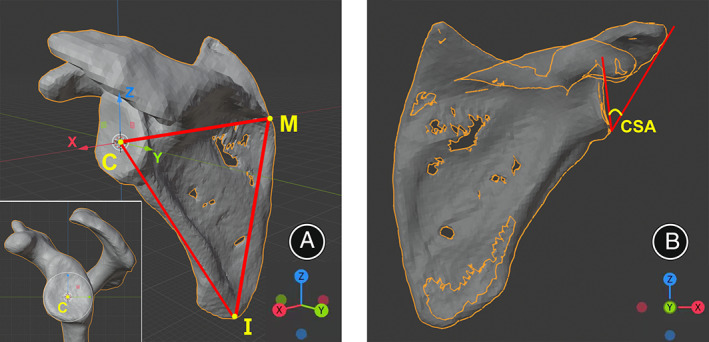
Anteroposterior (AP) radiographs do not necessarily offer the optimal approach to measuring the critical shoulder angle (CSA) due to the malposition of the scapula. Three-dimensional computed tomography (3D-CT) may offer some advantages, including the ability to rotate the scapula for position alignment and pre-operative planning for reducing CSA. This study aimed to investigate the accuracy and reliability of CSA measurement in 3D-CT and to determine whether there is an association between CSA and rotator cuff tears (RCTs).
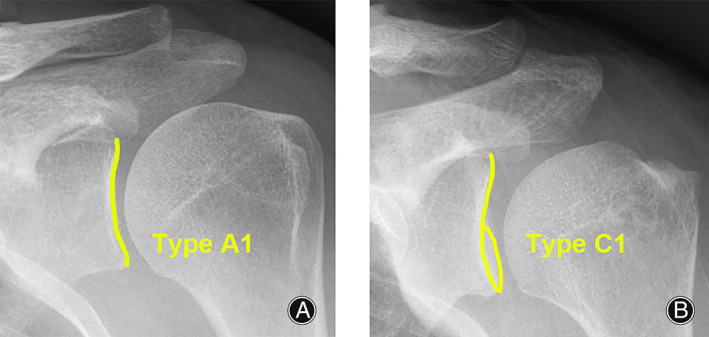
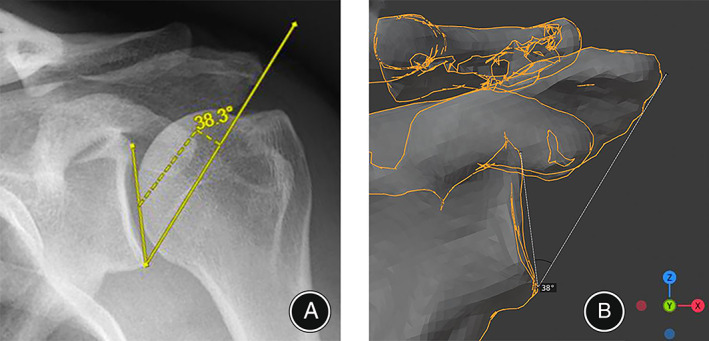
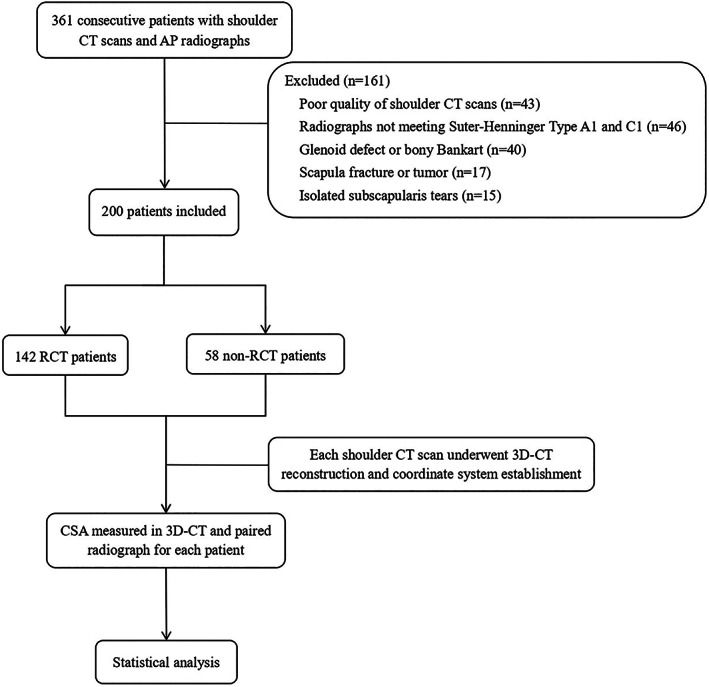
In this retrospective study we identified 200 patients who received shoulder arthroscopy from 2019 to 2021, including 142 patients (81 females, 61 males) with RCTs and 58 patients (14 females, 44 males) with non-RCTs. For each participant, CSA was measured from standard shoulder AP radiographs and anterior views of 3D-CT of the scapula by two independent assessors. Inter- and intra-observer agreements were assessed by the intraclass correlation coefficient (ICC). The relationship between the two measurement methodologies was determined by Spearman's correlation coefficient and Bland-Altman plots. Discriminative capacity was calculated by using receiver operating curve (ROC) analyses in the whole cohort and age sub-groups above and below 45 years.
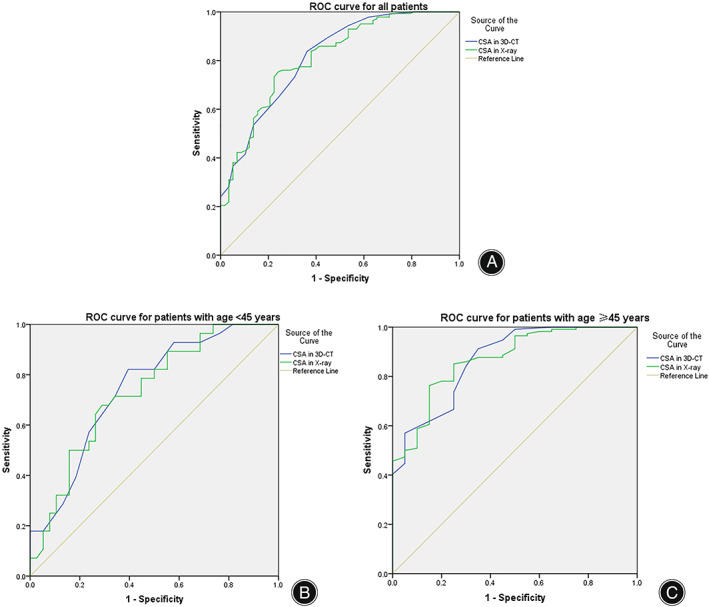
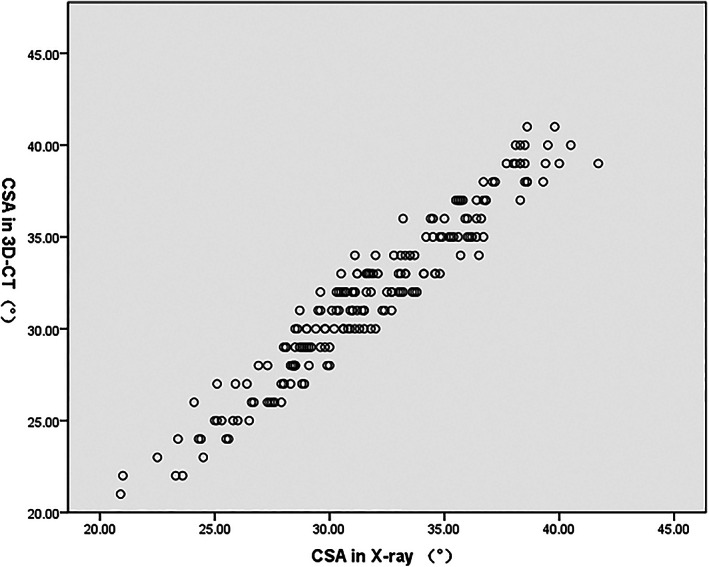
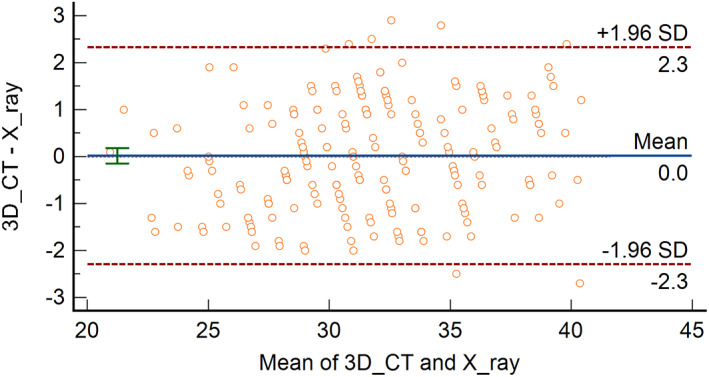
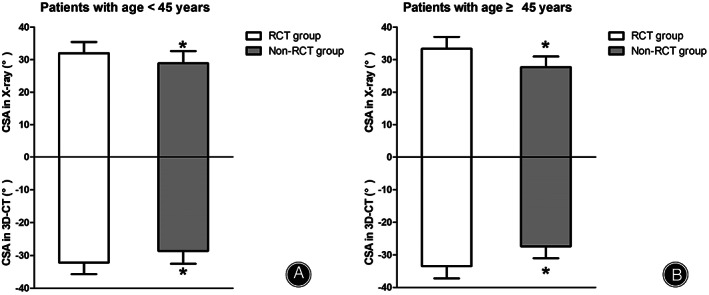
We found perfect inter-observer (ICC >0.96) and intra-observer (ICC >0.97) reliabilities for CSA measurements obtained from the standard AP radiographs and the 3D-CT. There was a strong correlation between the two methods (r = 0.960, P < 0.001). The mean CSA was 31.7° ± 4.2° in the standard AP radiographs and 31.8° ± 4.4° in the 3D-CT (mean difference 0.02°, P = 0.940; bias 0.02°, limits of agreement -2.29° to +2.33°). ROC analysis of the whole cohort showed that the CSA measured in the standard AP radiographs (area under the ROC curve [AUC] = 0.812, P < 0.001) and the 3D-CT (AUC = 0.815, P < 0.001) predicted RCT with high confidence. ROC analysis of patients aged ≥45 years showed that the CSA measured from the standard AP radiographs (AUC = 0.869, P < 0.001) and the 3D-CT (AUC = 0.870, P < 0.001) were very good at predicting RCTs.
CSA measured from standard AP radiographs and 3D-CT showed high consistency, and the CSA could be accurately and reliably measured using 3D-CT. CSAs measured from standard AP radiographs and 3D-CT could predict RCTs, especially in patients aged ≥45 years.
由于肩胛骨的位置不当,前后(AP)射线照相不一定提供测量关键肩角(CSA)的最佳方法。三维计算机断层扫描(3D-CT)可能具有一些优势,包括旋转肩胛骨以进行位置对准和 CSA 降低的术前规划。本研究旨在研究 3D-CT 中 CSA 测量的准确性和可靠性,并确定 CSA 是否与肩袖撕裂(RCT)之间存在关联。
在这项回顾性研究中,我们从 2019 年至 2021 年确定了 200 名接受肩关节镜检查的患者,其中包括 142 名(81 名女性,61 名男性)患有 RCT 和 58 名(14 名女性,44 名男性)无 RCT 的患者。对于每个参与者,由两名独立评估者从标准肩部 AP 射线照相和肩胛骨的 3D-CT 的前视图中测量 CSA。通过组内相关系数(ICC)评估组内和组间一致性。通过 Spearman 相关系数和 Bland-Altman 图确定两种测量方法之间的关系。在整个队列和年龄大于和小于 45 岁的亚组中,使用接收者操作曲线(ROC)分析计算鉴别能力。
我们发现,从标准 AP 射线照相和 3D-CT 获得的 CSA 测量具有完美的组间(ICC>0.96)和组内(ICC>0.97)可靠性。两种方法之间存在很强的相关性(r=0.960,P<0.001)。标准 AP 射线照相的平均 CSA 为 31.7°±4.2°,3D-CT 为 31.8°±4.4°(平均差异 0.02°,P=0.940;偏差 0.02°,一致性界限-2.29°至+2.33°)。整个队列的 ROC 分析表明,标准 AP 射线照相(ROC 曲线下面积[AUC]为 0.812,P<0.001)和 3D-CT(AUC 为 0.815,P<0.001)测量的 CSA 具有较高的 RCT 预测置信度。年龄≥45 岁患者的 ROC 分析表明,标准 AP 射线照相(AUC 为 0.869,P<0.001)和 3D-CT(AUC 为 0.870,P<0.001)测量的 CSA 能够非常好地预测 RCT。
从标准 AP 射线照相和 3D-CT 测量的 CSA 显示出高度的一致性,并且可以使用 3D-CT 准确可靠地测量 CSA。标准 AP 射线照相和 3D-CT 测量的 CSA 可预测 RCT,尤其是在年龄≥45 岁的患者中。