Williams Trevor, Melo-Molina Guadalupe Del Carmen, Jiménez-Fernández Jaime A, Weissenberger Holger, Gómez-Díaz Juan S, Navarro-de-la-Fuente Laura, Richards Andrew R
Instituto de Ecología AC (INECOL), Xalapa 91073, Veracruz, Mexico.
El Colegio de la Frontera Sur (ECOSUR), Tapachula 30700, Chiapas, Mexico.
Insects. 2023 Jan 13;14(1):80. doi: 10.3390/insects14010080.
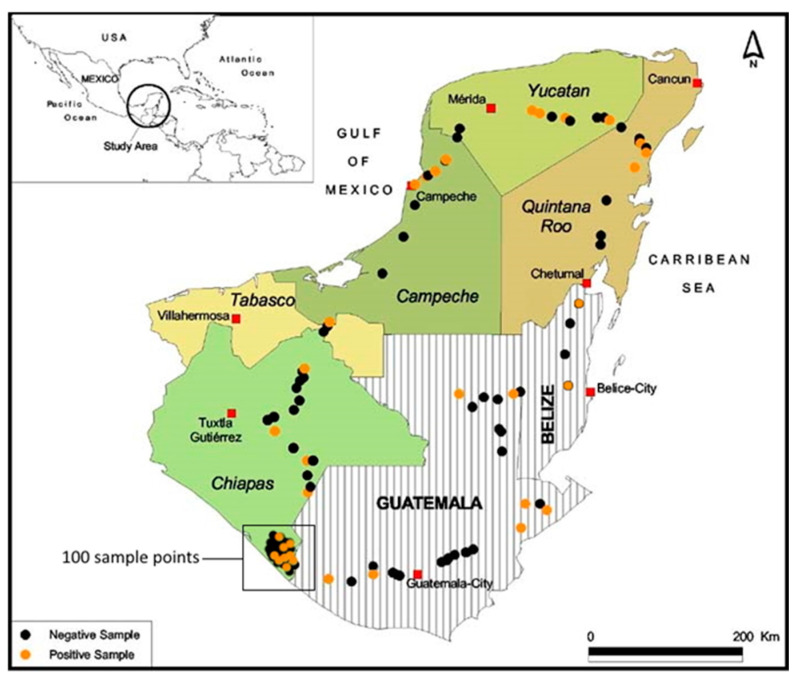
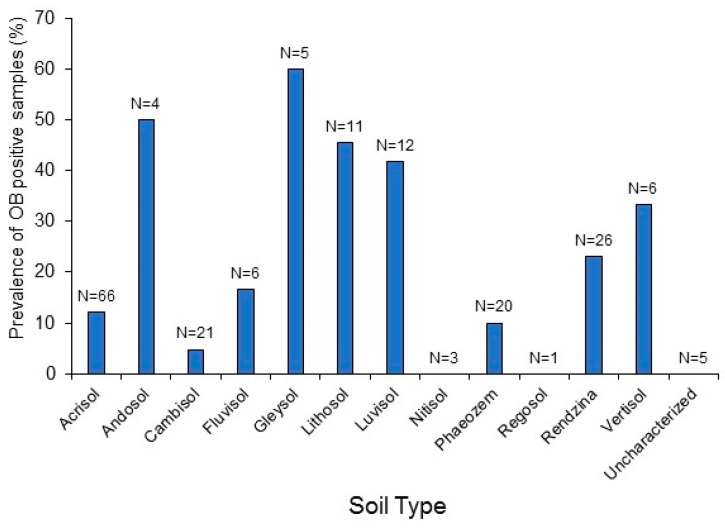
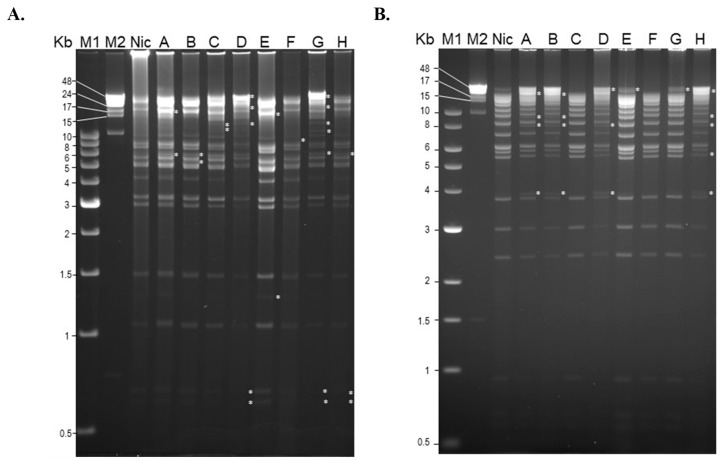
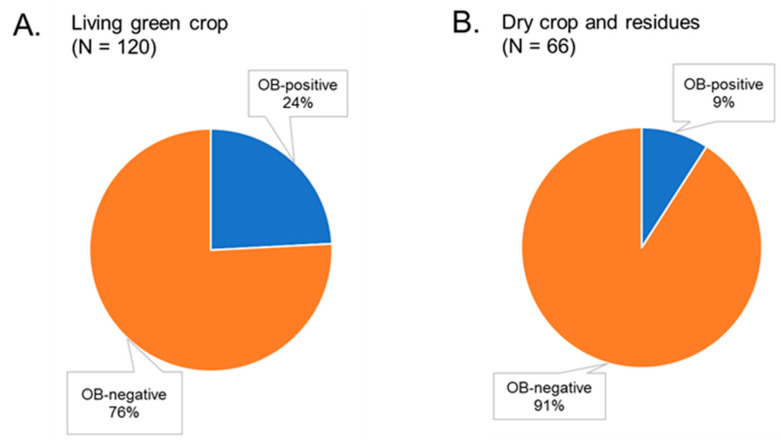
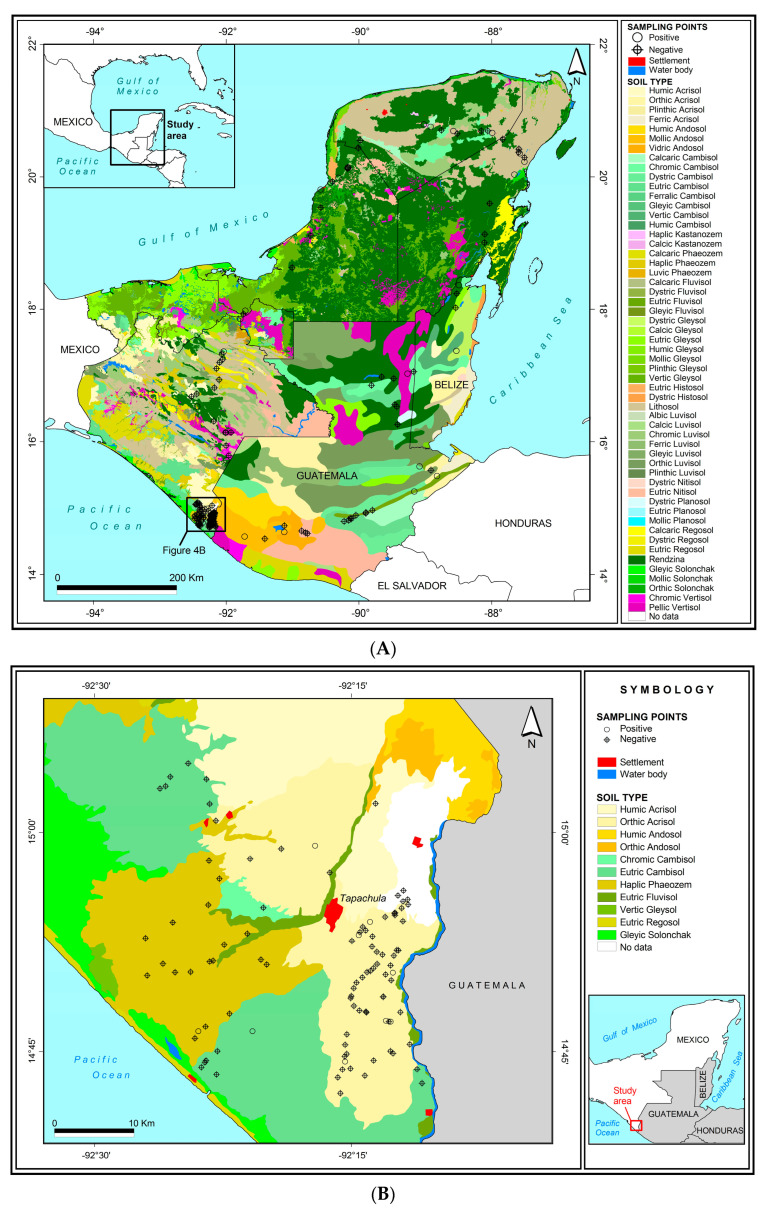
The occlusion bodies (OBs) of lepidopteran nucleopolyhedroviruses can persist in soil for extended periods before being transported back on to the foliage for transmission to the host insect. A sensitive insect bioassay technique was used to detect OBs of Spodoptera frugiperda multiple nucleopolyhedrovirus (SfMNPV) in 186 soil samples collected from maize fields in the southern Mexican states of Chiapas, Tabasco, Campeche, Yucatán, and Quintana Roo, as well Belize and Guatemala. Overall, 35 (18.8%) samples proved positive for SfMNPV OBs. The frequency of OB-positive samples varied significantly among Mexican states and countries (p < 0.05). Between 1.7 and 4.4% of S. frugiperda larvae that consumed OB-positive samples died from polyhedrosis disease. Restriction endonuclease analysis using PstI and HindIII confirmed that the soil-derived isolates were strains of SfMNPV and that genetic diversity was evident among the isolates. The prevalence of OB-positive soil samples did not differ with altitude or extension (area) of the maize field, but it was significantly higher in fields with the presence of living maize plants compared to those containing dead plants or crop residues (p < 0.05). Georeferenced soil samples were used to identify soil types on digitized soil maps. Lithosol and Luvisol soils had a higher than average prevalence of OB-positive samples (42−45% positive) (p = 0.006), as did Andosol, Gleysol, and Vertisol soils (33−60% OB-positive), although the sample sizes were small (<5 samples) for the latter three soils. In contrast, Cambisol soils had a lower than average prevalence of OB-positive samples (5% positive). Bioassays on Acrisol, Fluvisol, Phaeozem, and Rendzina soils resulted in intermediate levels of OB-positive samples. We conclude that certain soil types may favor OB persistence and virus-mediated biological pest control. The soil is also likely to provide a valuable source of genetic diversity for the design of virus-based insecticides against this pest.
鳞翅目核多角体病毒的包涵体(OBs)能在土壤中长时间存留,之后才会被带回叶片上,以便传播给宿主昆虫。运用一种灵敏的昆虫生物测定技术,对从墨西哥南部恰帕斯州、塔巴斯科州、坎佩切州、尤卡坦州和金塔纳罗奥州的玉米田,以及伯利兹和危地马拉采集的186份土壤样本进行检测,以探寻草地贪夜蛾多粒包埋核型多角体病毒(SfMNPV)的OBs。总体而言,35份(18.8%)样本被证实含有SfMNPV的OBs。OBs阳性样本的出现频率在墨西哥各州及不同国家之间存在显著差异(p < 0.05)。取食OBs阳性样本的草地贪夜蛾幼虫中,有1.7%至4.4%死于多角体病。使用PstI和HindIII进行的限制性内切酶分析证实,从土壤中分离出的菌株属于SfMNPV,且各分离株之间存在明显的遗传多样性。OBs阳性土壤样本的流行率与玉米田的海拔或面积并无差异,但与那些仅有死株或作物残茬的田地相比,有活玉米植株的田地中OBs阳性样本的比例显著更高(p < 0.05)。利用地理定位的土壤样本,在数字化土壤图上确定土壤类型。石质土和淋溶土中OBs阳性样本的流行率高于平均水平(阳性率为42% - 45%)(p = 0.006),火山灰土、潜育土和变性土也是如此(OBs阳性率为33% - 60%),不过后三种土壤的样本量较小(<5份样本)。相比之下,始成土中OBs阳性样本的流行率低于平均水平(阳性率为5%)。对淋溶土、冲积土、黑土和腐殖质土进行的生物测定,得到的OBs阳性样本水平处于中等。我们得出结论,某些土壤类型可能有利于OBs的存留以及病毒介导的生物害虫防治。土壤也可能为设计针对这种害虫的病毒杀虫剂提供宝贵的遗传多样性来源。