Department of Public Health, Osaka City University Graduate School of Medicine, Osaka, Japan.
Research Center for Infectious Disease Sciences, Osaka City University Graduate School of Medicine, Osaka, Japan.
Geriatr Gerontol Int. 2023 Mar;23(3):179-187. doi: 10.1111/ggi.14539. Epub 2023 Jan 20.
The risk of developing infectious diarrhea among elderly residents at Japanese geriatric intermediate care facilities is unclear. We investigated the incidence rate and risk factors of norovirus-related diarrhea at such facilities.
This prospective cohort study followed 1727 residents from November 2018 to April 2020 at 10 geriatric intermediate care facilities in Osaka, Japan regarding the occurrence of diarrhea. Resident data were collected from their medical records using structured forms at two to three of the following three time points: at recruitment, if they developed diarrhea, and when they left the facility. Residents who developed diarrhea were tested using rapid diagnostic tests for norovirus. Cox proportional hazard model was employed to hazard ratios (HRs) with 95% confidence intervals (CIs) to estimate the risk factors for norovirus-related diarrhea.
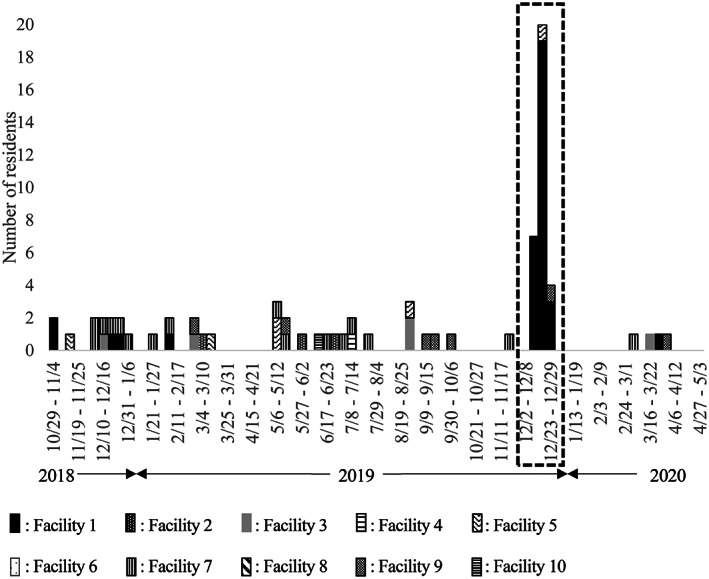
During the study period, 74 residents developed diarrhea, 13 of whom were norovirus positive. The incidence rate of norovirus-related diarrhea was 10.11 per 1000 person-years (95% CI: 4.61-15.61). In terms of risk factors, people with care-needs level 3 were at a higher risk for developing norovirus-related diarrhea (adjusted HR [aHR] = 7.35, 95% CI: 1.45-37.30). Residents with hypertension (aHR = 3.41, 95% CI: 1.05-11.04) or stroke (aHR = 8.84, 95% CI: 2.46-31.83), and those who walked with canes (aHR = 16.68, 95% CI: 1.35-206.52) also had a significantly higher risk for norovirus-related diarrhea.
Throughout the study period, the incidence of development of diarrhea was low. Care-needs level 3, stroke, hypertension and use of a cane were identified as risk factors for norovirus-related diarrhea in Japanese geriatric intermediate care facilities. Geriatr Gerontol Int 2023; 23: 179-187.
日本老年护理机构中老年人患传染性腹泻的风险尚不清楚。我们调查了这些机构中诺如病毒相关腹泻的发病率和危险因素。
这项前瞻性队列研究从 2018 年 11 月至 2020 年 4 月,对日本大阪的 10 家老年护理机构的 1727 名居民进行了腹泻发生情况的随访。使用结构化表格从居民病历中收集居民数据,在以下三个时间点中的两个到三个时间点进行收集:招募时、出现腹泻时和离开护理机构时。出现腹泻的居民使用快速诊断测试进行诺如病毒检测。采用 Cox 比例风险模型计算风险比(HR)和 95%置信区间(CI),以估计诺如病毒相关腹泻的危险因素。
在研究期间,74 名居民出现腹泻,其中 13 名诺如病毒检测阳性。诺如病毒相关腹泻的发病率为 10.11/1000人年(95%CI:4.61-15.61)。在危险因素方面,护理需求等级为 3 的人群发生诺如病毒相关腹泻的风险更高(调整后的 HR[aHR] = 7.35,95%CI:1.45-37.30)。患有高血压(aHR = 3.41,95%CI:1.05-11.04)或中风(aHR = 8.84,95%CI:2.46-31.83)的居民以及使用拐杖行走的居民(aHR = 16.68,95%CI:1.35-206.52),发生诺如病毒相关腹泻的风险也显著更高。
在整个研究期间,腹泻的发病率较低。护理需求等级 3、中风、高血压和使用拐杖被确定为日本老年护理机构中诺如病毒相关腹泻的危险因素。