US Naval Medical Research Unit No. 6, Lima, Peru.
Division of Viral Diseases, Centers for Disease Control and Prevention, Atlanta, Georgia.
Clin Infect Dis. 2017 Sep 1;65(5):833-839. doi: 10.1093/cid/cix423.
Data on norovirus epidemiology among all ages in community settings are scarce, especially from tropical settings.
We implemented active surveillance in 297 households in Peru from October 2012 to August 2015 to assess the burden of diarrhea and acute gastroenteritis (AGE) due to norovirus in a lower-middle-income community. During period 1 (October 2012-May 2013), we used a "traditional" diarrhea case definition (≥3 loose/liquid stools within 24 hours). During period 2 (June 2013-August 2015), we used an expanded case definition of AGE (by adding ≥2 vomiting episodes without diarrhea or 1-2 vomiting episodes plus 1-2 loose/liquid stools within 24 hours). Stool samples were tested for norovirus by reverse-transcription polymerase chain reaction.
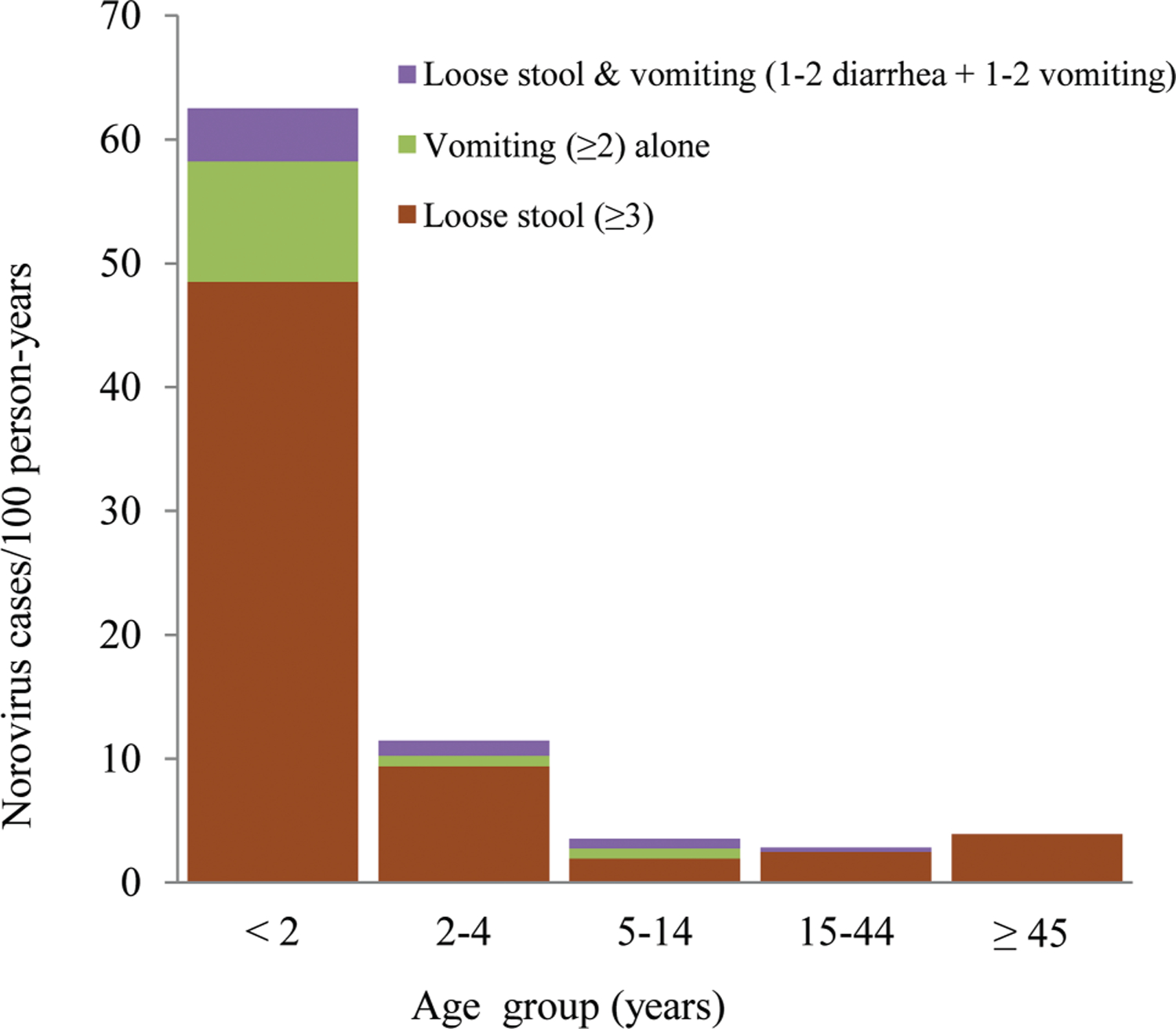
During period 1, overall diarrhea and norovirus-associated diarrhea incidence was 37.2/100 person-years (PY) (95% confidence interval [CI], 33.2-41.7) and 5.7/100 PY (95% CI, 3.9-8.1), respectively. During period 2, overall AGE and norovirus-associated AGE incidence was 51.8/100 PY (95% CI, 48.8-54.9) and 6.5/100 PY (95% CI, 5.4-7.8), respectively. In both periods, children aged <2 years had the highest incidence of norovirus. Vomiting without diarrhea occurred among norovirus cases in participants <15 years old, but with a higher proportion among children <2 years, accounting for 35% (7/20) of all cases in this age group. Noroviruses were identified in 7% (23/335) of controls free of gastroenteric symptoms.
Norovirus was a significant cause of AGE in this community, especially among children <2 years of age. Inclusion of vomiting in the case definition resulted in a 20% improvement for detection of norovirus cases.
在社区环境中,关于所有年龄段的诺如病毒流行病学的数据很少,尤其是来自热带地区的数据。
我们在秘鲁的 297 个家庭中开展了主动监测,以评估中低收入社区中诺如病毒引起的腹泻和急性胃肠炎(AGE)的负担。在第 1 期(2012 年 10 月至 2013 年 5 月),我们使用了“传统”腹泻病例定义(24 小时内≥3 次稀便或水样便)。在第 2 期(2013 年 6 月至 2015 年 8 月),我们使用了扩大的 AGE 病例定义(通过添加 24 小时内≥2 次呕吐发作而无腹泻或 1-2 次呕吐发作加 1-2 次稀便或水样便)。粪便样本通过逆转录聚合酶链反应检测诺如病毒。
在第 1 期,总腹泻和诺如病毒相关腹泻的发病率分别为 37.2/100 人年(95%置信区间[CI],33.2-41.7)和 5.7/100 人年(95%CI,3.9-8.1)。在第 2 期,总 AGE 和诺如病毒相关 AGE 的发病率分别为 51.8/100 人年(95%CI,48.8-54.9)和 6.5/100 人年(95%CI,5.4-7.8)。在两个时期,<2 岁的儿童诺如病毒发病率最高。在<15 岁的参与者中,诺如病毒病例出现无腹泻的呕吐,但<2 岁的儿童比例更高,占该年龄组所有病例的 35%(7/20)。在无胃肠道症状的对照者中,有 7%(23/335)检测到诺如病毒。
在这个社区,诺如病毒是 AGE 的一个重要原因,尤其是在<2 岁的儿童中。在病例定义中纳入呕吐可使诺如病毒病例的检出率提高 20%。