Santoni Matteo, Molina-Cerrillo Javier, Santoni Giorgio, Lam Elaine T, Massari Francesco, Mollica Veronica, Mazzaschi Giulia, Rapoport Bernardo L, Grande Enrique, Buti Sebastiano
Oncology Unit, Macerata Hospital, Via Santa Lucia 2, 62100 Macerata, Italy.
Department of Medical Oncology, Hospital Ramón y Cajal, 28029 Madrid, Spain.
Cancers (Basel). 2023 Jan 7;15(2):408. doi: 10.3390/cancers15020408.
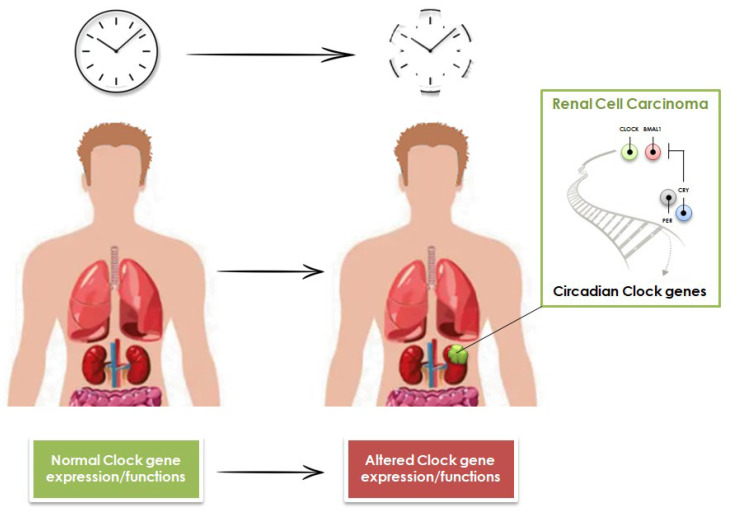
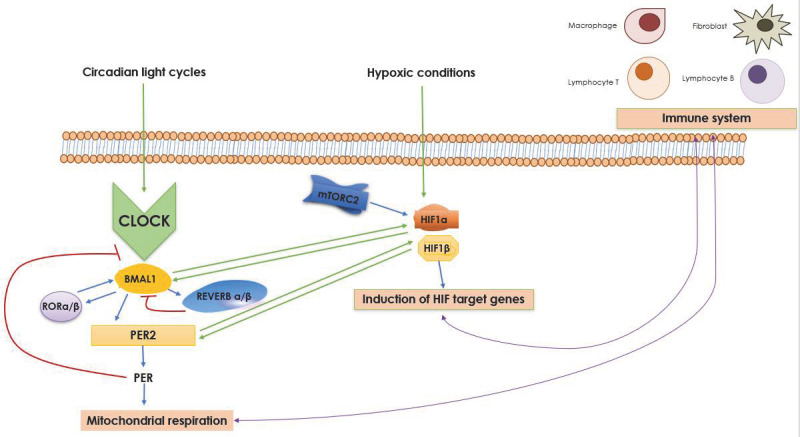
Circadian rhythm regulates cellular differentiation and physiology and shapes the immune response. Altered expression of clock genes might lead to the onset of common malignant cancers, including Renal Cell Carcinoma (RCC). Data from Cancer Genome Atlas (TCGA) indicate that clock genes , , , and are overexpressed in RCC tissues and correlate with patients' prognosis. The expression of clock genes could finely tune transcription factor activity in RCC and is associated with the extent of immune cell infiltration. The clock system interacts with hypoxia-induced factor-1α (HIF-1α) and regulates the circadian oscillation of mammalian target of rapamycin (mTOR) activity thereby conditioning the antitumor effect of mTOR inhibitors. The stimulation of natural killer (NK) cell activity exerted by the administration of interferon-α, a cornerstone of the first era of immunotherapy for RCC, relevantly varies according to circadian dosing time. Recent evidence demonstrated that time-of-day infusion directly affects the efficacy of immune checkpoint inhibitors in cancer patients. Compounds targeting the circadian clock have been identified and their role in the era of immunotherapy deserves to be further investigated. In this review, we aimed at addressing the impact of clock genes on the natural history of kidney cancer and their potential therapeutic implications.
昼夜节律调节细胞分化和生理功能,并塑造免疫反应。时钟基因表达的改变可能导致包括肾细胞癌(RCC)在内的常见恶性肿瘤的发生。来自癌症基因组图谱(TCGA)的数据表明,时钟基因 、 、 、 和 在RCC组织中过表达,且与患者预后相关。时钟基因的表达可以精细调节RCC中的转录因子活性,并与免疫细胞浸润程度相关。时钟系统与缺氧诱导因子-1α(HIF-1α)相互作用,并调节雷帕霉素哺乳动物靶点(mTOR)活性的昼夜振荡,从而影响mTOR抑制剂的抗肿瘤效果。干扰素-α是RCC免疫治疗第一个时代的基石,其给药对自然杀伤(NK)细胞活性的刺激根据昼夜给药时间有显著差异。最近的证据表明,一天中的给药时间直接影响癌症患者免疫检查点抑制剂的疗效。已经鉴定出靶向昼夜节律时钟的化合物,它们在免疫治疗时代的作用值得进一步研究。在这篇综述中,我们旨在探讨时钟基因对肾癌自然病程的影响及其潜在的治疗意义。