Choi Yong Jun, Park Chul Hwan, Park Hye Jung, Shin Jae Min, Kim Tae Hoon, Lee Kyung-A, Moon Duk Hwan, Lee Sungsoo, Lee Sang Eun, Byun Min Kwang
Pulmonary Division, Department of Internal Medicine, Gangnam Severance Hospital, Yonsei University College of Medicine, Seoul 06273, Republic of Korea.
Department of Radiology and the Research Institute of Radiological Science, Gangnam Severance Hospital, Yonsei University College of Medicine, Seoul 06273, Republic of Korea.
Diagnostics (Basel). 2023 Jan 5;13(2):198. doi: 10.3390/diagnostics13020198.
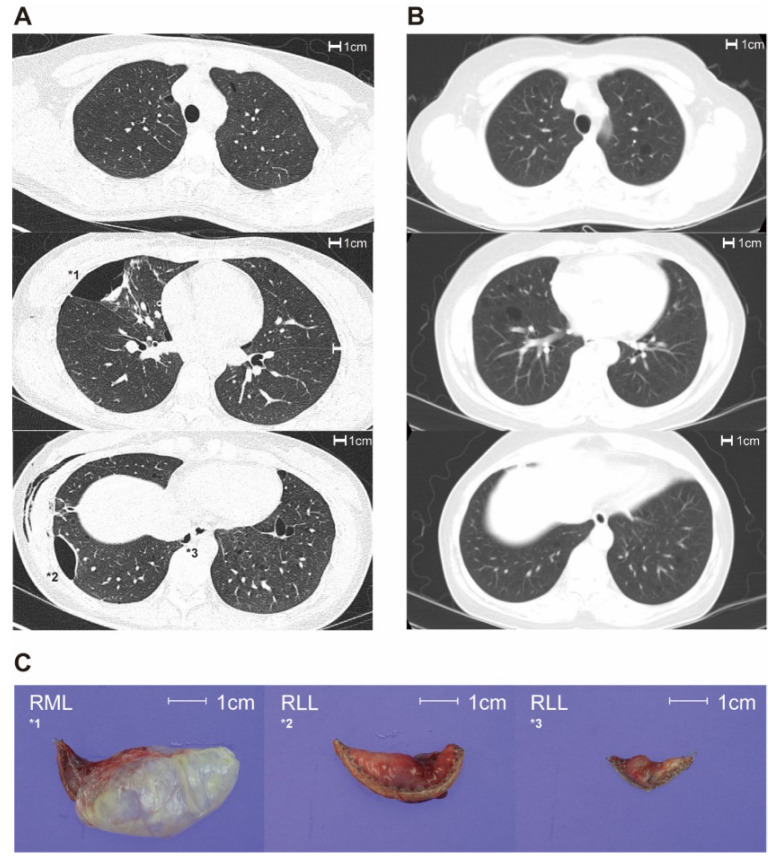
Background: Chest computed tomography (CT) findings are important for identifying Birt−Hogg−Dube (BHD) syndrome. However, the predictive power of classical criteria for chest CT findings is weak. Here, we aimed to identify more specific chest CT findings necessitating genetic examination for FLCN gene mutations. Methods: From June 2016 to December 2017, we prospectively enrolled 21 patients with multiple bilateral and basally located lung cysts on chest CT with no other apparent cause, including cases with and without spontaneous primary pneumothorax. All enrolled patients underwent FLCN mutation testing for diagnosis confirmation. Results: BHD was diagnosed in 10 of 21 enrolled patients (47.6%). There were no differences in clinical features between the BHD and non-BHD groups. Maximal cyst diameter was significantly greater in the BHD group (mean ± standard deviation; 4.1 ± 1.1 cm) than in the non-BHD group (1.6 ± 0.9 cm; p < 0.001). Diversity in cyst size was observed in 100.0% of BHD cases and 18.2% of non-BHD cases (p = 0.001). Morphological diversity was observed in 100.0% of BHD cases and 54.6% of non-BHD cases (p = 0.054). Areas under the receiver operating characteristic curves for predicting FLCN gene mutations were 0.955 and 0.909 for maximal cyst diameter and diversity in size, respectively. The optimal cut-off value for maximal diameter FLCN mutations prediction was 2.1 cm (sensitivity: 99%; specificity: 82%). Conclusions: Reliable chest CT features suggesting the need for FLCN gene mutations screening include variations in cyst size and the presence of cysts > 2.1 cm in diameter, predominantly occurring in the bilateral basal lungs.
胸部计算机断层扫描(CT)结果对于识别Birt-Hogg-Dube(BHD)综合征很重要。然而,胸部CT结果的经典标准预测能力较弱。在此,我们旨在识别更具体的胸部CT结果,这些结果需要对FLCN基因突变进行基因检测。方法:2016年6月至2017年12月,我们前瞻性纳入了21例胸部CT显示双侧多发且位于肺底部的肺囊肿且无其他明显病因的患者,包括有和无自发性原发性气胸的病例。所有纳入患者均接受FLCN突变检测以确诊。结果:21例纳入患者中有10例(47.6%)被诊断为BHD。BHD组和非BHD组的临床特征无差异。BHD组最大囊肿直径(平均值±标准差;4.1±1.1 cm)显著大于非BHD组(1.6±0.9 cm;p<0.001)。100.0%的BHD病例和18.2%的非BHD病例观察到囊肿大小的差异(p = 0.001)。100.0%的BHD病例和54.6%的非BHD病例观察到形态学差异(p = 0.054)。预测FLCN基因突变的受试者工作特征曲线下面积,最大囊肿直径和大小差异分别为0.955和0.909。预测FLCN基因突变的最大直径最佳截断值为2.1 cm(敏感性:99%;特异性:82%)。结论:提示需要进行FLCN基因突变筛查的可靠胸部CT特征包括囊肿大小的变化以及直径>2.1 cm囊肿的存在,主要发生在双侧肺底部。