Gherghe Mirela, Lazar Alexandra Maria, Simion Laurentiu, Irimescu Ionela-Nicoleta, Sterea Maria-Carla, Mutuleanu Mario-Demian, Anghel Rodica Maricela
Nuclear Medicine Department, University of Medicine and Pharmacy "Carol Davila" Bucharest, 050474 Bucharest, Romania.
Nuclear Medicine Department, Institute of Oncology "Professor Doctor Alexandru Trestioreanu", 022328 Bucharest, Romania.
Diagnostics (Basel). 2023 Jan 15;13(2):318. doi: 10.3390/diagnostics13020318.
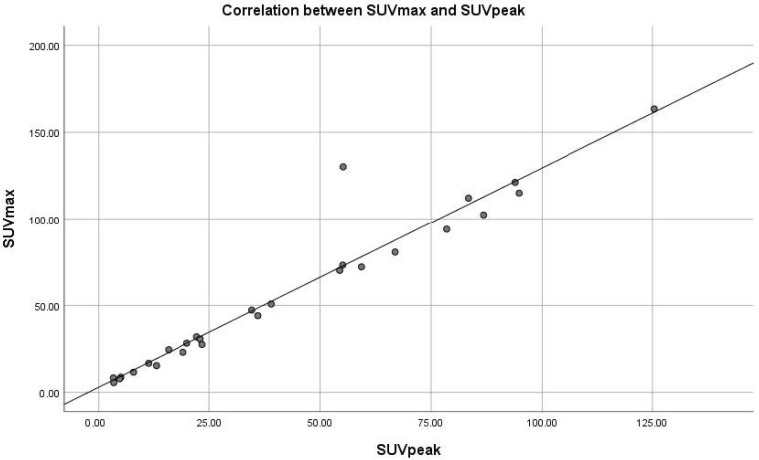
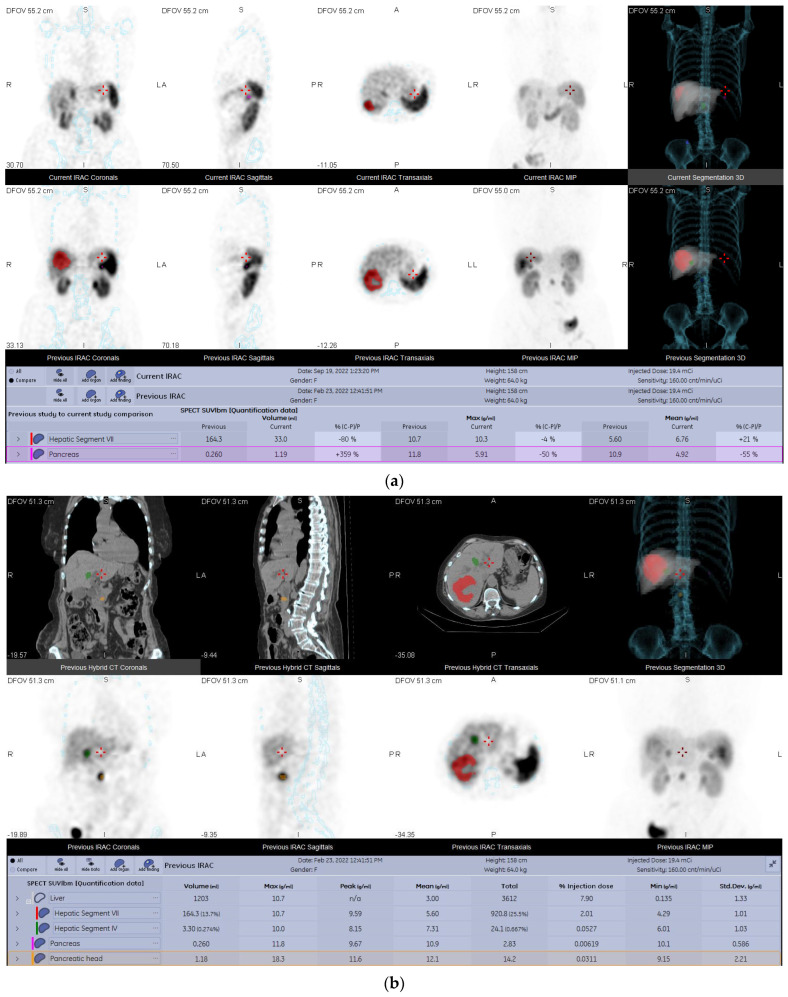
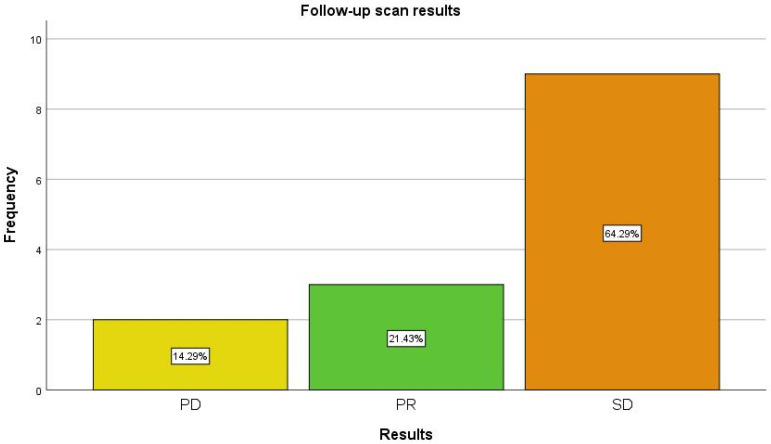
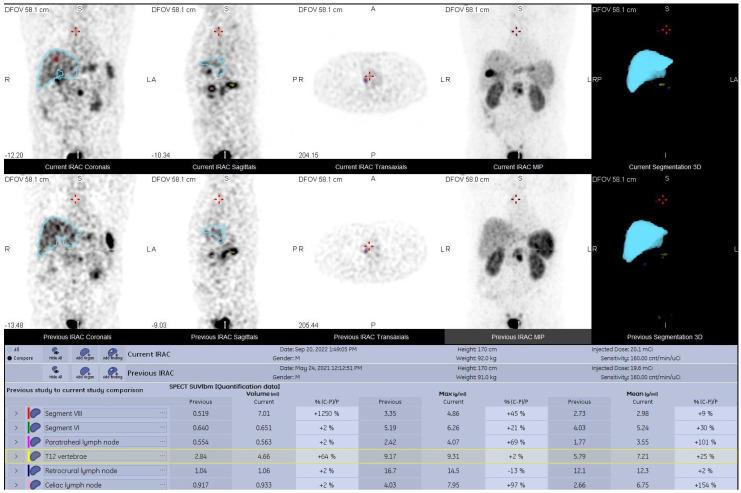
(1) Background: The aim of our study was to assess the feasibility of 99mTcEDDA/HYNIC-TOC SPECT/CT quantitative analysis in evaluating treatment response and disease progression in patients with NETs. (2) Methods: This prospective monocentric study evaluated 35 SPECT/CT examinations performed on 14 patients with neuroendocrine tumours who underwent a baseline and at least one follow-up 99mTcEDDA/HYNIC-TOC scan as part of their clinical management. The examination protocol included a whole-body scan acquired 2 h after the radiotracer’s administration, with the SPECT/CT performed 4 h post-injection. Images were analyzed by two experienced physicians and patients were classified into response categories based on their changes in SUV values. (3) Results: We evaluated 14 baseline studies and 21 follow-up scans, accounting for 123 lesions. A statistically positive correlation has been found between the SUVmax and SUVpeak values in tumoral lesions (p < 0.05). No correlation has been found between the SUV values and the ki67 proliferation index. Finally, 64.29% patients were classified as SD at the end of the study, with only 14.29% of patients exhibiting PD and 21.43% patients with PR. (4) Conclusions: The quantitative analysis of 99mTcEDDA/HYNIC-TOC SPECT/CT data in patients with neuroendocrine tumours could represent an alternative to 68Ga-DOTA-peptides PET/CT for the monitoring and prognosis of NETs.
(1) 背景:我们研究的目的是评估⁹⁹ᵐTc-乙二胺二乙酸/六氮杂环三烯核心片段-奥曲肽单光子发射计算机断层扫描/计算机断层扫描(⁹⁹ᵐTcEDDA/HYNIC-TOC SPECT/CT)定量分析在评估神经内分泌肿瘤(NETs)患者治疗反应和疾病进展方面的可行性。(2) 方法:这项前瞻性单中心研究评估了对14例神经内分泌肿瘤患者进行的35次SPECT/CT检查,这些患者作为临床管理的一部分接受了基线检查以及至少一次随访⁹⁹ᵐTcEDDA/HYNIC-TOC扫描。检查方案包括在注射放射性示踪剂后2小时进行全身扫描,注射后4小时进行SPECT/CT检查。由两名经验丰富的医生对图像进行分析,并根据SUV值的变化将患者分类为不同的反应类别。(3) 结果:我们评估了14次基线研究和21次随访扫描,共涉及123个病灶。在肿瘤病灶中,SUVmax和SUVpeak值之间存在统计学上的正相关(p < 0.05)。未发现SUV值与ki67增殖指数之间存在相关性。最后,在研究结束时,64.29%的患者被分类为疾病稳定(SD),只有14.29%的患者出现疾病进展(PD),21.43%的患者有部分缓解(PR)。(4) 结论:对神经内分泌肿瘤患者的⁹⁹ᵐTcEDDA/HYNIC-TOC SPECT/CT数据进行定量分析,可能是⁶⁸Ga-多胺基肽PET/CT用于NETs监测和预后评估的一种替代方法。