Velikyan Irina, Bossart Martin, Haack Torsten, Laitinen Iina, Estrada Sergio, Johansson Lars, Pierrou Stefan, Wagner Michael, Eriksson Olof
Science for Life Laboratory, Department of Medicinal Chemistry, Uppsala University, SE-751 83 Uppsala, Sweden.
PET Centre, Centre for Medical Imaging, Uppsala University Hospital, SE-751 85 Uppsala, Sweden.
Pharmaceuticals (Basel). 2022 Dec 31;16(1):61. doi: 10.3390/ph16010061.
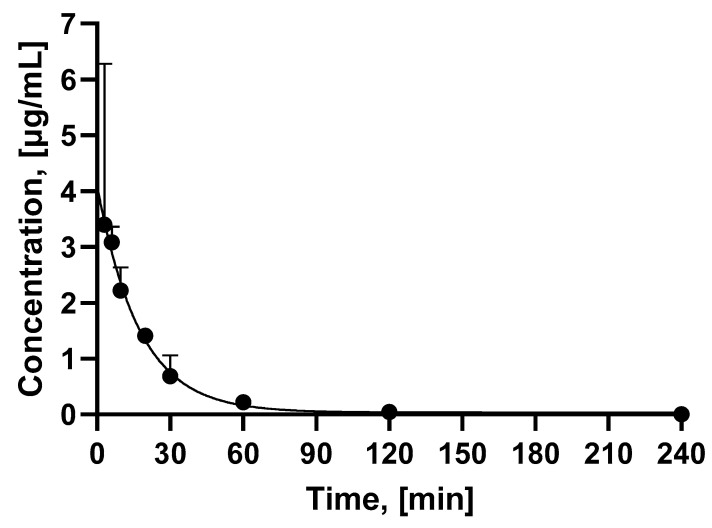
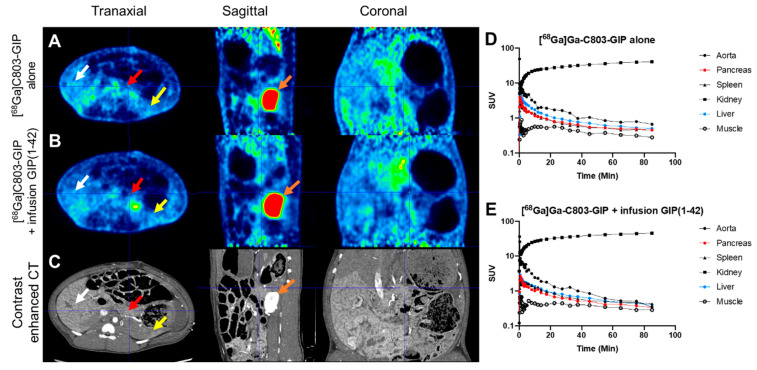
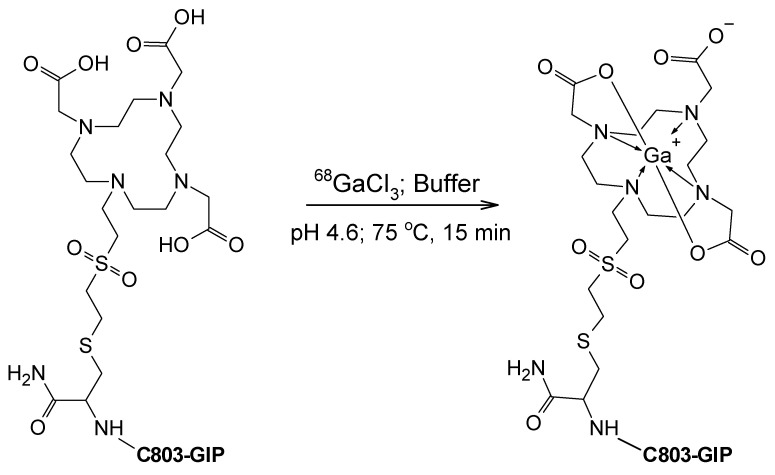
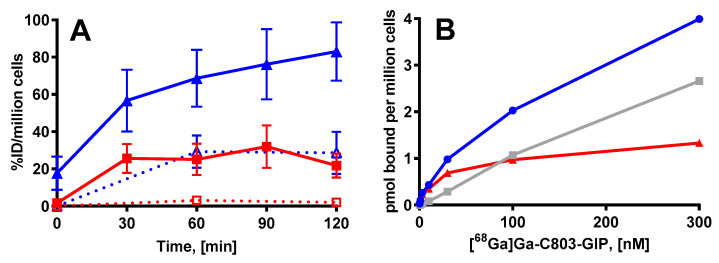
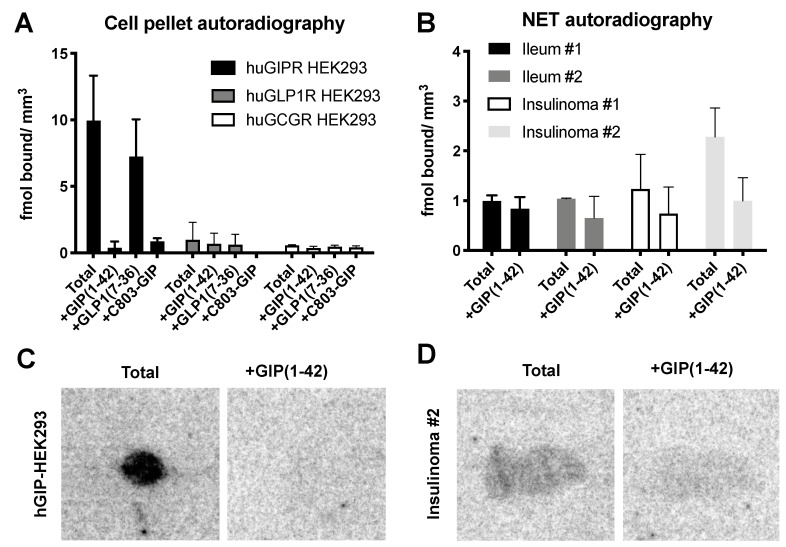
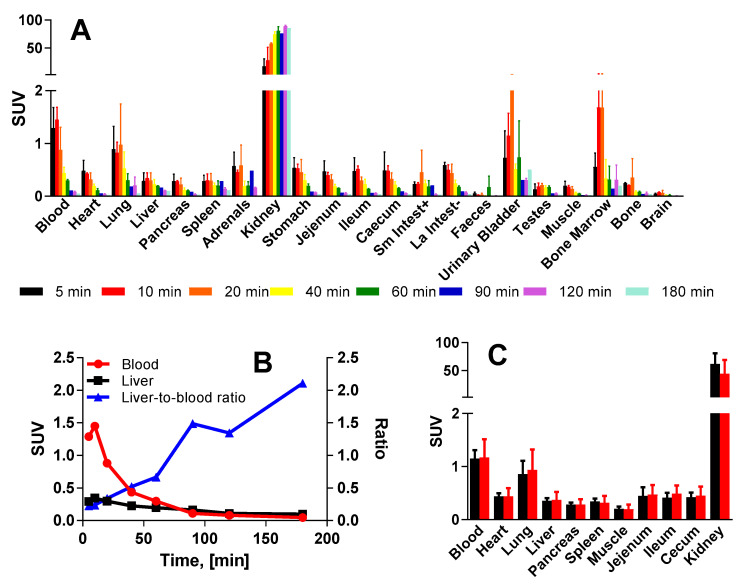
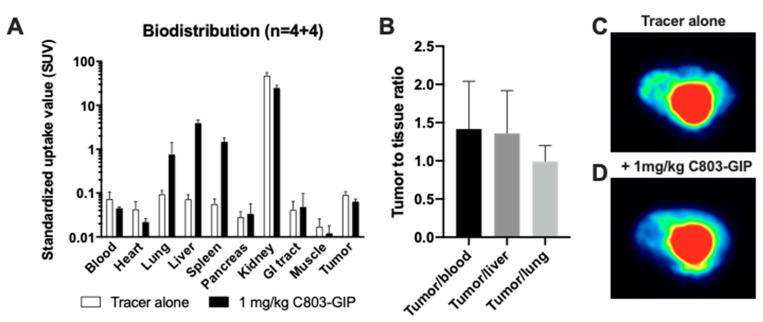
Imaging and radiotherapy targeting the glucose-dependent insulinotropic polypeptide receptor (GIPR) could potentially benefit the management of neuroendocrine neoplasms (NENs), complementing clinically established radiopharmaceuticals. The aim of this study was to evaluate a GIPR-targeting positron emission tomography (PET) radioligand with receptor-specific binding, fast blood clearance, and low liver background uptake. The peptide DOTA-bioconjugate, C803-GIP, was developed based on the sequence of the endogenous GIP(1-30) and synthetic exendin-4 peptides with selective amino acid mutations to combine their specificity for the GIPR and in vivo stability, respectively. The Ga-labeled bioconjugate was evaluated in vitro in terms of binding affinity, specificity, and internalization in HEK293 cells transfected with the human GIPR, GLP1, or GCG receptors and in sections of human insulinoma and NENs. In vivo binding specificity, biodistribution, and tissue background were investigated in mice bearing huGIPR-HEK293 xenografts and in a pig. Ex vivo organ distribution, pharmacokinetics, and dosimetry were studied in normal rats. [Ga]Ga-C803-GIP was stable and demonstrated a high affinity to the huGIPR-HEK293 cells. Binding specificity was demonstrated in vitro in frozen sections of NENs and huGIPR-HEK293 cells. No specific uptake was observed in the negative controls of huGLP1R and huGCGR cells. A novel rationally designed PET radioligand, [Ga]Ga-C803-GIP, demonstrated promising binding characteristics and specificity towards the GIPR.
针对葡萄糖依赖性促胰岛素多肽受体(GIPR)的成像和放射治疗可能会有益于神经内分泌肿瘤(NENs)的管理,作为临床既定放射性药物的补充。本研究的目的是评估一种具有受体特异性结合、快速血液清除和低肝脏本底摄取的靶向GIPR的正电子发射断层扫描(PET)放射性配体。肽DOTA生物共轭物C803-GIP是基于内源性GIP(1-30)的序列和具有选择性氨基酸突变的合成艾塞那肽-4肽开发的,分别结合了它们对GIPR的特异性和体内稳定性。用镓标记的生物共轭物在体外对转染了人GIPR、GLP1或GCG受体的HEK293细胞以及人胰岛素瘤和NENs切片进行了结合亲和力、特异性和内化评估。在携带huGIPR-HEK293异种移植瘤的小鼠和猪体内研究了结合特异性、生物分布和组织本底。在正常大鼠体内研究了离体器官分布、药代动力学和剂量学。[镓]Ga-C803-GIP稳定,对huGIPR-HEK293细胞表现出高亲和力。在NENs和huGIPR-HEK293细胞的冷冻切片中体外证明了结合特异性。在huGLP1R和huGCGR细胞的阴性对照中未观察到特异性摄取。一种新的合理设计的PET放射性配体[镓]Ga-C803-GIP对GIPR表现出有前景的结合特性和特异性。