Li Linjin, Zhu Jianlong, Shao Huan, Huang Laijian, Wang Xiaoting, Bao Wenshuo, Sheng Tao, Chen Dake, He Yanmei, Song Baolin
Department of Urology, the Third Clinical Institute Affiliated to Wenzhou Medical University, Wenzhou People's Hospital, Wenzhou, China.
Department of Urology, Jiaxing Hospital of Traditional Chinese Medicine, Jiaxing, China.
Front Surg. 2023 Jan 6;9:1012897. doi: 10.3389/fsurg.2022.1012897. eCollection 2022.
Partial nephrectomy (PN) is one of the most preferred nephron-sparing treatments for clinical T1 (cT1) renal cancer, while radiofrequency ablation (RFA) is usually used for patients who are poor surgical candidates. The long-term oncologic outcome of RFA vs. PN for cT1 renal cancer remains undetermined. This meta-analysis aims to compare the treatment efficacy and safety of RFA and PN for patients with cT1 renal cancer with long-term follow-up of at least 5 years.
This meta-analysis was performed following the PRISMA reporting guidelines. Literature studies that had data on the comparison of the efficacy or safety of RFA vs. PN in treating cT1 renal cancer were searched in databases including PubMed, Embase, Web of Science, and the Cochrane Library from 1 January2000 to 1 May 2022. Only long-term studies with a median or mean follow-up of at least 5 years were included. The following measures of effect were pooled: odds ratio (OR) for recurrence and major complications; hazard ratio (HR) for progression-free survival (PFS), cancer-specific survival (CSS), and overall survival (OS). Additional analyses, including sensitivity analysis, subgroup analysis, and publication bias analysis, were also performed.
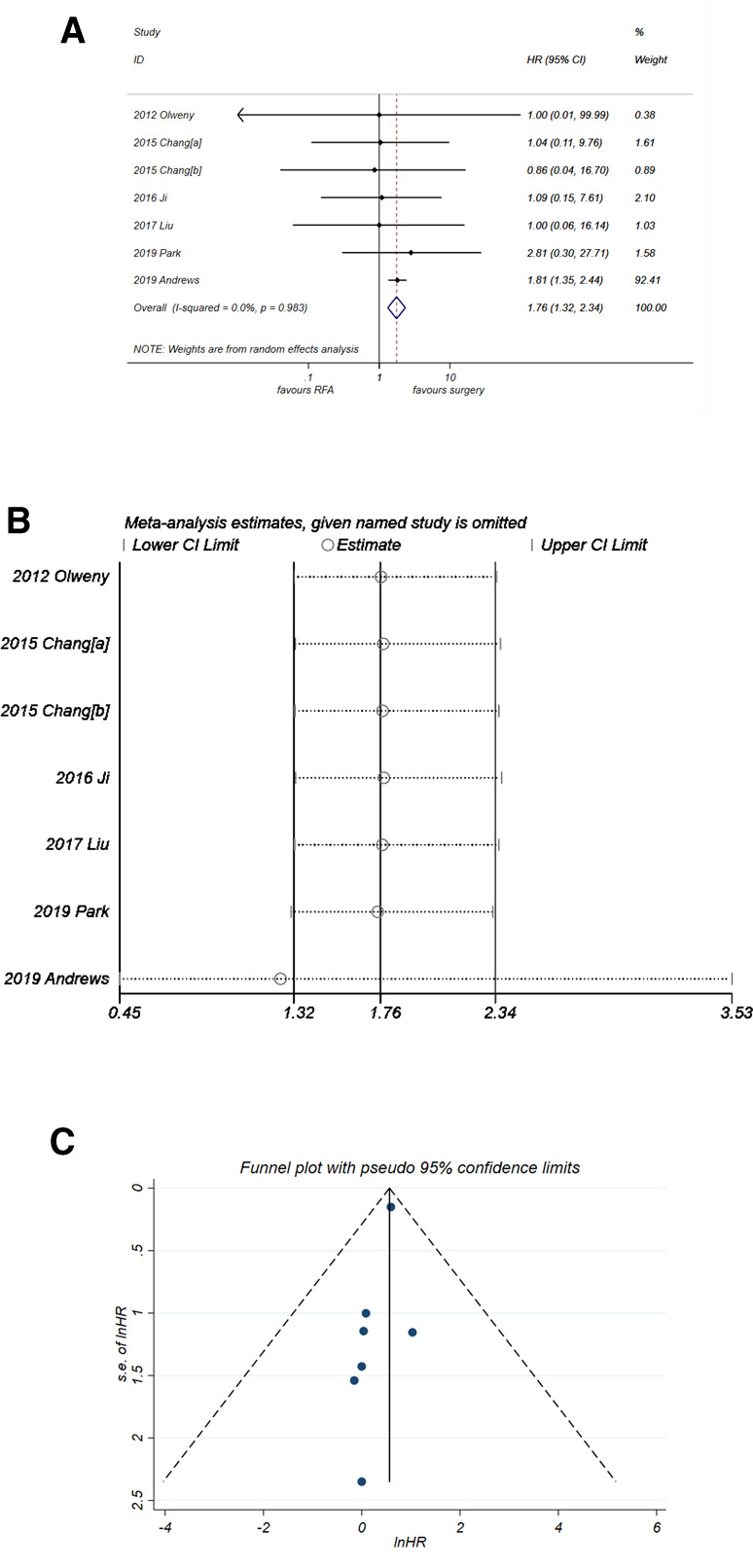
A total of seven studies with 1,635 patients were finally included. The treatment efficacy of RFA was not different with PN in terms of cancer recurrence (OR = 1.22, 95% CI, 0.45-3.28), PFS (HR = 1.26, 95% CI, 0.75-2.11), and CSS (HR = 1.27, 95% CI, 0.41-3.95) as well as major complications (OR = 1.31, 95% CI, 0.55-3.14) ( > 0.05 for all). RFA was a potential significant risk factor for OS (HR = 1.76, 95% CI, 1.32-2.34, < 0.001). No significant heterogeneity and publication bias were observed.
This is the first meta-analysis that focuses on the long-term oncological outcomes of cT1 renal cancer, and the results suggest that RFA has comparable therapeutic efficacy with PN. RFA is a nephron-sparing technique with favorable oncologic efficacy and safety and a good treatment alternative for cT1 renal cancer.
对于临床T1(cT1)期肾癌,部分肾切除术(PN)是最常用的保留肾单位治疗方法之一,而射频消融(RFA)通常用于手术条件较差的患者。RFA与PN治疗cT1期肾癌的长期肿瘤学结局仍未确定。本荟萃分析旨在比较RFA和PN治疗cT1期肾癌患者的疗效和安全性,并进行至少5年的长期随访。
本荟萃分析按照PRISMA报告指南进行。在2000年1月1日至2022年5月1日期间,检索了PubMed、Embase、Web of Science和Cochrane图书馆等数据库中有关RFA与PN治疗cT1期肾癌疗效或安全性比较的数据。仅纳入中位或平均随访时间至少5年的长期研究。汇总了以下效应指标:复发和主要并发症的比值比(OR);无进展生存期(PFS)、癌症特异性生存期(CSS)和总生存期(OS)的风险比(HR)。还进行了敏感性分析、亚组分析和发表偏倚分析等额外分析。
最终纳入7项研究,共1635例患者。在癌症复发(OR = 1.22,95%CI,0.45 - 3.28)、PFS(HR = 1.26,95%CI,0.75 - 2.11)、CSS(HR = 1.27,95%CI,0.41 - 3.95)以及主要并发症(OR = 1.31,95%CI,0.55 - 3.14)方面,RFA与PN的治疗效果无差异(均P > 0.05)。RFA是OS的潜在显著危险因素(HR = 1.76,95%CI,1.32 - 2.34,P < 0.001)。未观察到显著的异质性和发表偏倚。
这是第一项关注cT1期肾癌长期肿瘤学结局的荟萃分析,结果表明RFA与PN具有相当的治疗效果。RFA是一种保留肾单位的技术,具有良好的肿瘤学疗效和安全性,是cT1期肾癌的一种良好治疗选择。