Foris Vasile, Kovacs Gabor, Avian Alexander, Bálint Zoltán, Douschan Philipp, Ghanim Bahil, Klepetko Walter, Olschewski Andrea, Olschewski Horst
Division of Pulmonology, Department of Internal Medicine, Medical University of Graz, Graz, Austria.
Ludwig Boltzmann Institute for Lung Vascular Research, Graz, Austria.
Front Physiol. 2023 Jan 4;13:986295. doi: 10.3389/fphys.2022.986295. eCollection 2022.
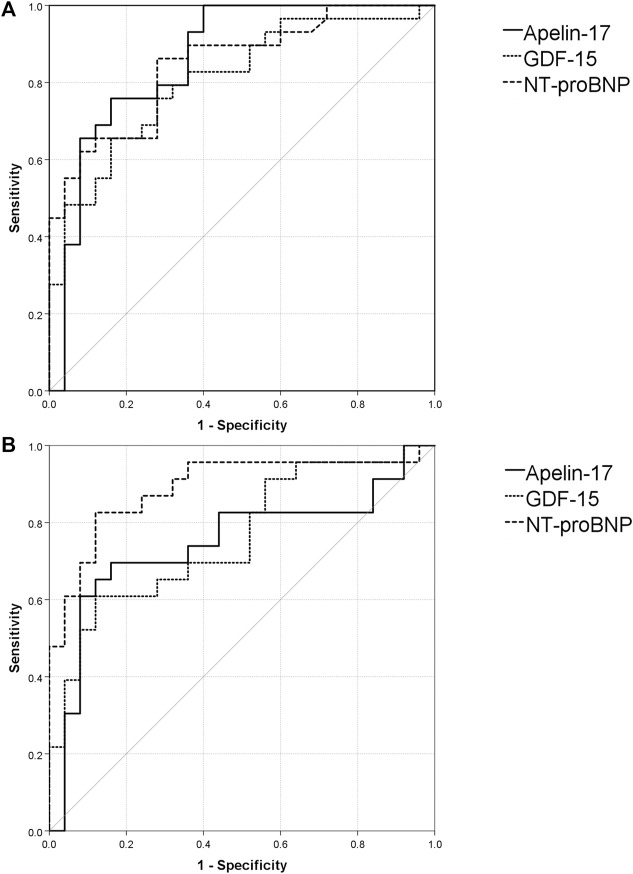
NT-proBNP and GDF-15 are established blood-derived biomarkers for risk assessment in pulmonary hypertension (PH), despite limited sensitivity and specificity. Apelin has a crucial function in endothelial homeostasis, thus it might represent a new biomarker for PH. However, there are numerous circulating apelin isoforms, and their potential role in this setting is unknown. This study evaluated different apelin isoforms in PH patients and prospectively evaluated the role of apelin-17 in comparison with NT-proBNP and GDF-15 as diagnostic marker in idiopathic pulmonary arterial hypertension (IPAH). Based on our pilot study, we performed a power calculation for apelin-13, apelin-17, apelin-36, as predictor of IPAH vs healthy controls. Apelin-17 provided the best discriminatory power, and accordingly, we enrolled n = 31 patients with IPAH and n = 31 matched healthy controls in a prospective study. NT-proBNP and GDF-15 was determined in all patients. ROC curve analysis was performed to assess the diagnostic value of the markers and their combinations. Apelin-17, NT-proBNP, and GDF-15 were significantly elevated in IPAH patients as compared to controls ( < .001). Apelin-17 detected IPAH with a sensitivity of 68% and a specificity of 93% at a cut-off value of >1,480 pg/ml (AUC 0.86, 95%CI:0.76-0.95) as compared to GDF-15 (sensitivity 86%; specificity 72%, AUC 0.81 (95%CI:0.7-0.92)) and NT-proBNP (sensitivity 86%; specificity 72% (AUC 0.85, 95%CI:0.75-0.95)). Combinations of these markers could be used to increase either specificity or sensitivity. Apelin-17 appears to be suitable blood derived diagnostic marker for idiopathic pulmonary arterial hypertension.
尽管N末端B型利钠肽原(NT-proBNP)和生长分化因子15(GDF-15)的敏感性和特异性有限,但它们是已确立的用于评估肺动脉高压(PH)风险的血液生物标志物。Apelin在内皮稳态中起关键作用,因此它可能是PH的一种新型生物标志物。然而,循环中有多种Apelin异构体,它们在这种情况下的潜在作用尚不清楚。本研究评估了PH患者中不同的Apelin异构体,并前瞻性地评估了Apelin-17与NT-proBNP和GDF-15相比作为特发性肺动脉高压(IPAH)诊断标志物的作用。基于我们的初步研究,我们对Apelin-13、Apelin-17、Apelin-36作为IPAH与健康对照的预测指标进行了功效计算。Apelin-17具有最佳的鉴别能力,因此,我们在一项前瞻性研究中纳入了31例IPAH患者和31例匹配的健康对照。测定了所有患者的NT-proBNP和GDF-15。进行ROC曲线分析以评估标志物及其组合的诊断价值。与对照组相比,IPAH患者的Apelin-17、NT-proBNP和GDF-15显著升高(P<0.001)。与GDF-15(敏感性86%;特异性72%,AUC 0.81(95%CI:0.7-0.92))和NT-proBNP(敏感性86%;特异性72%(AUC 0.85,95%CI:0.75-0.95))相比,Apelin-17在截断值>1480 pg/ml时检测IPAH的敏感性为68%,特异性为93%(AUC 0.86,95%CI:0.76-0.95)。这些标志物的组合可用于提高特异性或敏感性。Apelin-17似乎是特发性肺动脉高压合适的血液来源诊断标志物。