Brain and Mind Centre, The University of Sydney, Camperdown, New South Wales, Australia.
Brain and Mind Centre, The University of Sydney, Camperdown, New South Wales, Australia
BMJ Open. 2022 Sep 6;12(9):e056298. doi: 10.1136/bmjopen-2021-056298.
Sleep-wake and circadian disturbance is a key feature of mood disorders with a potential causal role and particular relevance to young people. Brexpiprazole is a second-generation antipsychotic medication with demonstrated efficacy as an adjunct to antidepressant treatment for major depressive disorder (MDD) in adults, with preliminary evidence suggesting greater effectiveness in subgroups of depressed patients with sleep disturbances. This clinical trial aims to evaluate the relationships between changes in sleep-wake and circadian parameters and changes in depressive symptoms following adjunctive brexpiprazole treatment in young adults with MDD and sleep-wake disturbance.
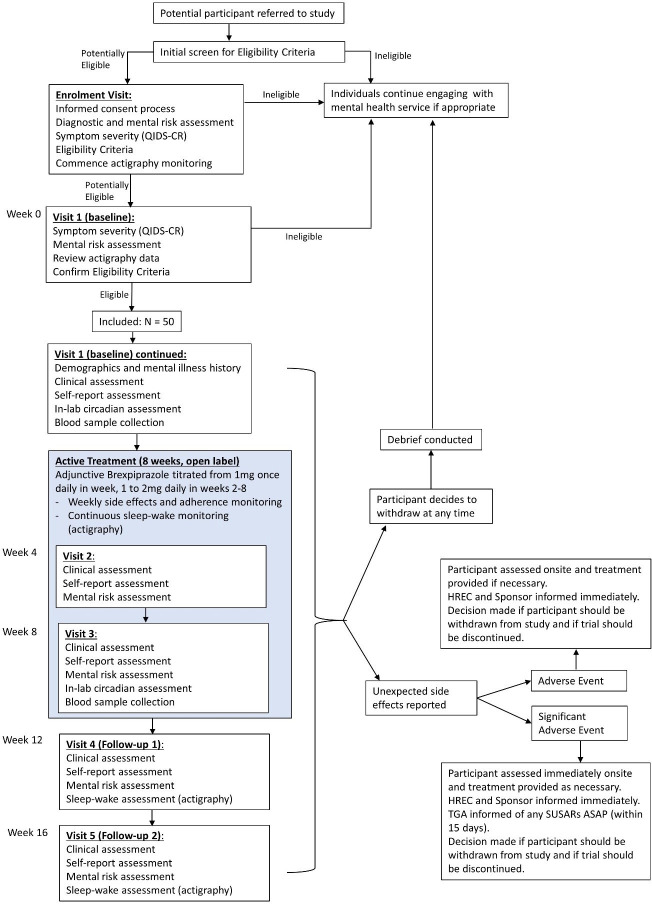
This study is designed as a 16 week (8 weeks active treatment, 8 weeks follow-up) mechanistic, open-label, single-arm, phase IV clinical trial and aims to recruit 50 young people aged 18-30 with MDD and sleep-wake cycle disturbance through an early intervention youth mental health clinic in Sydney, Australia. At baseline, participants will undergo multidimensional outcome assessment and subsequently receive 8 weeks of open-label treatment with brexpiprazole as adjunctive to their stable psychotropic medication. Following 4 weeks of treatment, clinical and self-report measures will be repeated. Ambulatory sleep-wake monitoring will be conducted continuously for the duration of treatment. After 8 weeks of treatment, all multidimensional outcome assessments will be repeated. Follow-up visits will be conducted 4 and 8 weeks after trial completion (including sleep-wake, clinical and self-report assessments). Circadian rhythm biomarkers including salivary melatonin, cortisol and core body temperature will be collected during an in-lab assessment. Additionally, metabolic, inflammatory and genetic risk markers will be collected at baseline and after 8 weeks of treatment.
This trial protocol has been approved by the Human Research Ethics Committee of the Sydney Local Health District (X19-0417 and 2019/ETH12986, Protocol Version 1-3, dated 25 February 2021). The results of this study, in deidentified form, will be disseminated through publication in peer-reviewed journals, scholarly book chapters, presentation at conferences and publication in conference proceedings.
ACTRN12619001456145.
睡眠-觉醒和昼夜节律紊乱是心境障碍的一个主要特征,具有潜在的因果关系,尤其与年轻人有关。布瑞哌唑是一种第二代抗精神病药物,已被证明在成人重度抑郁症(MDD)的抗抑郁治疗中作为辅助治疗有效,初步证据表明,在伴有睡眠障碍的抑郁患者亚组中更有效。这项临床试验旨在评估在年轻的 MDD 伴睡眠-觉醒障碍患者中,添加布瑞哌唑治疗后,睡眠-觉醒和昼夜节律参数的变化与抑郁症状变化之间的关系。
本研究设计为一项 16 周(8 周活性治疗,8 周随访)的机制、开放标签、单臂、四期临床试验,旨在通过澳大利亚悉尼的早期干预青年心理健康诊所招募 50 名年龄在 18-30 岁之间的 MDD 伴睡眠-觉醒周期紊乱的年轻人。在基线时,参与者将接受多维结果评估,随后接受 8 周的布瑞哌唑开放标签治疗,作为其稳定精神药物的辅助治疗。治疗 4 周后,将重复进行临床和自我报告测量。在治疗期间将连续进行动态睡眠-觉醒监测。治疗 8 周后,将重复所有多维结果评估。在试验结束后 4 周和 8 周时进行随访(包括睡眠-觉醒、临床和自我报告评估)。将在实验室评估期间收集昼夜节律生物标志物,包括唾液褪黑素、皮质醇和核心体温。此外,还将在基线和 8 周治疗后收集代谢、炎症和遗传风险标志物。
本试验方案已获得悉尼地方卫生区人体研究伦理委员会的批准(X19-0417 和 2019/ETH12986,协议版本 1-3,日期为 2021 年 2 月 25 日)。本研究的结果将以匿名形式发表在同行评议期刊、学术书籍章节、会议演讲和会议论文集上,以进行传播。
ACTRN12619001456145。