
喀麦隆西南部昆巴地区孕妇中HIV感染对疟疾免疫反应的影响:一项横断面研究方案
The Effects of HIV Infection on the Immune Response to Malaria Among Pregnant Women in Kumba, Southwest Cameroon: Protocol for a Cross-sectional Study.
作者信息
Obase Bekindaka Ngemani, Francis Zeukeng, Forgu Esemu Livo, Honore Awanakam, Bigoga Jude Daiga, Nsagha Dickson S
机构信息
Pan African University of Life and Earth Science Institute (Including Health and Agriculture), University of Ibadan, Ibadan, Nigeria.
College of Medicine, University of Ibadan Teaching Hospital, Ibadan, Nigeria.
出版信息
JMIR Res Protoc. 2023 Jan 24;12:e38213. doi: 10.2196/38213.
BACKGROUND
Malaria and HIV, 2 of the world's deadliest diseases, share a lot of territory in sub-Saharan Africa.
OBJECTIVE
This study seeks to investigate the effect of HIV on the immune response to malaria infection among pregnant women in Kumba in the southwest region (SWR) of Cameroon. The study aims to determine the prevalence of malaria infection, assess the occurrence of Plasmodium falciparum genetic diversity, and evaluate the antibody (immunoglobulin [Ig]G and IgM: apical membrane antigen-1 [AMA1], merozoite surface protein [MSP]1, MSP2, MSP3, and erythrocyte-binding antigen [EBA]175) and cytokine (interleukin [IL]-10, tumor necrosis factor alpha [TNF-α], and interferon gamma [IFNγ]) response to malaria infection among pregnant women with and without HIV in Kumba.
METHODS
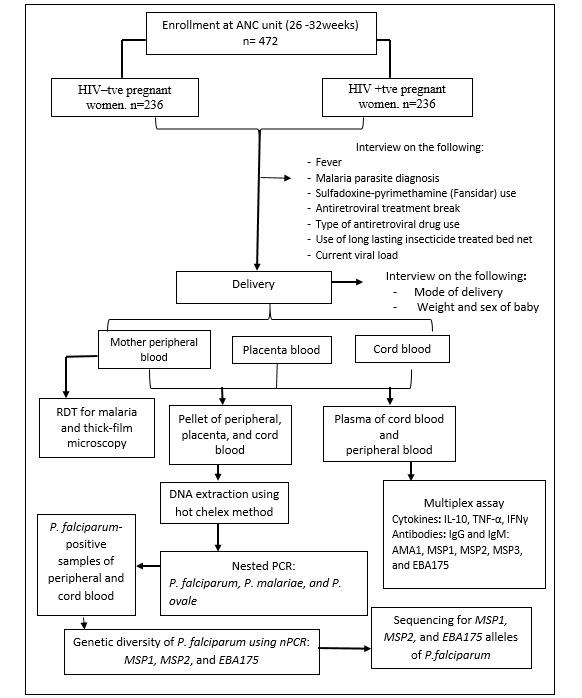
The study will be a hospital-based cross-sectional design that will run from March 2022 to February 2023. It will recruit pregnant women with and without HIV who are in their third trimester of pregnancy. The study will be carried out in 5 health institutions in Kumba: General Hospital Kumba, Presbyterian Hospital Kumba, District Hospital Kumba-town, Kossala Integrated Health Center Kumba, and Catholic Hospital Kumba. About 3 mL of the mother's venous blood, placental blood, and baby cord blood will be collected from each pregnant women at the point of delivery. Microscopy, rapid diagnostic tests (RDTs), and nested polymerase chain reaction (PCR) will be performed to identify the malaria parasite in all the samples, and nested PCR targeting the different genetic diversity markers for P. falciparum will also be performed. Furthermore, sequencing will be performed to study the nucleotide sequence of different alleles, and the genetic diversity of the alleles responsible for malaria infection among pregnant women will be assessed. A multiplex assay will be conducted to analyze the peripheral blood plasma and cord blood plasma for the cytokine and total antibody response to malaria infection among pregnant women with and without HIV. The questionnaire for data collection will be pretested at the Kumba District Hospital, and ethical clearance will be obtained from the University of Buea and the Regional Delegation of Public Health for the SWR. Data will be analyzed using SPSS Statistics and STATA. All P values <.05 will be considered statistically significant. BioEdit 7.0.0 software will be used to align the nucleotide sequences of different genes after sequencing. Phylogenetic tree searching will be conducted using the maximum-likelihood (ML) method in MEGA V6.0.
RESULTS
The project started in March 2022 and will end in February 2023. Presently, three-fourth of the project funding has been disbursed to date. A total of 218 participants have been enrolled: 193 (88.5%) women without HIV and 25 (11.5%) women with HIV. Between February 2023 and March 2024, the following results will be ready for publication: maternal-neonatal malaria prevalence among pregnant women and babies in Kumba, the effect of HIV on (1) P. falciparum genetic diversity among pregnant women in Kumba, (2) the maternal and neonatal immune response to MSP1, MSP2, and EBA175 IgG antibody response to P. falciparum-caused malaria infection among pregnant women, and (3) the maternal and neonatal pro-inflammatory and anti-inflammatory cytokine response to malaria infection.
CONCLUSIONS
HIV infection increases the prevalence of malaria infection among pregnant women and also influences the genetic diversity of P. falciparum, with MSP1 alleles being the most prevalent. HIV infection also reduces the antibody response to malaria infection, as well as altering the level of pro-inflammatory and anti-inflammatory responses to malaria infection.
INTERNATIONAL REGISTERED REPORT IDENTIFIER (IRRID): DERR1-10.2196/38213.
背景
疟疾和艾滋病是世界上最致命的两种疾病,在撒哈拉以南非洲地区广泛共存。
目的
本研究旨在调查喀麦隆西南部地区昆巴市孕妇中,艾滋病病毒(HIV)对疟疾感染免疫反应的影响。该研究旨在确定疟疾感染的患病率,评估恶性疟原虫基因多样性的发生情况,并评估有和没有感染HIV的昆巴市孕妇对疟疾感染的抗体(免疫球蛋白[Ig]G和IgM:顶端膜抗原-1[AMA1]、裂殖子表面蛋白[MSP]1、MSP2、MSP3和红细胞结合抗原[EBA]175)和细胞因子(白细胞介素[IL]-10、肿瘤坏死因子α[TNF-α]和干扰素γ[IFNγ])反应。
方法
该研究将采用基于医院的横断面设计,从2022年3月持续至2023年2月。它将招募处于妊娠晚期、有和没有感染HIV的孕妇。研究将在昆巴市的5家医疗机构进行:昆巴市综合医院、昆巴市长老会医院、昆巴镇地区医院、昆巴市科索拉综合健康中心和昆巴市天主教医院。在分娩时,将从每位孕妇采集约3 mL母亲静脉血、胎盘血和婴儿脐带血。将进行显微镜检查、快速诊断检测(RDT)和巢式聚合酶链反应(PCR),以鉴定所有样本中的疟原虫,还将进行针对恶性疟原虫不同基因多样性标记的巢式PCR。此外,将进行测序以研究不同等位基因的核苷酸序列,并评估孕妇中导致疟疾感染的等位基因的遗传多样性。将进行多重检测,以分析外周血浆和脐带血浆中,有和没有感染HIV的孕妇对疟疾感染的细胞因子和总抗体反应。数据收集问卷将在昆巴地区医院进行预测试,并将获得布埃亚大学和西南地区公共卫生区域代表团的伦理批准。数据将使用SPSS Statistics和STATA进行分析。所有P值<.05将被视为具有统计学意义。测序后,将使用BioEdit 7.0.0软件对不同基因的核苷酸序列进行比对。将使用MEGA V6.0中的最大似然(ML)方法进行系统发育树搜索。
结果
该项目于2022年3月启动,将于2023年2月结束。目前,该项目资金的四分之三已拨付到位。总共招募了218名参与者:193名(88.5%)未感染HIV的女性和25名(11.5%)感染HIV的女性。在2023年2月至2024年3月期间,以下结果将准备好发表:昆巴市孕妇和婴儿中的母婴疟疾患病率、HIV对(1)昆巴市孕妇中恶性疟原虫基因多样性的影响、(2)孕妇对MSP1、MSP2和EBA175 IgG抗体对恶性疟原虫引起的疟疾感染的母婴免疫反应,以及(3)母婴对疟疾感染的促炎和抗炎细胞因子反应。
结论
HIV感染增加了孕妇疟疾感染的患病率,也影响了恶性疟原虫的基因多样性,其中MSP1等位基因最为普遍。HIV感染还会降低对疟疾感染的抗体反应,并改变对疟疾感染的促炎和抗炎反应水平。
国际注册报告识别码(IRRID):DERR1-10.2196/38213。
 Zotero 插件