Department of Tropical Medicine, Medical Microbiology and Pharmacology, John A. Burns School of Medicine, University of Hawaii at Manoa, Honolulu, HI, USA.
Biotechnology Center, University of Yaoundé I, Yaoundé, Cameroon.
Malar J. 2019 Mar 12;18(1):73. doi: 10.1186/s12936-019-2711-4.
Accurate diagnosis of malaria is important for effective disease management and control. In Cameroon, presumptive clinical diagnosis, thick-film microscopy (TFM), and rapid diagnostic tests (RDT) are commonly used to diagnose cases of Plasmodium falciparum malaria. However, these methods lack sensitivity to detect low parasitaemia. Polymerase chain reaction (PCR), on the other hand, enhances the detection of sub-microscopic parasitaemia making it a much-needed tool for epidemiological surveys, mass screening, and the assessment of interventions for malaria elimination. Therefore, this study sought to determine the frequency of cases missed by traditional methods that are detected by PCR.
Blood samples, collected from 551 febrile Cameroonian patients between February 2014 and February 2015, were tested for P. falciparum by microscopy, RDT and PCR. The hospital records of participants were reviewed to obtain data on the clinical diagnosis made by the health care worker.
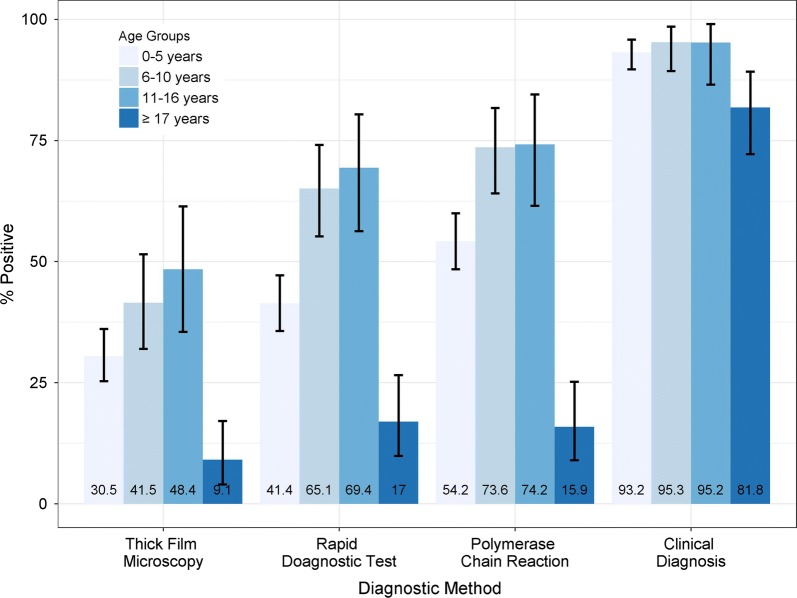
The prevalence of malaria by microscopy, RDT and PCR was 31%, 45%, and 54%, respectively. However, of the 92% of participants diagnosed as having clinical cases of malaria by the health care worker, 38% were malaria-negative by PCR. PCR detected 23% and 12% more malaria infections than microscopy and RDT, respectively. A total of 128 (23%) individuals had sub-microscopic infections in the study population. The sensitivity of microscopy, RDT, and clinical diagnosis was 57%, 78% and 100%; the specificity was 99%, 94%, and 17%; the positive predictive values were 99%, 94%, and 59%; the negative predictive values were 66%, 78%, and 100%, respectively. Thus, 41% of the participants clinically diagnosed as having malaria had fever caused by other pathogens.
Malaria diagnostic methods, such as TFM and RDT missed 12-23% of malaria cases detected by PCR. Therefore, traditional diagnostic approaches (TFM, RDT and clinical diagnosis) are not adequate when accurate epidemiological data are needed for monitoring malaria control and elimination interventions.
准确诊断疟疾对于有效管理和控制疾病至关重要。在喀麦隆,临床疑似诊断、厚血膜显微镜检查(TFM)和快速诊断检测(RDT)常用于诊断恶性疟原虫疟疾病例。然而,这些方法对检测低寄生虫血症缺乏敏感性。聚合酶链反应(PCR)增强了对亚微观寄生虫血症的检测,使其成为流行病学调查、大规模筛查和评估消除疟疾干预措施的急需工具。因此,本研究旨在确定 PCR 检测到的传统方法漏诊的病例频率。
从 2014 年 2 月至 2015 年 2 月期间采集的 551 例发热喀麦隆患者的血液样本,通过显微镜、RDT 和 PCR 检测恶性疟原虫。回顾参与者的医院记录,以获取卫生保健工作者做出的临床诊断数据。
显微镜、RDT 和 PCR 检测的疟疾患病率分别为 31%、45%和 54%。然而,92%的参与者被卫生保健工作者诊断为患有临床疟疾病例,其中 38%的人 PCR 检测为疟疾阴性。PCR 检测到的疟疾感染比显微镜和 RDT 分别多 23%和 12%。在研究人群中,共有 128 人(23%)存在亚微观感染。显微镜、RDT 和临床诊断的敏感性分别为 57%、78%和 100%;特异性分别为 99%、94%和 17%;阳性预测值分别为 99%、94%和 59%;阴性预测值分别为 66%、78%和 100%。因此,41%的临床诊断为疟疾的参与者发热是由其他病原体引起的。
TFM 和 RDT 等疟疾诊断方法漏诊了 12-23%由 PCR 检测到的疟疾病例。因此,当需要准确的流行病学数据来监测疟疾控制和消除干预措施时,传统的诊断方法(TFM、RDT 和临床诊断)并不充分。