
COVID-19 大流行对 NMOSD 和 MOGA 相关疾病患者的影响:COPANMO(G)-研究。
Effects of the COVID-19 Pandemic on Patients With NMO Spectrum Disorders and MOG-Antibody-Associated Diseases: COPANMO(G)-Study.
机构信息
From the Department of Neurology (M.W.H., F.B., D.T., S.G., C.T.), Hannover Medical School, Germany; Department of Neurology (I.A., T.P., K.H., I.K.), St. Josef Hospital, Ruhr University Bochum, Germany; Department of Neurology (L.K.), University of Münster, Germany; Department of Neurology and Institute of Neuroimmunology and MS (INIMS) (V.H., J.-P.S.), University Medical Center Hamburg-Eppendorf, Germany; Aix-Marseille Univ (J.-P.S.), CNRS, CRMBM, UMR 7339, Marseille Cedex, France; APHM (J.-P.S.), Hopital de La Timone, CEMEREM, Marseille, France; Department of Neurology (C.W., Y.G.), Faculty of Medicine and University Hospital Cologne, University of Cologne, Germany; Department of Neurology (T.E.), Kliniken Südostbayern-Klinikum Traunstein, Germany; Department of Neurology (F.L.), University Medical Center of the Johannes Gutenberg University Mainz, Germany; Hannover Medical School (P.B.), Department of Diagnostic and Interventional Neuroradiology, Germany; Department of Neurology (A.-S.L.), German Diagnostic Clinic, DKD Helios Clinic Wiesbaden, Germany; Marianne-Strauß-Klinik (I.K.), Behandlungszentrum Kempfenhausen für Multiple Sklerose Kranke, Berg, Germany; Department of Neurology (P.S.R.), Medical University of Vienna, Austria; Experimental and Clinical Research Center (F.P., J.B.-S., A.D.), a Cooperation Between the Max Delbrück Center for Molecular Medicine in the Helmholtz Association and Charité Universitätsmedizin Berlin, Germany; Department of Neurology (F.P., J.B.-S., A.D.), Charité-Universitätsmedizin Berlin, Corporate Member of Freie Universität Berlin and Humboldt-Universität zu Berlin, Experimental and Clinical Research Center, Germany; Max Delbrück Center for Molecular Medicine in the Helmholtz Association (MDC) (F.P., J.B.-S., A.D.), Berlin, Germany; Department of Neurology (F.T.B.), University of Leipzig, Germany; Department of Neurology (R.P.), University of Essen, Germany; Department of Neurology (A.W.), Herford Hospital, Germany; Institute of Clinical Neuroimmunology (H.P., T.K.), LMU Hospital, Ludwig-Maximilians Universität München, Germany; Department of Neurology (M.P., M.K.), Alfried-Krupp-Krankenhaus Essen, Germany; Department of Neurology (M.K., P.A., O.A., M.R.), Medical Faculty, Heinrich Heine University Düsseldorf, Germany; Department of Neurology (M.R.), Center for Neurology and Neuropsychiatry, LVR-Klinikum, Heinrich Heine University Düsseldorf, Germany; Department of Neurology (M.S.), University of Ulm, Germany; Department of Neurology (K.G., A.B.), School of Medicine, Technical University Munich, Klinikum Rechts der Isar, Germany; and Molecular Neuroimmunology Group (S.J., B.W.), Department of Neurology, University of Heidelberg, Germany.
出版信息
Neurol Neuroimmunol Neuroinflamm. 2023 Jan 24;10(2). doi: 10.1212/NXI.0000000000200082. Print 2023 Mar.
BACKGROUND AND OBJECTIVES
To evaluate the effects of the coronavirus disease 2019 (COVID-19) pandemic on the life of patients with neuromyelitis optica spectrum disorders (NMOSD) and myelin oligodendrocyte glycoprotein antibody-associated diseases (MOGAD).
METHODS
This multicenter, cross-sectional study included data of 187 patients recruited from 19 different German and Austrian Neuromyelitis Optica Study Group (NEMOS) centers between July 2021 and March 2022. The effects of the pandemic on immunotherapeutic treatment and access to care, the possible severe acute respiratory syndrome coronavirus 2 (SARS-CoV-2) infection, and the potential effect of vaccination against SARS-CoV-2 on disease incidence and relapse risk were assessed using a patient questionnaire. Health-related quality of life (HRQoL) was measured with the EuroQoL Group 5-Dimension 5-Level Scale (EQ-5D-5L). Demographic and clinical characteristics were retrieved from the NEMOS database.
RESULTS
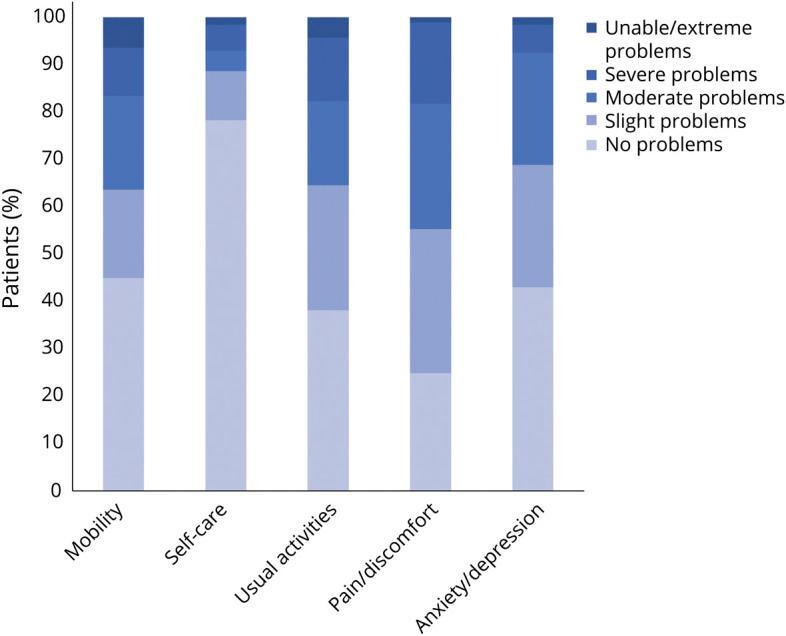
One hundred eighty-seven patients (75% women; median age 47 [range 21-86] years; median disease duration 5.5 [range 0-67] years; median Expanded Disability Status Scale 2.0 [range 0-8.0]; 51% aquaporin-4 immunoglobulin G (AQP4-IgG)-positive, 36% myelin oligodendrocyte glycoprotein (MOG)-IgG-positive 13% double-seronegative) were analyzed. Most patients maintained excellent access to healthcare services throughout the pandemic. Immunotherapy was not changed in 88% of patients. Ninety-one percent of all patients were satisfied with medical care during the pandemic. Nearly two-thirds (64%) of patients rated their risk of infection with SARS-CoV-2 as low or moderate. Among this study sample, 23 patients (12%) knowingly acquired an infection with SARS-CoV-2 and predominantly had a nonsevere course of illness (n = 22/23, 96%). The SARS-CoV-2 vaccination rate was 89%, with 4 cases of confirmed attack or first manifestation of NMOSD/MOGAD occurring in temporal association with the vaccination (range 2-9 days). The reported HRQoL did not decline compared with a prepandemic assessment (mean EQ-5D-5L index value 0.76, 95% bootstrap confidence interval [CI] 0.72-0.80; mean EQ-VAS 66.5, 95% bootstrap CI 63.5-69.3).
DISCUSSION
This study demonstrates that, overall, patients with NMOSD/MOGAD affiliated with specialized centers received ongoing medical care during the pandemic. Patients' satisfaction with medical care and HRQoL did not decrease.
背景与目的
评估 2019 年冠状病毒病(COVID-19)大流行对视神经脊髓炎谱系疾病(NMOSD)和髓鞘少突胶质细胞糖蛋白抗体相关疾病(MOGAD)患者生活的影响。
方法
这项多中心、横断面研究纳入了 2021 年 7 月至 2022 年 3 月期间,19 个不同的德国和奥地利视神经脊髓炎研究组(NEMOS)中心招募的 187 例患者的数据。采用患者问卷评估大流行对免疫治疗和获得护理的影响、可能的严重急性呼吸综合征冠状病毒 2(SARS-CoV-2)感染,以及 SARS-CoV-2 疫苗接种对疾病发病率和复发风险的潜在影响。采用 EuroQoL 集团 5 维度 5 级量表(EQ-5D-5L)评估健康相关生活质量(HRQoL)。从 NEMOS 数据库中检索人口统计学和临床特征。
结果
共分析了 187 例患者(75%为女性;中位年龄 47 岁[范围 21-86 岁];中位疾病持续时间 5.5 年[范围 0-67 年];中位扩展残疾状态量表 2.0 分[范围 0-8.0 分];51%水通道蛋白 4 免疫球蛋白 G(AQP4-IgG)阳性,36%髓鞘少突胶质细胞糖蛋白(MOG)-IgG 阳性,13%双阴性)。大多数患者在整个大流行期间都能很好地获得医疗服务。88%的患者免疫治疗未改变。91%的患者对大流行期间的医疗护理满意。近三分之二(64%)的患者认为自己感染 SARS-CoV-2 的风险低或中度。在本研究样本中,23 例患者(12%)有意感染了 SARS-CoV-2,主要为非重症病程(23/23,96%)。SARS-CoV-2 疫苗接种率为 89%,4 例 NMOSD/MOGAD 确诊或首次发病与疫苗接种有时间关联(接种后 2-9 天)。与大流行前评估相比,报告的 HRQoL 没有下降(平均 EQ-5D-5L 指数值为 0.76,95%置信区间[CI]为 0.72-0.80;平均 EQ-VAS 为 66.5,95%CI 为 63.5-69.3)。
讨论
本研究表明,总体而言,与专门中心相关的 NMOSD/MOGAD 患者在大流行期间仍接受持续的医疗护理。患者对医疗护理和 HRQoL 的满意度没有下降。
 Zotero 插件