Eshghali Masoud, Kannan Devika, Salmanzadeh-Meydani Navid, Esmaieeli Sikaroudi Amir Mohammad
Department of Systems and Industrial Engineering, University of Arizona, Tucson, AZ 85721 USA.
Centre for Sustainable Supply Chain Engineering, Department of Technology and Innovation, University of Southern Denmark, 5230 Odense M, Denmark.
Ann Oper Res. 2023 Jan 19:1-24. doi: 10.1007/s10479-023-05168-x.
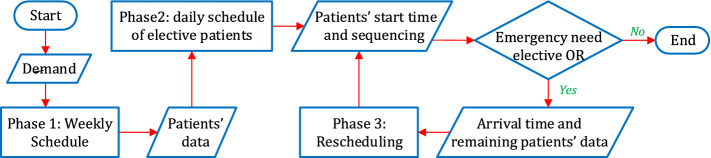
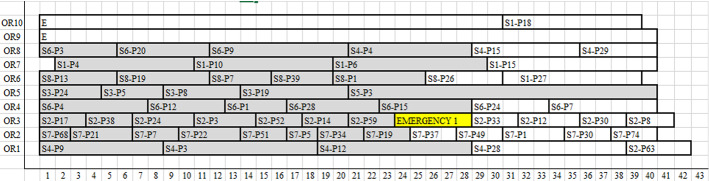
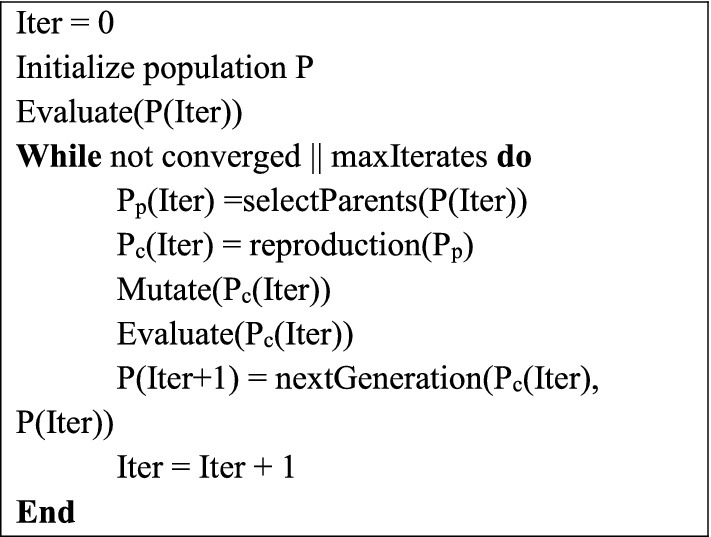
As the only largest source of revenue and cost in a hospital, the operation room (OR) scheduling problem is a hot research topic. Nonetheless, an integrated model is the missing key to managing and improving the efficiency of ORs. This paper presents a fully integrated model regarding three concepts: meditating elective patients and emergency patients together, considering ORs and downstream units, and proposing hierarchical weekly, daily, and rescheduling models. Due to the inherent randomness in emergency patient arrival, a random forest machine learning model and geographical information systems are used to obtain the emergency patient surgery duration and arrival time, respectively. According to the machine learning model in weekly and daily scheduling, initially, fixed capacity is reserved for emergency patients. When an emergency patient arrives, the surgery starts if a reserved OR is available. Otherwise, the first available OR will be dedicated to the patient due to an emergency patient's higher priority than an elective patient. In this case, it is needed to reschedule the OT schedule for the remaining patient. Moreover, the three-phase model guarantees that an emergency patient assigns to an OR within a specific time limit. To solve the models, genetic algorithm and particle swarm optimization are developed and compared. In addition, a real-world case study is undertaken at a hospital. The results of comparing the proposed approach to the hospital's current scheduling show that the three-phase model had a considerable positive effect on the ORs schedule.
作为医院唯一最大的收入和成本来源,手术室排班问题是一个热门研究课题。然而,一个集成模型是管理和提高手术室效率的关键缺失环节。本文提出了一个完全集成的模型,涉及三个概念:将择期患者和急诊患者一起考虑,兼顾手术室和下游科室,并提出分层的周、日和重新排班模型。由于急诊患者到达具有内在随机性,分别使用随机森林机器学习模型和地理信息系统来获取急诊患者的手术时长和到达时间。根据周排班和日排班上的机器学习模型,首先,为急诊患者预留固定容量。当急诊患者到达时,如果有预留的手术室可用,则开始手术。否则,由于急诊患者优先级高于择期患者,第一个可用的手术室将分配给该患者。在这种情况下,需要重新安排其余患者的手术时间表。此外,三相模型保证急诊患者在特定时间限制内分配到手术室。为求解这些模型,开发并比较了遗传算法和粒子群优化算法。此外,在一家医院进行了实际案例研究。将所提方法与医院当前排班进行比较的结果表明,三相模型对手术室排班有相当大的积极影响。