Department of Electrical Engineering, Pontificia Universidad Católica de Chile, Santiago, Chile.
Biomedical Imaging Center, Pontificia Universidad Católica de Chile, Santiago, Chile.
Magn Reson Med. 2023 Jun;89(6):2402-2418. doi: 10.1002/mrm.29597. Epub 2023 Jan 25.
QSM outside the brain has recently gained interest, particularly in the abdominal region. However, the absence of reliable ground truths makes difficult to assess reconstruction algorithms, whose quality is already compromised by additional signal contributions from fat, gases, and different kinds of motion. This work presents a realistic in silico phantom for the development, evaluation and comparison of abdominal QSM reconstruction algorithms.
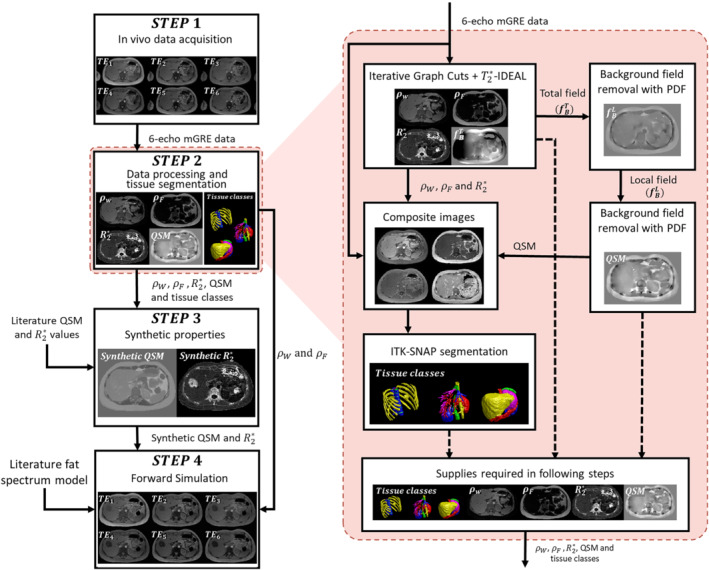
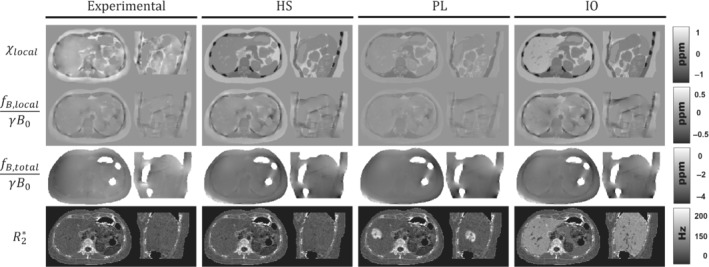
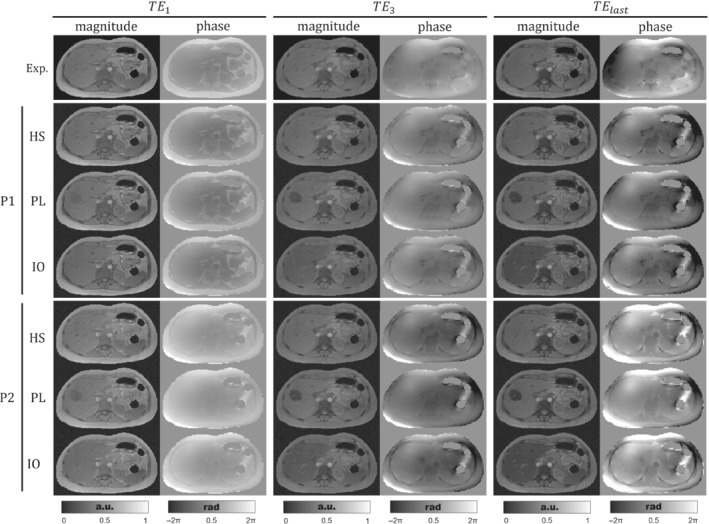
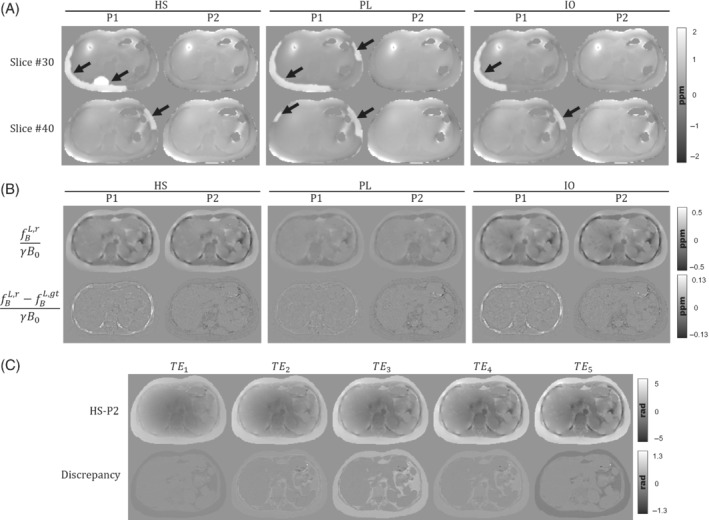
Synthetic susceptibility and maps were generated by segmenting and postprocessing the abdominal 3T MRI data from a healthy volunteer. Susceptibility and values in different tissues/organs were assigned according to literature and experimental values and were also provided with realistic textures. The signal was simulated using as input the synthetic QSM and maps and fat contributions. Three susceptibility scenarios and two acquisition protocols were simulated to compare different reconstruction algorithms.
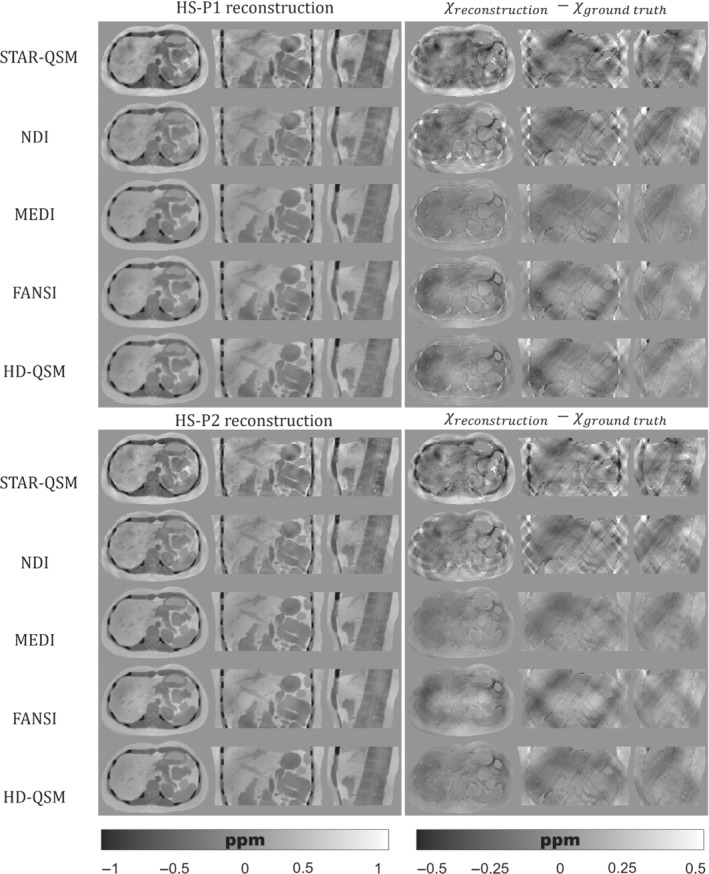
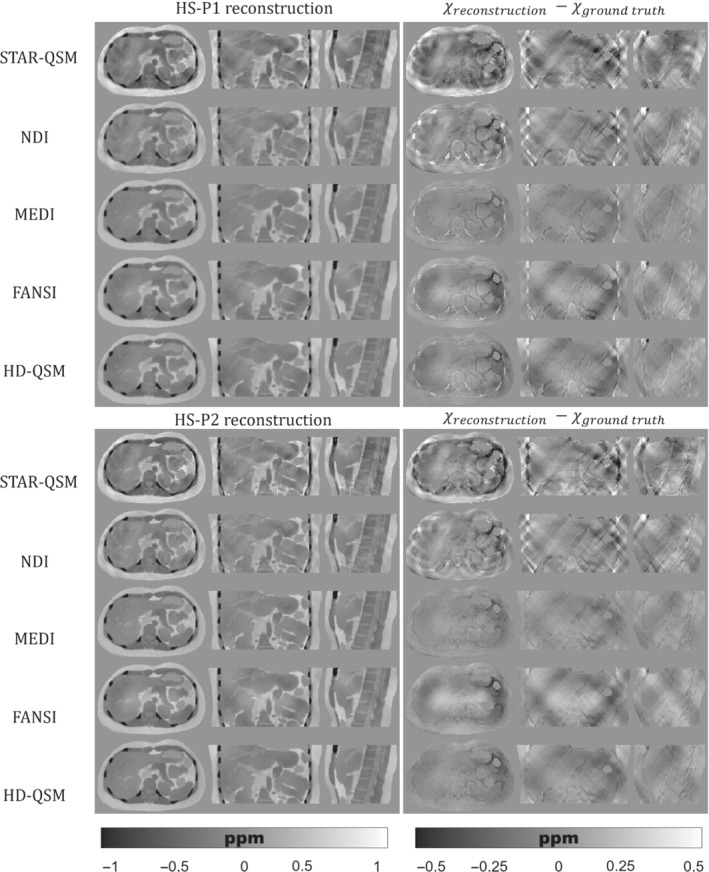
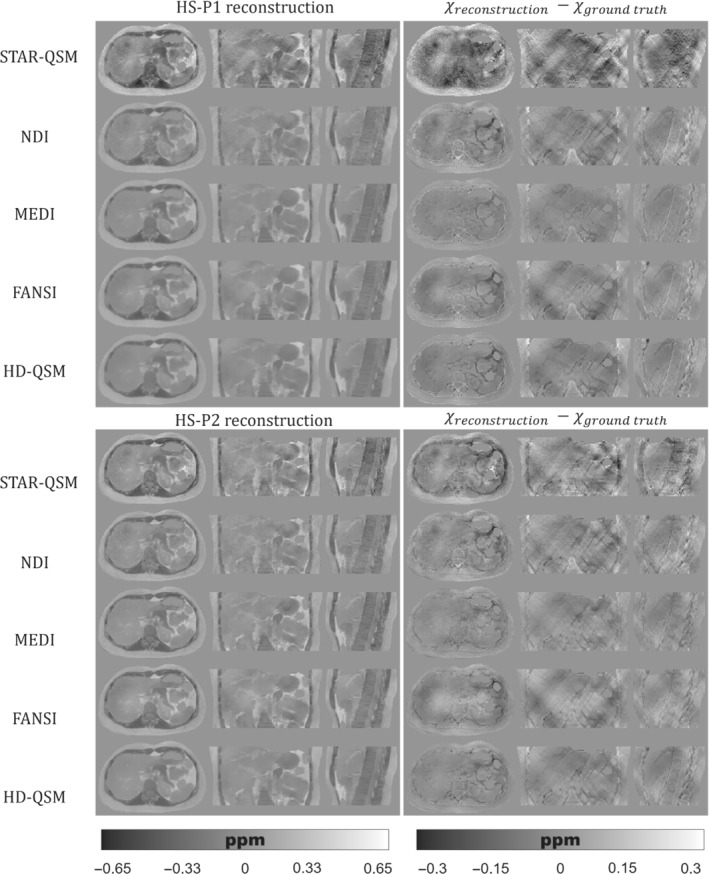
QSM reconstructions show that the phantom allows to identify the main strengths and limitations of the acquisition approaches and reconstruction algorithms, such as in-phase acquisitions, water-fat separation methods, and QSM dipole inversion algorithms.
The phantom showed its potential as a ground truth to evaluate and compare reconstruction pipelines and algorithms. The publicly available source code, designed in a modular framework, allows users to easily modify the susceptibility, and TEs, and thus creates different abdominal scenarios.
脑外 QSM 最近引起了人们的兴趣,特别是在腹部区域。然而,由于缺乏可靠的真实数据,评估重建算法变得困难,这些算法的质量已经受到来自脂肪、气体和不同类型运动的额外信号贡献的影响。本研究提出了一种用于开发、评估和比较腹部 QSM 重建算法的真实仿体。
通过对一名健康志愿者的腹部 3T MRI 数据进行分割和后处理,生成了合成的磁化率和图。根据文献和实验值,为不同的组织/器官分配了磁化率和值,并为其提供了真实的纹理。使用合成 QSM 和图以及脂肪贡献作为输入来模拟信号。模拟了三种磁化率情况和两种采集方案,以比较不同的重建算法。
QSM 重建结果表明,该仿体可以识别采集方法和重建算法的主要优缺点,例如同相采集、水脂分离方法和 QSM 偶极子反演算法。
该仿体显示出作为评估和比较重建管道和算法的真实数据的潜力。公开的源代码采用模块化框架设计,允许用户轻松修改磁化率、弛豫时间和 TEs,从而创建不同的腹部场景。