Li Hongyan, Kucharavy Herman C, Hajj Carla, Zhao Liyang, Hua Guoqiang, Glass Ryan, Paty Phillip B, Fuks Zvi, Kolesnick Richard, Hubbard Karen, Haimovitz-Friedman Adriana
Department of Radiation Oncology, Memorial Sloan Kettering Cancer Center, New York, NY, USA.
Department of Biology, The City College of New York, New York, NY, 10031, USA.
Cell Death Discov. 2023 Jan 25;9(1):31. doi: 10.1038/s41420-023-01298-0.
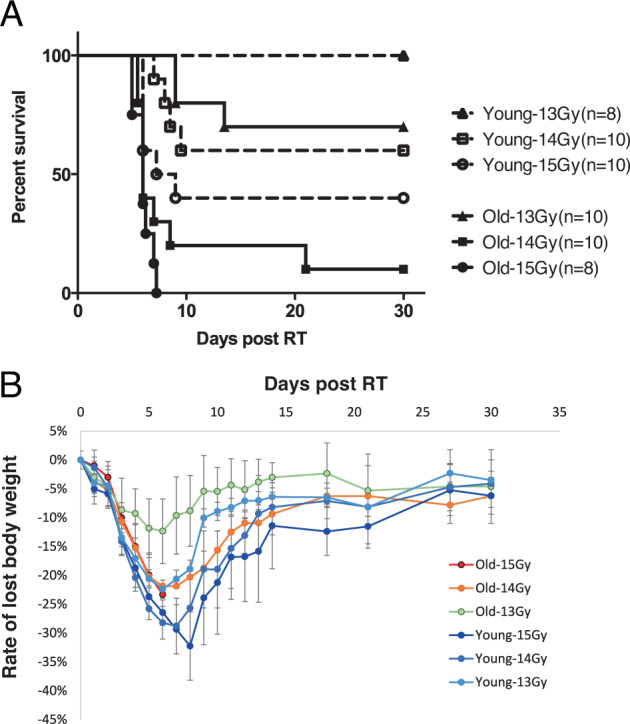
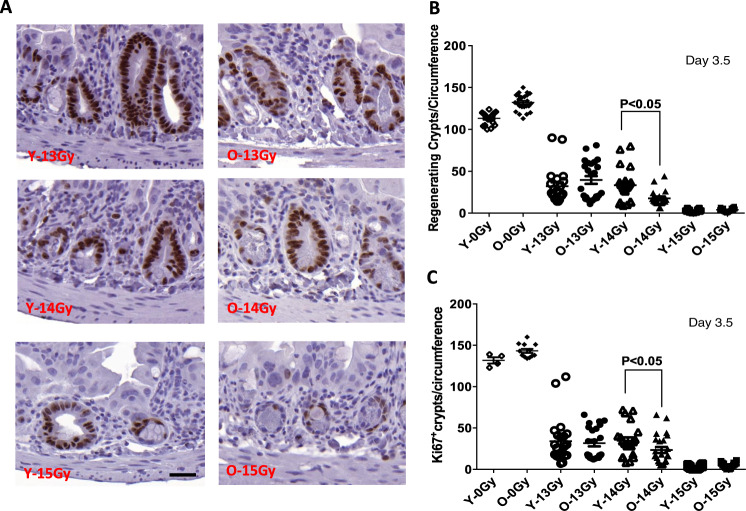
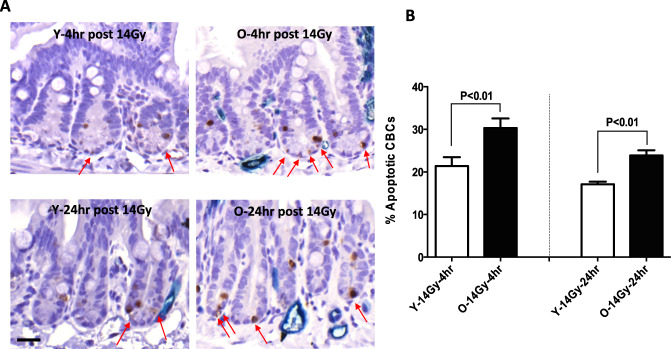
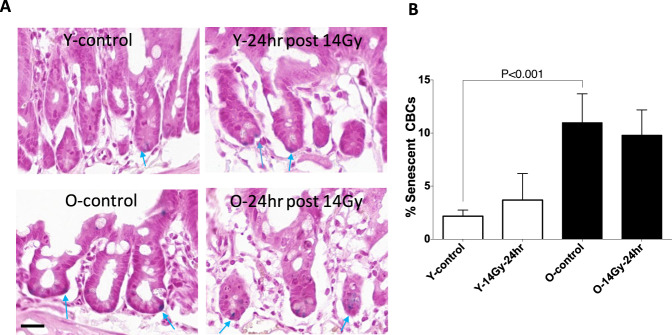
Previous studies show increased sensitivity of older mice (28-29 months) compared with young adult mice (3 months, possessing a mature immune system) to radiation-induced GI lethality. Age-dependent lethality was associated with higher levels of apoptotic stem cells in small intestinal crypts that correlated with sphingomyelinase activity, a source of pro-apoptotic ceramide. The objective of this study is to determine whether the cycling crypt base columnar cells (CBCs) in aging animals are specifically more sensitive to radiation effects than the CBCs in young adult mice, and to identify factors that contribute to increased radiosensitivity. Mortality induced by subtotal body radiation was assessed at different doses (13 Gy, 14 Gy, and 15 Gy) in young adult mice versus older mice. Each dose was evaluated for the occurrence of lethal GI syndrome. A higher death rate due to radiation-induced GI syndrome was observed in older mice as compared with young adult mice: 30 vs. 0% at 13 Gy, 90 vs. 40% at 14 Gy, and 100 vs. 60% at 15 Gy. Radiation-induced damage to crypts was determined by measuring crypt regeneration (H&E staining, Ki67 expression), CBC biomarkers (lgr5 and ascl2), premature senescence (SA-β-gal activity), and apoptosis of CBCs. At all three doses, crypt microcolony survival assays showed that the older mice had fewer regenerating crypts at 3.5 days post-radiation treatment. Furthermore, in the older animals, baseline CBCs numbers per circumference were significantly decreased, correlating with an elevated apoptotic index. Analysis of tissue damage showed an increased number of senescent CBCs per crypt circumference in older mice relative to younger mice, where the latter was not significantly affected by radiation treatment. It is concluded that enhanced sensitivity to radiation-induced GI syndrome and higher mortality in older mice can be attributed to a decreased capacity to regenerate crypts, presumably due to increased apoptosis and senescence of CBCs.
先前的研究表明,与年轻成年小鼠(3个月,拥有成熟的免疫系统)相比,老年小鼠(28 - 29个月)对辐射诱导的胃肠道致死性更敏感。年龄依赖性致死率与小肠隐窝中凋亡干细胞水平较高有关,这与鞘磷脂酶活性相关,鞘磷脂酶是促凋亡神经酰胺的来源。本研究的目的是确定衰老动物中循环的隐窝基底柱状细胞(CBCs)是否比年轻成年小鼠中的CBCs对辐射效应更敏感,并确定导致放射敏感性增加的因素。在年轻成年小鼠和老年小鼠中,以不同剂量(13 Gy、14 Gy和15 Gy)评估全身局部照射诱导的死亡率。评估每个剂量下致死性胃肠道综合征的发生情况。与年轻成年小鼠相比,老年小鼠因辐射诱导的胃肠道综合征导致的死亡率更高:13 Gy时分别为30%和0%,14 Gy时为90%和40%,15 Gy时为100%和60%。通过测量隐窝再生(苏木精和伊红染色、Ki67表达)、CBC生物标志物(lgr5和ascl2)、早衰(SA-β-半乳糖苷酶活性)以及CBCs的凋亡来确定辐射对隐窝的损伤。在所有三个剂量下,隐窝微集落存活试验表明,辐射治疗后3.5天,老年小鼠再生的隐窝较少。此外,在老年动物中,每个周长的基线CBCs数量显著减少,与凋亡指数升高相关。组织损伤分析表明,相对于年轻小鼠,老年小鼠每个隐窝周长的衰老CBCs数量增加,而年轻小鼠未受到辐射治疗的显著影响。结论是,老年小鼠对辐射诱导的胃肠道综合征敏感性增强和死亡率更高可归因于隐窝再生能力下降,可能是由于CBCs的凋亡和衰老增加所致。