Department of Paediatrics, Faculty of Medicine Siriraj Hospital, Mahidol University, Bangkok, 10700, Thailand.
Department of Paediatrics, Samutprakan Hospital, Samutprakan, 10270, Thailand.
Sci Rep. 2023 Jan 25;13(1):1376. doi: 10.1038/s41598-023-28405-6.
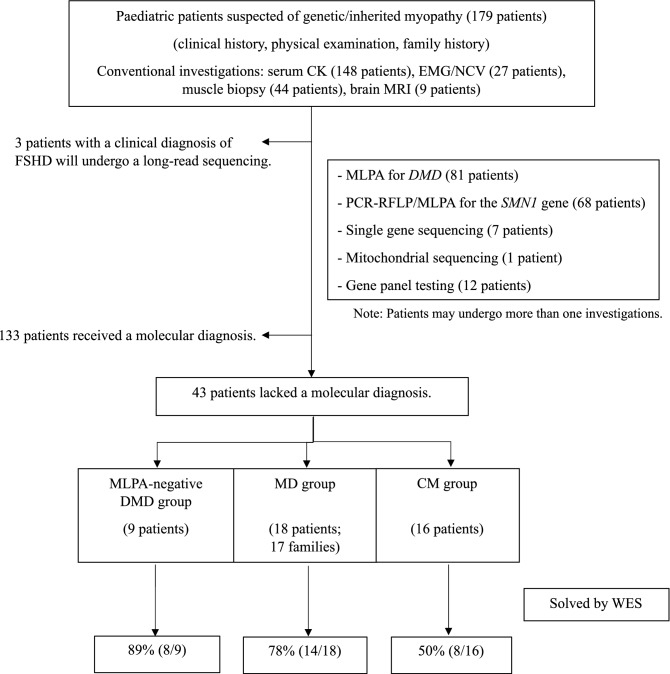
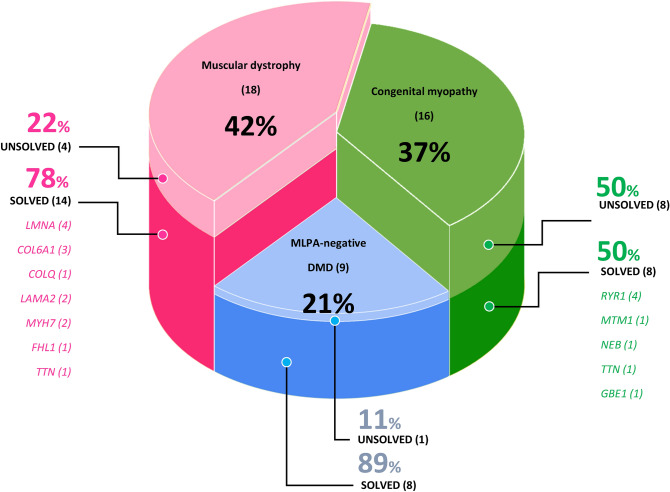
Muscular dystrophies and congenital myopathies are heterogeneous groups of inherited muscular disorders. An accurate diagnosis is challenging due to their complex clinical presentations and genetic heterogeneity. This study aimed to determine the utilisation of exome sequencing (ES) for Thai paediatric patients with muscular disorders. Of 176 paediatric patients suspected of genetic/inherited myopathies, 133 patients received a molecular diagnosis after performing conventional investigations, single gene testing, and gene panels. The remaining 43 patients from 42 families could be classified into three groups: Group 1, MLPA-negative Duchenne muscular dystrophy (DMD) with 9 patients (9/43; 21%), Group 2, other muscular dystrophies (MD) with 18 patients (18/43; 42%) and Group 3, congenital myopathies (CM) with 16 patients (16/43; 37%). All underwent exome sequencing which could identify pathogenic variants in 8/9 (89%), 14/18 (78%), and 8/16 (50%), for each Group, respectively. Overall, the diagnostic yield of ES was 70% (30/43) and 36 pathogenic/likely pathogenic variants in 14 genes were identified. 18 variants have never been previously reported. Molecular diagnoses provided by ES changed management in 22/30 (73%) of the patients. Our study demonstrates the clinical utility and implications of ES in inherited myopathies.
肌肉萎缩症和先天性肌病是一组异质性遗传性肌肉疾病。由于其复杂的临床表现和遗传异质性,准确诊断具有挑战性。本研究旨在确定外显子组测序(ES)在泰国儿科肌肉疾病患者中的应用。在 176 名疑似遗传性/遗传性肌病的儿科患者中,133 名患者在进行常规检查、单基因检测和基因面板检测后获得了分子诊断。其余 43 名来自 42 个家庭的患者可分为三组:组 1,9 名 MLPA 阴性杜氏肌营养不良症(DMD)患者(9/43;21%),组 2,其他肌营养不良症(MD)患者 18 名(18/43;42%)和组 3,先天性肌病(CM)患者 16 名(16/43;37%)。所有患者均接受外显子组测序,分别可在每组中鉴定出 8/9(89%)、14/18(78%)和 8/16(50%)的致病性变异。总体而言,ES 的诊断率为 70%(30/43),在 14 个基因中发现了 36 个致病性/可能致病性变异。其中 18 个变异从未被报道过。ES 提供的分子诊断改变了 30/43(73%)患者的治疗方法。本研究证明了 ES 在遗传性肌病中的临床应用和意义。