Pai Rahul, Singh Arvinder, Tang Maureen H, Kalra Vibha
Department of Chemical and Biological Engineering, Drexel University, 3141 Chestnut Street, Philadelphia, PA, 19104, USA.
Commun Chem. 2022 Feb 10;5(1):17. doi: 10.1038/s42004-022-00626-2.
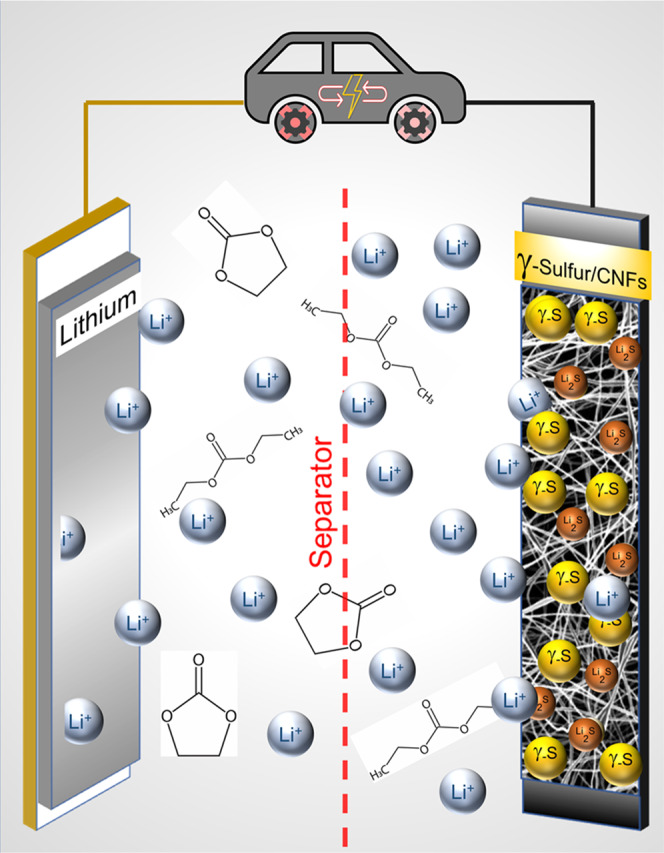
This past decade has seen extensive research in lithium-sulfur batteries with exemplary works mitigating the notorious polysulfide shuttling. However, these works utilize ether electrolytes that are highly volatile severely hindering their practicality. Here, we stabilize a rare monoclinic γ-sulfur phase within carbon nanofibers that enables successful operation of Lithium-Sulfur (Li-S) batteries in carbonate electrolyte for 4000 cycles. Carbonates are known to adversely react with the intermediate polysulfides and shut down Li-S batteries in first discharge. Through electrochemical characterization and post-mortem spectroscopy/ microscopy studies on cycled cells, we demonstrate an altered redox mechanism in our cells that reversibly converts monoclinic sulfur to LiS without the formation of intermediate polysulfides for the entire range of 4000 cycles. To the best of our knowledge, this is the first study to report the synthesis of stable γ-sulfur and its application in Li-S batteries. We hope that this striking discovery of solid-to-solid reaction will trigger new fundamental and applied research in carbonate electrolyte Li-S batteries.
在过去十年中,锂硫电池领域开展了广泛研究,一些具有示范意义的成果减轻了臭名昭著的多硫化物穿梭效应。然而,这些研究使用的醚类电解质挥发性极高,严重阻碍了其实际应用。在此,我们在碳纳米纤维中稳定了一种罕见的单斜γ-硫相,使得锂硫(Li-S)电池能够在碳酸盐电解质中成功运行4000次循环。众所周知,碳酸盐会与中间多硫化物发生不良反应,并在首次放电时使Li-S电池停止工作。通过对循环电池的电化学表征以及事后光谱/显微镜研究,我们证明了我们的电池中存在一种改变的氧化还原机制,该机制在4000次循环的整个范围内将单斜硫可逆地转化为LiS,而不会形成中间多硫化物。据我们所知,这是首次报道合成稳定的γ-硫及其在Li-S电池中的应用的研究。我们希望这一关于固-固反应的惊人发现将引发碳酸盐电解质Li-S电池领域新的基础研究和应用研究。