Cohen Zachary D, DeRubeis Robert J, Hayes Rachel, Watkins Edward R, Lewis Glyn, Byng Richard, Byford Sarah, Crane Catherine, Kuyken Willem, Dalgleish Tim, Schweizer Susanne
Department of Psychiatry, University of California Los Angeles, Los Angeles, USA.
Department of Psychology, University of Pennsylvania, Philadelphia, Pennsylvania, USA.
Clin Psychol Sci. 2023 Jan;11(1):59-76. doi: 10.1177/21677026221076832. Epub 2022 Apr 29.
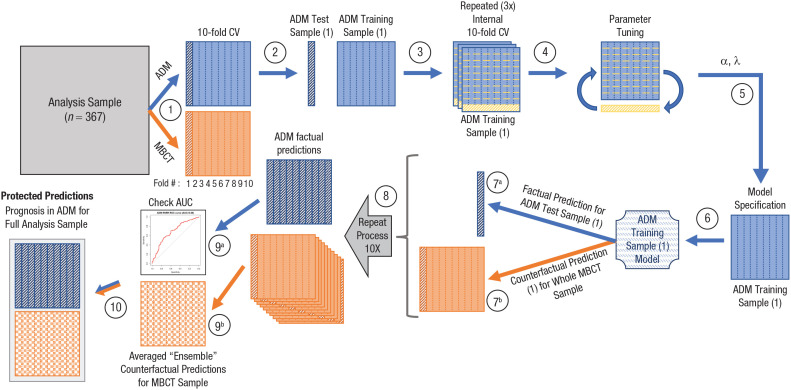
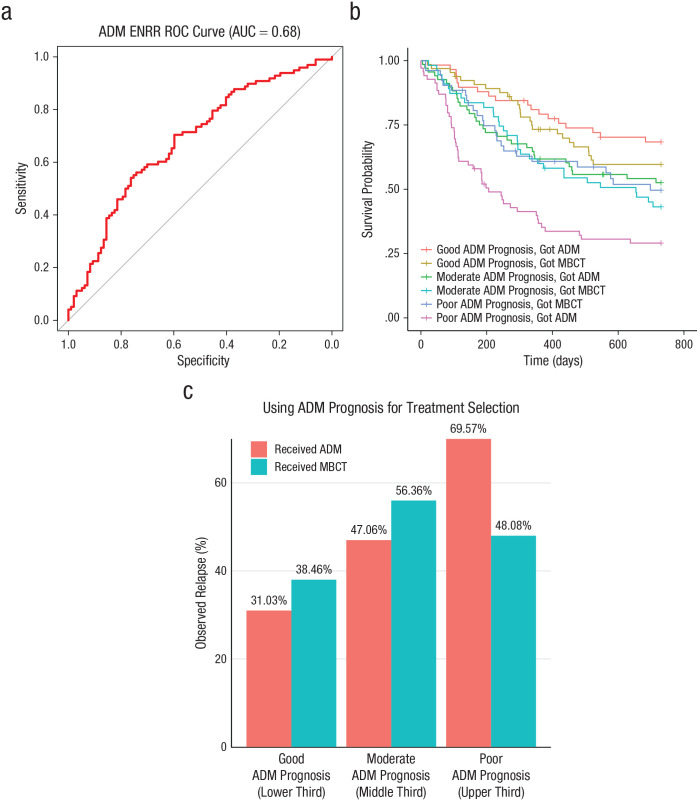
Depression is highly recurrent, even following successful pharmacological and/or psychological intervention. We aimed to develop clinical prediction models to inform adults with recurrent depression choosing between antidepressant medication (ADM) maintenance or switching to Mindfulness-Based Cognitive Therapy (MBCT). Using data from the PREVENT trial (=424), we constructed prognostic models using elastic net regression that combined demographic, clinical and psychological factors to predict relapse at 24 months under ADM or MBCT. Only the ADM model (discrimination performance: AUC=.68) predicted relapse better than baseline depression severity (AUC=.54; one-tailed DeLong's test: =2.8, =.003). Individuals with the poorest ADM prognoses who switched to MBCT had better outcomes compared to those who maintained ADM (48% vs. 70% relapse, respectively; superior survival times [=-2.7, =.008]). For individuals with moderate-to-good ADM prognosis, both treatments resulted in similar likelihood of relapse. If replicated, the results suggest that predictive modeling can inform clinical decision-making around relapse prevention in recurrent depression.
抑郁症极易复发,即使在药物和/或心理干预成功之后也是如此。我们旨在开发临床预测模型,为患有复发性抑郁症的成年人在选择抗抑郁药物(ADM)维持治疗或转而接受基于正念的认知疗法(MBCT)时提供参考。利用来自预防试验(n = 424)的数据,我们使用弹性网络回归构建了预后模型,该模型结合了人口统计学、临床和心理因素,以预测在接受ADM或MBCT治疗24个月时的复发情况。只有ADM模型(区分性能:AUC = 0.68)比基线抑郁严重程度(AUC = 0.54;单尾德龙检验:z = 2.8,p = 0.003)能更好地预测复发。与维持ADM治疗的患者相比,转而接受MBCT治疗的ADM预后最差的个体有更好的结果(复发率分别为48%和70%;生存时间更长[z = -2.7,p = 0.008])。对于ADM预后为中度至良好的个体,两种治疗导致复发的可能性相似。如果得到重复验证,结果表明预测模型可为复发性抑郁症预防复发的临床决策提供参考。