Yasmin Farah, Najeeb Hala, Siddiqui Hasan Fareed, Asghar Muhammad Sohaib, Awan Hashir Ali, Usama Rana Muhammad, Allahuddin Zoha, Tahir Muhammad Junaid, Ullah Kaleem, Mahmmoud Fadelallah Eljack Mohammed
Department of Medicine, Dow Medical College Dow University of Health Sciences Karachi Pakistan.
Department of Medicine, Dow University Hospital-Ojha Campus Dow University of Health Sciences Karachi Pakistan.
Health Sci Rep. 2023 Jan 18;6(1):e1071. doi: 10.1002/hsr2.1071. eCollection 2023 Jan.
Coronavirus disease 2019 (COVID-19) vaccine side effects have an important role in the hesitancy of the general population toward vaccine administration. Therefore, this study was conducted to document the COVID-19 vaccine side effects in our population.
An online survey-based, cross-sectional study was carried out from September 1, 2021, to October 1, 2021, to document the side effects of the COVID-19 vaccine among the general public. The questionnaire included participants' sociodemographic data, type of vaccine, comorbidities, previous COVID-19 infection, and assessment of side effects reported by them.
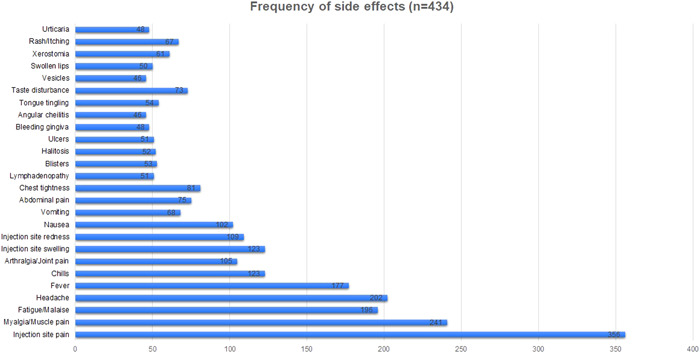
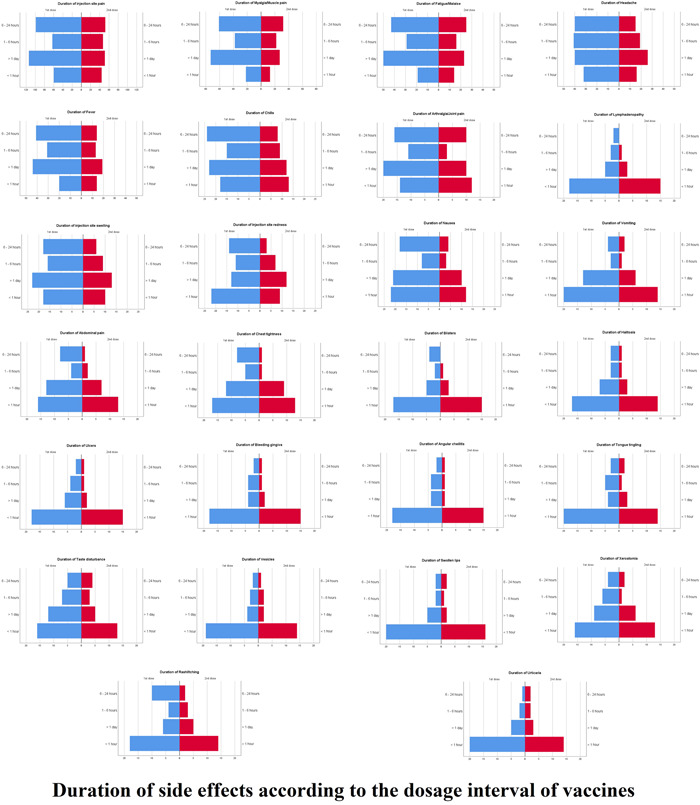
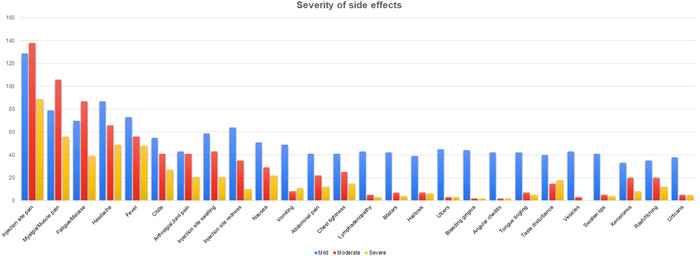
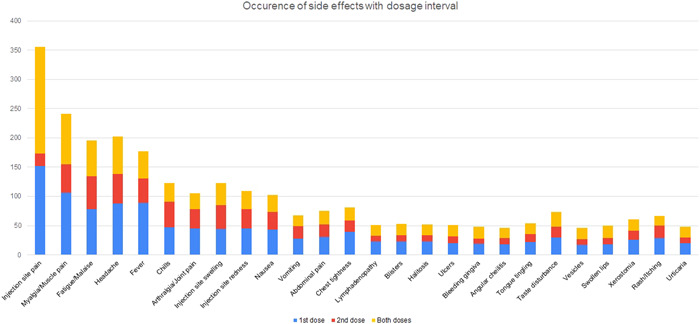
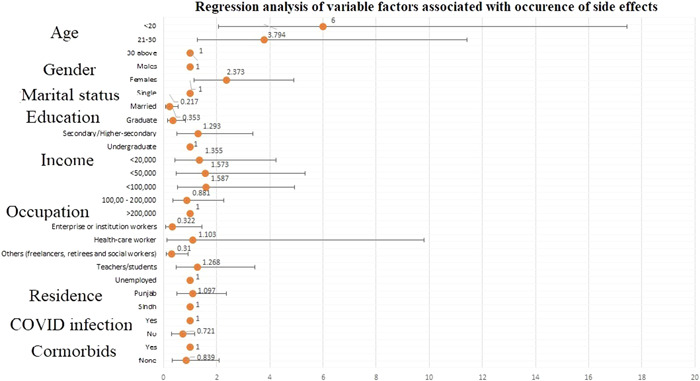
The majority of the participants were <20 years of age (62.2%), females (74.9%), belonged to the educational sector (58.1%), residents of Sindh (65.7%), and were previously unaffected by COVID-19 infection (73.3%). Sinovac (38.7%) followed by Sinopharm (30.4%) and Moderna (18.4%) were administered more frequently. Commonly reported side effects were injection site pain (82%), myalgia (55%), headache (46%), fatigue/malaise (45%), and fever (41%). Vaccine side effects were more likely to be reported with the first dose as compared to the second dose. On regression analysis, factors associated with occurrence of side effects included younger age (odds ratio [OR]: 6.000 [2.065-17.431], < 0.001), female gender (OR: 2.373 [1.146-4.914], = 0.020), marital status (OR: 0.217 [0.085-0.556], < 0.001), graduate level of education (OR: 0.353 [0.153-0.816], = 0.015), and occupation being either retired, freelancers, or social workers (OR: 0.310 [0.106-0.909]), = 0.033). Previous infection with COVID-19 ( = 0.458) and comorbidities were found unrelated ( = 0.707) to the occurrence of side effects.
The overall prevalence of local side effects was quite higher than the systemic ones. Further large-scale studies on vaccine safety are required to strengthen public confidence in the vaccination drive.
2019冠状病毒病(COVID-19)疫苗的副作用在普通人群对疫苗接种的犹豫态度中起着重要作用。因此,本研究旨在记录我国人群中COVID-19疫苗的副作用。
于2021年9月1日至2021年10月1日开展了一项基于在线调查的横断面研究,以记录普通公众中COVID-19疫苗的副作用。问卷包括参与者的社会人口统计学数据、疫苗类型、合并症、既往COVID-19感染情况以及他们报告的副作用评估。
大多数参与者年龄小于20岁(62.2%),为女性(74.9%),来自教育部门(58.1%),是信德省居民(65.7%),且既往未感染过COVID-19(73.3%)。接种频率较高的依次是科兴疫苗(38.7%)、国药疫苗(30.4%)和莫德纳疫苗(18.4%)。常见的副作用报告有注射部位疼痛(82%)、肌痛(55%)、头痛(46%)、疲劳/不适(45%)和发热(41%)。与第二剂相比,第一剂疫苗更易出现副作用报告。回归分析显示,与副作用发生相关的因素包括年龄较小(比值比[OR]:6.000[2.065 - 17.431],P<0.001)、女性(OR:2.373[1.146 - 4.914],P = 0.020)、婚姻状况(OR:0.217[0.085 - 0.556],P<0.001)、研究生学历(OR:0.353[0.153 - 0.816],P = 0.015)以及职业为退休人员(自由职业者或社会工作者)(OR:0.310[0.106 - 0.909],P = 0.033)。既往感染COVID-19(P = 0.458)和合并症与副作用的发生无关(P = 0.707)。
局部副作用的总体发生率远高于全身副作用。需要进一步开展大规模的疫苗安全性研究,以增强公众对疫苗接种工作的信心。