
一种用于改善脊柱手术病例持续时间预测的集成学习方法:算法开发与验证
An Ensemble Learning Approach to Improving Prediction of Case Duration for Spine Surgery: Algorithm Development and Validation.
作者信息
Gabriel Rodney Allanigue, Harjai Bhavya, Simpson Sierra, Du Austin Liu, Tully Jeffrey Logan, George Olivier, Waterman Ruth
机构信息
Division of Biomedical Informatics, Department of Medicine, University of California, San Diego, San Diego, CA, United States.
Division of Perioperative Informatics, Department of Anesthesiology, University of California, San Diego, San Diego, CA, United States.
出版信息
JMIR Perioper Med. 2023 Jan 26;6:e39650. doi: 10.2196/39650.
BACKGROUND
Estimating surgical case duration accurately is an important operating room efficiency metric. Current predictive techniques in spine surgery include less sophisticated approaches such as classical multivariable statistical models. Machine learning approaches have been used to predict outcomes such as length of stay and time returning to normal work, but have not been focused on case duration.
OBJECTIVE
The primary objective of this 4-year, single-academic-center, retrospective study was to use an ensemble learning approach that may improve the accuracy of scheduled case duration for spine surgery. The primary outcome measure was case duration.
METHODS
We compared machine learning models using surgical and patient features to our institutional method, which used historic averages and surgeon adjustments as needed. We implemented multivariable linear regression, random forest, bagging, and XGBoost (Extreme Gradient Boosting) and calculated the average R, root-mean-square error (RMSE), explained variance, and mean absolute error (MAE) using k-fold cross-validation. We then used the SHAP (Shapley Additive Explanations) explainer model to determine feature importance.
RESULTS
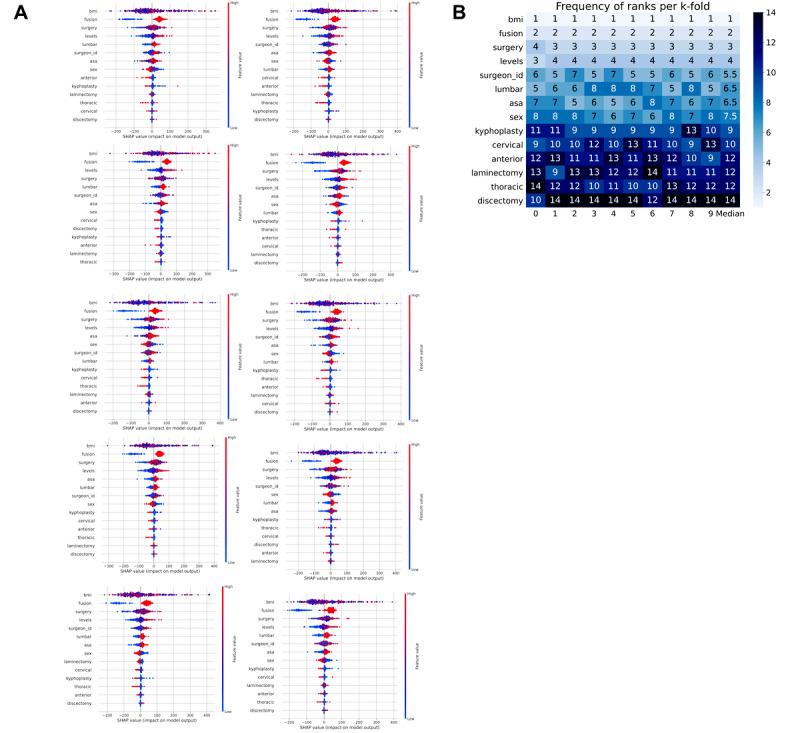
A total of 3189 patients who underwent spine surgery were included. The institution's current method of predicting case times has a very poor coefficient of determination with actual times (R=0.213). On k-fold cross-validation, the linear regression model had an explained variance score of 0.345, an R of 0.34, an RMSE of 162.84 minutes, and an MAE of 127.22 minutes. Among all models, the XGBoost regressor performed the best with an explained variance score of 0.778, an R of 0.770, an RMSE of 92.95 minutes, and an MAE of 44.31 minutes. Based on SHAP analysis of the XGBoost regression, body mass index, spinal fusions, surgical procedure, and number of spine levels involved were the features with the most impact on the model.
CONCLUSIONS
Using ensemble learning-based predictive models, specifically XGBoost regression, can improve the accuracy of the estimation of spine surgery times.
背景
准确估计手术病例持续时间是一项重要的手术室效率指标。脊柱手术当前的预测技术包括一些不太复杂的方法,如经典的多变量统计模型。机器学习方法已被用于预测诸如住院时间和恢复正常工作时间等结果,但尚未聚焦于病例持续时间。
目的
这项为期4年的单学术中心回顾性研究的主要目的是使用一种集成学习方法,该方法可能提高脊柱手术预定病例持续时间的准确性。主要结局指标为病例持续时间。
方法
我们将使用手术和患者特征的机器学习模型与我们机构的方法进行比较,我们机构的方法使用历史平均值并根据需要进行外科医生调整。我们实施了多变量线性回归、随机森林、装袋法和XGBoost(极端梯度提升),并使用k折交叉验证计算平均R值、均方根误差(RMSE)、解释方差和平均绝对误差(MAE)。然后我们使用SHAP(Shapley加法解释)解释模型来确定特征重要性。
结果
总共纳入了3189例行脊柱手术的患者。该机构当前预测病例时间的方法与实际时间的决定系数非常低(R = 0.213)。在k折交叉验证中,线性回归模型的解释方差得分为0.345,R值为0.34,RMSE为162.84分钟,MAE为127.22分钟。在所有模型中,XGBoost回归器表现最佳,解释方差得分为0.778,R值为0.770,RMSE为92.95分钟,MAE为44.31分钟。基于对XGBoost回归的SHAP分析,体重指数、脊柱融合、手术程序以及涉及的脊柱节段数量是对模型影响最大的特征。
结论
使用基于集成学习的预测模型,特别是XGBoost回归,可以提高脊柱手术时间估计的准确性。


 Zotero 插件