
在多替拉韦利匹韦林二线抗反转录病毒治疗中回收替诺福韦:72 周的结局和病毒载量轨迹。
Recycling Tenofovir in Second-line Antiretroviral Treatment With Dolutegravir: Outcomes and Viral Load Trajectories to 72 weeks.
机构信息
Medecins Sans Frontiers, Cape Town, South Africa.
Health Systems Collaborative, Oxford Centre for Global Health Research, Nuffield Department of Medicine, University of Oxford.
出版信息
J Acquir Immune Defic Syndr. 2023 Apr 15;92(5):422-429. doi: 10.1097/QAI.0000000000003157.
BACKGROUND
Recycling tenofovir and lamivudine/emtricitabine with dolutegravir (TLD) after failure of non-nucleoside transcriptase inhibitor first-line antiretroviral therapy is more tolerable and scalable than dolutegravir plus optimized nucleoside reverse transcriptase inhibitors. Studies have demonstrated TLD's efficacy as second line, but long-term follow-up is limited.
METHODS
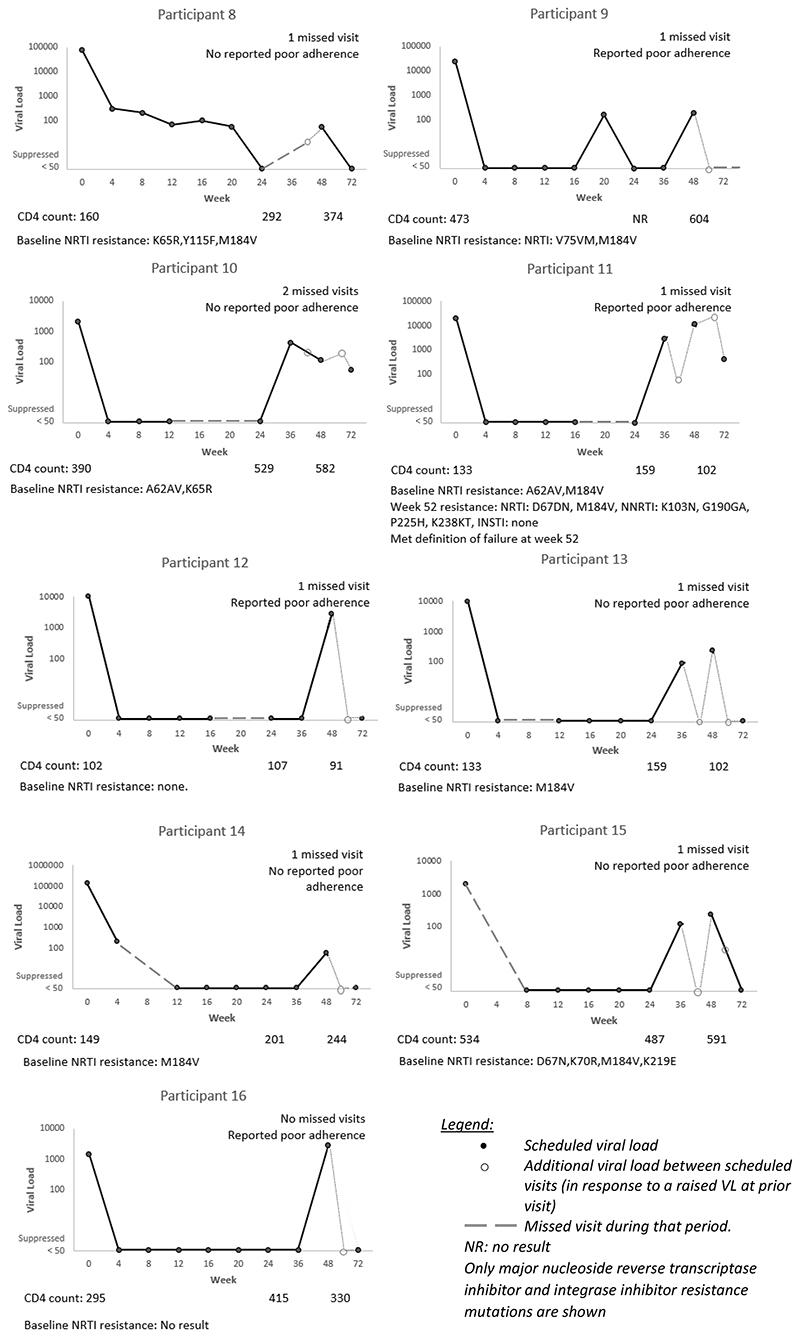
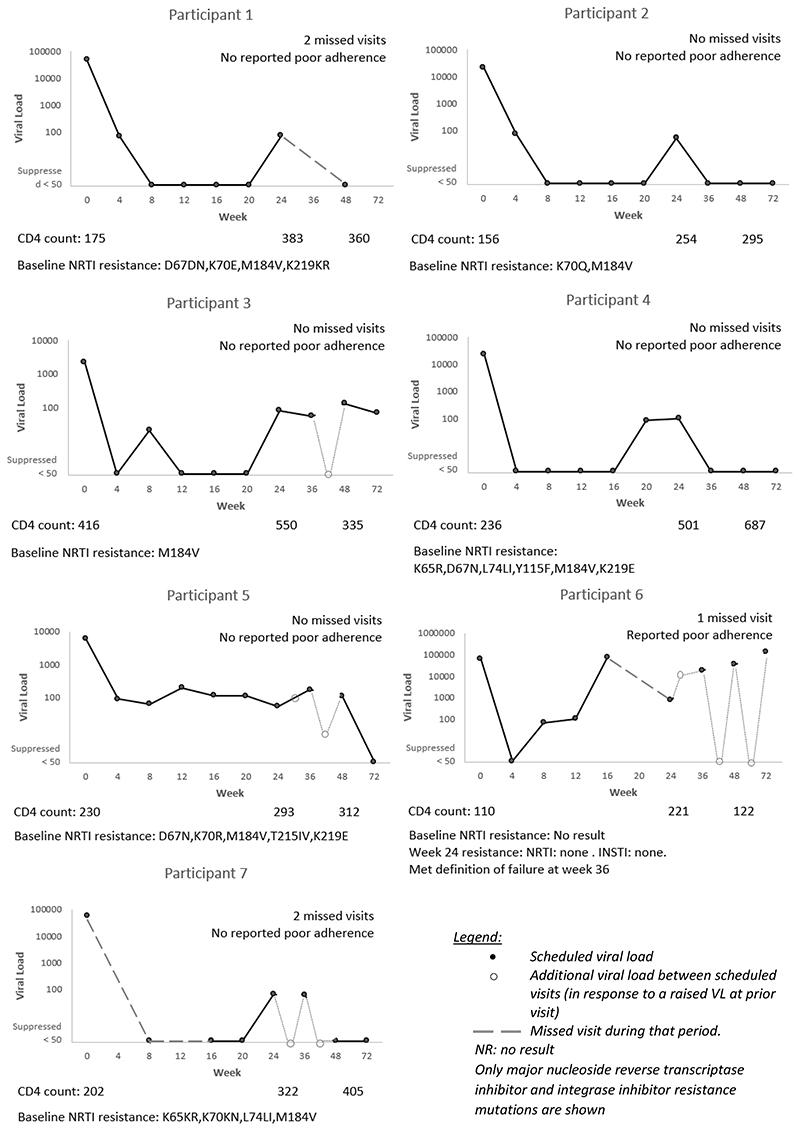
ARTIST is a single arm, prospective, interventional study conducted in Khayelitsha, South Africa, which switched 62 adults with 2 viral loads >1000 copies/mL from tenofovir, lamivudine/emtricitabine, and an non-nucleoside transcriptase inhibitor to TLD. We report efficacy to 72 weeks and, in a post hoc analysis, evaluated viral load trajectories of individuals with viremic episodes.
RESULTS
Virologic suppression was 86% [95% confidence interval (CI) 74 to 93], 74% (95% CI: 61 to 84), and 75% (95% CI: 63 to 86) <50 copies/mL and 95%, 84%, and 77% <400 copies/mL at week 24, 48, and 72, respectively, with 89% (50/56) resistant (Stanford score ≥15) to tenofovir and/or lamivudine preswitch. No participants developed integrase-inhibitor resistance. Of the 20 participants not suppressed at week 24 and/or 48, 2 developed virologic failure, 1 switched regimen (adverse event), 2 were lost to follow-up, 1 missed the visit, 1 transferred out, 9 resuppressed <50 copies/mL with enhanced adherence counseling, and 4 remained viremic (3 with <200 copies/mL) at week 72.
CONCLUSIONS
Recycling NRTIs with dolutegravir was effective for most participants to 72 weeks. Most with viremia did not develop virologic failure and subsequently suppressed with enhanced adherence counseling or continued to have low-level viremia. No integrase-inhibitor resistance was detected despite low-level viremia in a minority of participants.
背景
在非核苷类转录酶抑制剂一线抗逆转录病毒治疗失败后,用替诺福韦、拉米夫定/恩曲他滨和度鲁特韦(TLD)回收替诺福韦和拉米夫定/恩曲他滨比度鲁特韦加优化的核苷逆转录酶抑制剂更耐受和更具扩展性。研究表明 TLD 作为二线治疗是有效的,但长期随访是有限的。
方法
ARTIST 是一项在南非开普敦进行的单臂、前瞻性、干预性研究,该研究将 62 名病毒载量>1000 拷贝/ml 的成年人从替诺福韦、拉米夫定/恩曲他滨和非核苷类转录酶抑制剂转换为 TLD。我们报告了 72 周的疗效,并在事后分析中评估了有病毒血症发作的个体的病毒载量轨迹。
结果
病毒学抑制率分别为 86%(95%可信区间[CI]:74 至 93)、74%(95%CI:61 至 84)和 75%(95%CI:63 至 86)<50 拷贝/ml,95%、84%和 77%<400 拷贝/ml,分别在第 24、48 和 72 周时,89%(50/56)对替诺福韦和/或拉米夫定预转换耐药(斯坦福评分≥15)。没有参与者出现整合酶抑制剂耐药。在第 24 和/或 48 周未被抑制的 20 名参与者中,有 2 名发生病毒学失败,1 名更换治疗方案(不良事件),2 名失访,1 名漏诊,1 名转院,9 名在增强依从性咨询后重新抑制<50 拷贝/ml,4 名在第 72 周仍有病毒血症(3 名<200 拷贝/ml)。
结论
用度鲁特韦回收 NRTIs 对大多数参与者在 72 周内是有效的。大多数有病毒血症的患者没有发生病毒学失败,随后通过增强依从性咨询或继续低水平病毒血症得到抑制,尽管少数参与者有低水平病毒血症,但没有检测到整合酶抑制剂耐药。
 Zotero 插件