Department of Neurosurgery, Klinikum Rechts der Isar, Technical University Munich, Ismaningerstrasse 22, 81675, Munich, Germany.
Department of Neurosurgery, Cantonal Hospital St. Gallen, St. Gallen, Switzerland.
Sci Rep. 2023 Jan 27;13(1):1527. doi: 10.1038/s41598-022-27177-9.
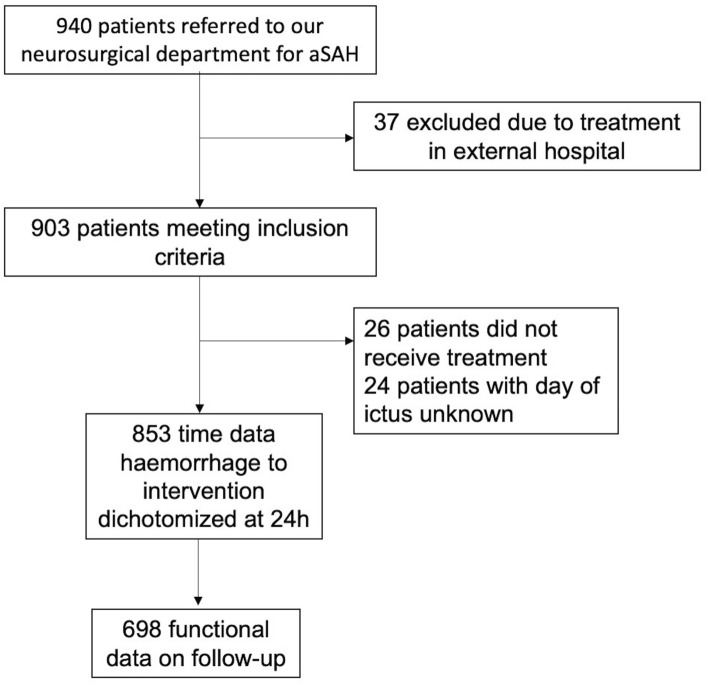
Timely treatment of aneurysmal subarachnoid haemorrhage (aSAH) is key to prevent further rupture and poor outcome. We evaluated complications and outcome adjusting for time from haemorrhage to treatment. Retrospective analysis of aSAH patients admitted between 2006 and 2020. Data was collected using standardized case report forms. We compared risk factors using multivariable logistic regression. We included 853 patients, 698 (81.8%) were treated within 24 h. Patients with higher Hunt and Hess grades were admitted and treated significantly faster than those with lower grades (overall p-value < 0.001). Fifteen patients (1.8%) rebled before intervention. In the multivariable logistic analysis adjusting for timing, Barrow Neurological Institute score and intracerebral haemorrhage were significantly associated with rebleeding (overall p-value 0.006; OR 3.12, 95%CI 1.09-8.92, p = 0.03, respectively) but timing was not. Treatment > 24 h was associated with higher mortality and cerebral infarction in only the subgroup of lower grades aSAH (OR 3.13, 1.02-9.58 95%CI, p-value = 0.05; OR 7.69, 2.44-25.00, p-value < 0.001, respectively). Therefore treatment > 24 h after rupture is associated with higher mortality and cerebral infarction rates in lower grades aSAH. Delay in treatment primarily affects lower grade aSAH patients. Patients with lower grade aSAH ought to be treated with the same urgency as higher-grade aSAH.
及时治疗颅内破裂动脉瘤(aSAH)是防止再次破裂和不良预后的关键。我们评估了并发症和预后,并对出血到治疗的时间进行了调整。回顾性分析了 2006 年至 2020 年期间收治的 aSAH 患者。使用标准化病例报告表收集数据。我们使用多变量逻辑回归比较了危险因素。我们纳入了 853 名患者,其中 698 名(81.8%)在 24 小时内接受了治疗。Hunt 和 Hess 分级较高的患者入院和治疗速度明显快于分级较低的患者(总体 p 值 < 0.001)。15 名患者(1.8%)在介入前再次出血。在多变量逻辑分析中,调整了时间因素后,巴罗神经研究所评分和脑内出血与再出血显著相关(总体 p 值为 0.006;OR 3.12,95%CI 1.09-8.92,p 值=0.03),而时间因素则没有。仅在低级别 aSAH 亚组中,治疗时间超过 24 小时与更高的死亡率和脑梗死相关(OR 3.13,95%CI 1.02-9.58,p 值=0.05;OR 7.69,2.44-25.00,p 值<0.001)。因此,在低级别 aSAH 中,破裂后治疗时间超过 24 小时与更高的死亡率和脑梗死发生率相关。治疗延迟主要影响低级别 aSAH 患者。低级别 aSAH 患者应与高级别 aSAH 患者一样紧急治疗。