
高分辨率皮肤超声(US)联合浅表放射治疗(SRT)与非影像引导 SRT 或外照射放射治疗(XRT)治疗早期上皮癌的研究比较。
High resolution dermal ultrasound (US) combined with superficial radiation therapy (SRT) versus non-image guided SRT or external beam radiotherapy (XRT) in early-stage epithelial cancer: a comparison of studies.
机构信息
Laserderm Dermatology, 327 Middle Country Rd, Smithtown, NY, 11787, USA.
New York Institute of Technology College of Osteopathic Medicine, Old Westbury, NY, USA.
出版信息
BMC Cancer. 2023 Jan 28;23(1):98. doi: 10.1186/s12885-023-10577-z.
BACKGROUND
To compare the effectiveness of high-resolution dermal ultrasound (US) guided superficial radiotherapy (SRT) to non-image-guided radiotherapy in the treatment of early-stage Non-Melanoma Skin Cancer (NMSC).
METHODS
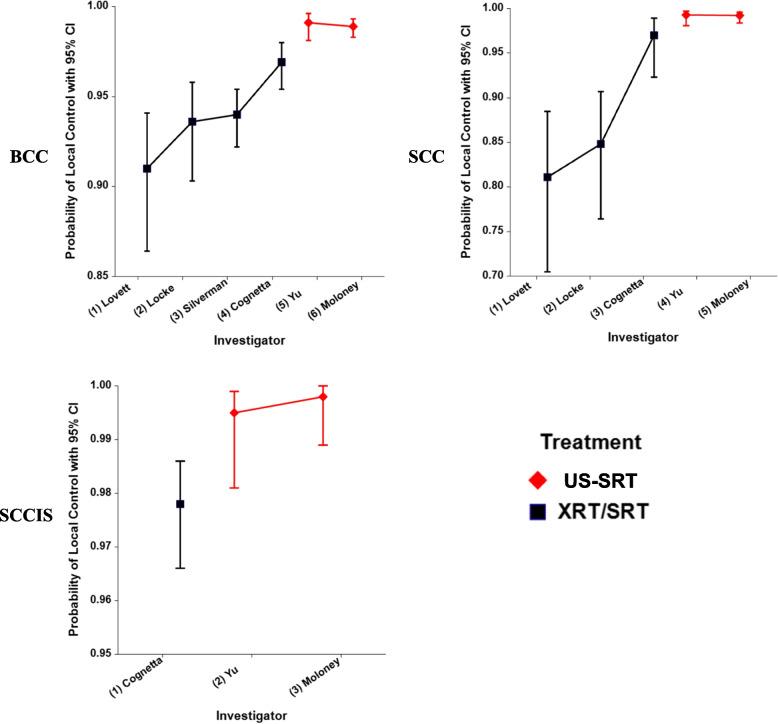
A high-resolution dermal ultrasound (US) image guided form of superficial radiation therapy (designated here as US-SRT) was developed in 2013 where the tumor configuration and depth can be visualized prior to, during, and subsequent to treatments, using a 22 megahertz (MHz) dermal ultrasound (US) with a doppler component. We previously published the results using this technology to treat 2917 early-stage epithelial cancers showing a high local control (LC) rate of 99.3%. We compared these results with similar American studies from a comprehensive literature search used in an article/guideline published by American Society of Radiation Oncology (ASTRO) on curative radiation treatment of basal cell carcinoma (BCC), squamous cell carcinoma (SCC) and squamous cell carcinoma in-situ (SCCIS) lesions from 1988 to 2018. Only U.S. based studies with greater than 100 cases with similar patient/lesion characteristics and stages treated by external beam, electron, or superficial/orthovoltage radiation therapy were included in the criteria for selection. The resultant 4 studies had appropriate comparable cases identified and the data analyzed/calculated with regard to local control. Logistic regression analysis was performed comparing each study to US-SRT individually and collectively with stratification by histology (BCC, SCC, and SCCIS).
RESULTS
US-SRT LC was found to be statistically superior to each of the 4 non-image-guided radiation therapy studies individually and collectively (as well as stratified by histology subtype) with p-values ranging from p < 0.0001 to p = 0.0438.
CONCLUSIONS
Results of US-SRT in local control were statistically significantly superior across the board versus non-image-guided radiation modalities in treatment of epithelial NMSC and should be considered a new gold standard for treatment of early-stage cutaneous BCC, SCC, and SCCIS.
背景
比较高分辨率皮肤超声(US)引导浅层放射治疗(SRT)与非影像引导放射治疗在治疗早期非黑色素瘤皮肤癌(NMSC)中的疗效。
方法
2013 年开发了一种高分辨率皮肤超声(US)引导浅层放射治疗(US-SRT)形式,在治疗过程中可以使用 22 兆赫(MHz)皮肤超声(US)和多普勒组件可视化肿瘤形态和深度,在此之前、期间和之后。我们之前使用该技术治疗了 2917 例早期上皮癌,结果显示局部控制(LC)率很高,达到 99.3%。我们将这些结果与美国放射肿瘤学会(ASTRO)发表的一篇文章/指南中对基底细胞癌(BCC)、鳞状细胞癌(SCC)和原位鳞状细胞癌(SCCIS)病变进行根治性放射治疗的综合文献检索中类似的美国研究进行了比较。从 1988 年到 2018 年,只有 100 多例具有相似患者/病变特征和分期的基于美国的研究,且接受外部束、电子或浅层/正交电压放射治疗,符合选择标准。对 4 项研究中的适当可比病例进行了识别,并对局部控制方面的数据进行了分析/计算。对数回归分析比较了每一项研究与 US-SRT 个体和集体,并按组织学(BCC、SCC 和 SCCIS)进行分层。
结果
US-SRT 的 LC 被发现与 4 项非影像引导放射治疗研究中的每一项和集体(以及按组织学亚型分层)相比均具有统计学优势,p 值范围从 p<0.0001 到 p=0.0438。
结论
US-SRT 在局部控制方面的结果在治疗上皮性 NMSC 方面与非影像引导放射治疗方式相比具有统计学显著优势,应被视为治疗早期皮肤 BCC、SCC 和 SCCIS 的新标准。
 Zotero 插件