Department of Animal Sciences and Biotechnology, Kyungpook National University, Sangju-Si 37224, South Korea; Department of Animal Sciences, The Ohio State University, Columbus, OH 43210, USA.
Department of Animal Sciences and Biotechnology, Kyungpook National University, Sangju-Si 37224, South Korea.
Poult Sci. 2023 Apr;102(4):102471. doi: 10.1016/j.psj.2022.102471. Epub 2023 Jan 4.
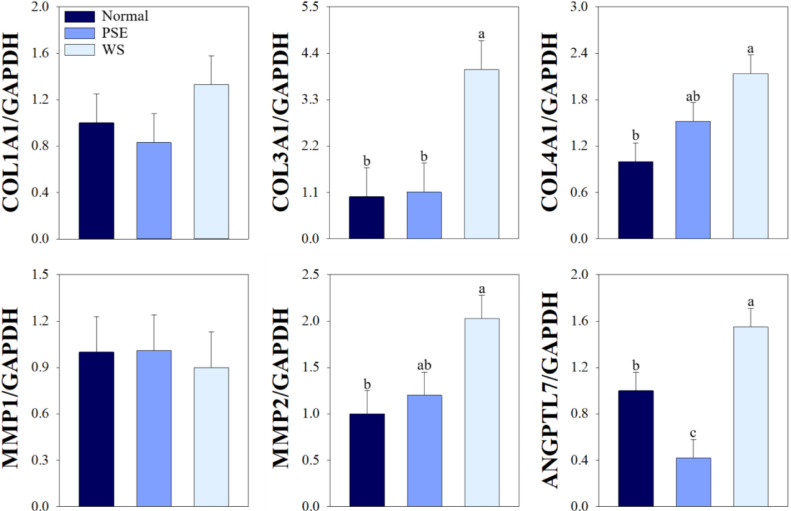
The objective of this study was to compare the meat quality characteristics and collagen-related gene expression levels in the broiler pectoralis major (PM) muscle among the meat quality groups, including normal, pale, soft, and exudative (PSE), and white striping (WS) groups. The group was classified by their WS degree (moderate or severe striping) and quality traits including pH and lightness values at 24 h postmortem (normal group: pH ≥5.7, 48≤L*≤53, without WS features; PSE group: pH <5.7, L* >53, without WS features; WS group: pH ≥5.7, 48≤L*≤53, with moderate or severe striping). The WS group revealed no differences in all measured meat quality traits compared to the normal group (P > 0.05). PM muscles exhibiting PSE conditions without WS indicated lower pH and pH values (P < 0.05). Whereas, lower lightness and cooking loss values were observed in the normal and WS groups compared to the PSE group (P < 0.05). No significant difference was observed in the level of type I collagen among the groups (P > 0.05), whereas a higher type III collagen level was observed in the WS group than in the other groups (P < 0.05). Additionally, the WS group showed a higher type IV collagen level compared to the normal group (P < 0.05) and a level not different from that of the PSE group (P > 0.05). In contrast, the expression levels of matrix metalloproteinase (MMP) 2, involved in type IV collagen degradation, and angiopoietin-like protein 7, associated with collagen accumulation, were higher in the WS group compared to the normal group (P < 0.05). However, no difference was detected in the MMP1 level among the all groups (P > 0.05). These results suggest that the occurrence of WS features in broiler PM muscle, unlike PSE and normal conditions, can be influenced by the expression levels of collagen-related genes associated with abnormalities in extracellular matrix components.
本研究旨在比较肉质组(正常组、苍白-柔软-渗水(PSE)组、白条纹(WS)组和肌肉颜色浅淡(WS)组)的肉鸡胸肌品质特性和与胶原蛋白相关的基因表达水平。根据 WS 严重程度(中度或重度条纹)和肉质特性(宰后 24 小时的 pH 值和亮度值)对其进行分类(正常组:pH≥5.7,48≤L*≤53,无 WS 特征;PSE 组:pH<5.7,L*>53,无 WS 特征;WS 组:pH≥5.7,48≤L*≤53,有中度或重度条纹)。WS 组与正常组相比,所有测量的肉质特性均无差异(P>0.05)。PM 肌肉表现出 PSE 条件但无 WS 特征的肌肉,其 pH 值和 pH 值较低(P<0.05)。而正常组和 WS 组的亮度和蒸煮损失值低于 PSE 组(P<0.05)。各组间 I 型胶原蛋白水平无显著差异(P>0.05),而 WS 组的 III 型胶原蛋白水平高于其他组(P<0.05)。此外,WS 组的 IV 型胶原蛋白水平高于正常组(P<0.05),与 PSE 组无差异(P>0.05)。相反,WS 组基质金属蛋白酶(MMP)2 的表达水平较高,MMP2 参与 IV 型胶原蛋白的降解,血管生成素样蛋白 7 与胶原蛋白的积累有关,与正常组相比,WS 组的表达水平较高(P<0.05)。然而,各组间 MMP1 水平无差异(P>0.05)。这些结果表明,与 PSE 和正常条件不同,肉鸡 PM 肌肉出现 WS 特征可能受与细胞外基质成分异常相关的胶原蛋白相关基因的表达水平影响。