Department of Emergency Medicine, Tri-Service General Hospital, National Defense Medical Center, No. 325, Sec. 2, Cheng-Kung Road, Neihu Dist., Taipei City, 114, Taiwan.
Institute of Clinical Medicine, National Yang-Ming University, Taipei, 112, Taiwan.
BMC Cardiovasc Disord. 2023 Jan 30;23(1):55. doi: 10.1186/s12872-022-03012-x.
Previous studies have revealed associations between hyperuricemia and microvascular diseases, but the association between hyperuricemia and abdominal aortic aneurysm (AAA) remains unclear. The aim of this study was to elucidate the pathogenesis and prove the relationship between AAA and hyperuricemia.
A retrospective study was performed to validate the growth rates of AAA in humans with different serum uric acid levels. A murine model of angiotensin II-induced AAA was used to assess the effects of hyperuricemia on AAA growth in vivo, and human aortic smooth muscle cells (HASMCs) were used to study the pathways involved in these effects in vitro.
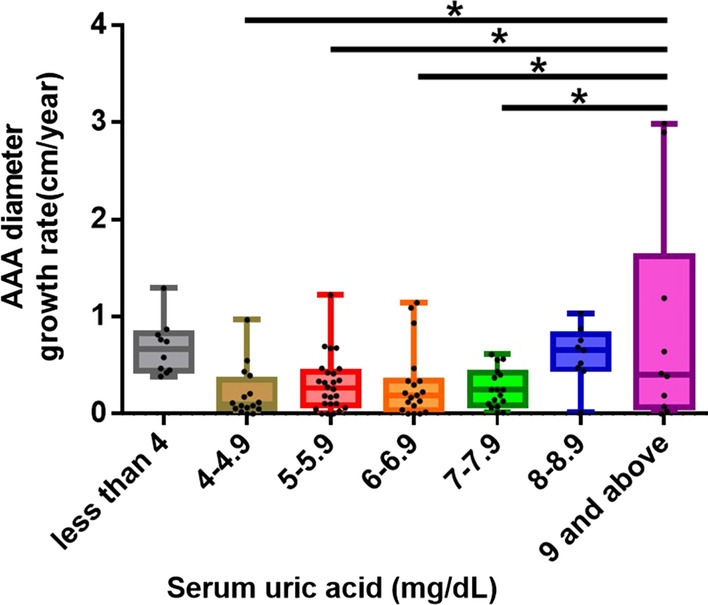
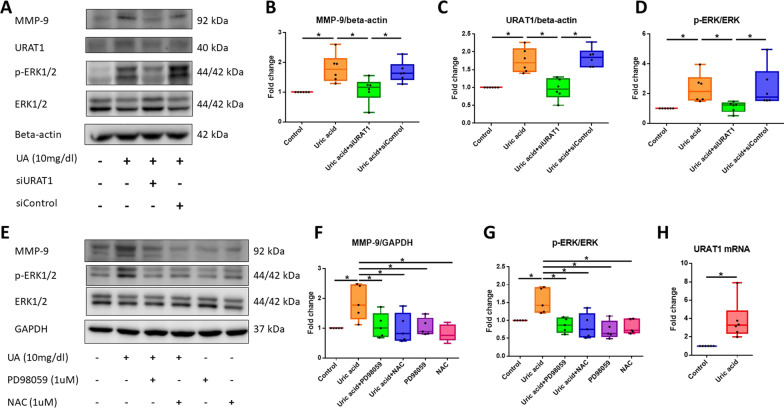
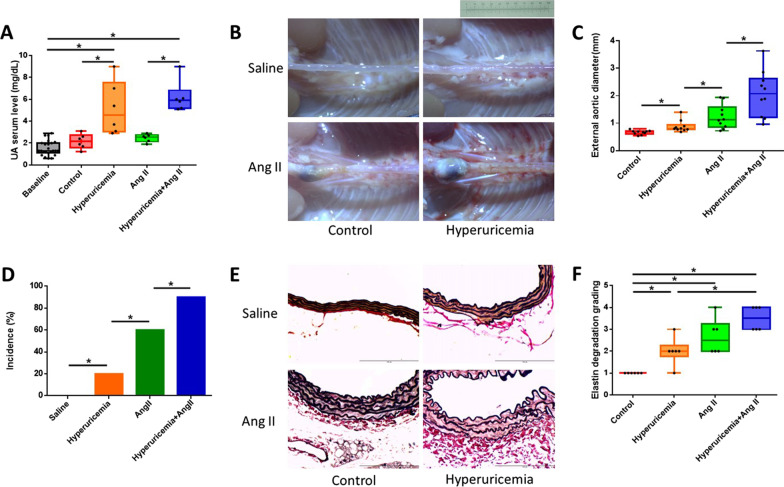
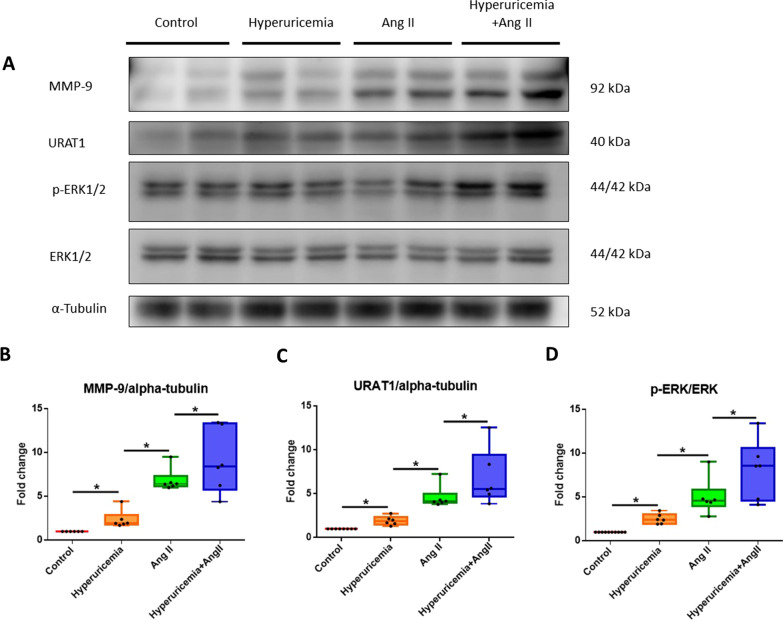
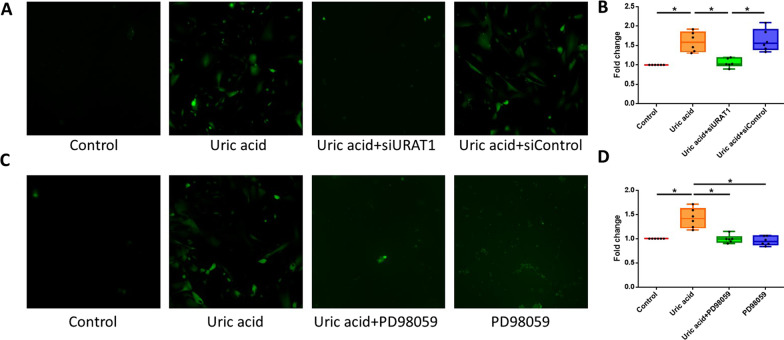
We analyzed data from 107 AAA patients and found that patients with serum uric acid levels above 9 mg/dl had higher AAA growth rates than patients with serum uric acid levels between 4 and 7.9 mg/dl. In vivo, induction of hyperuricemia increased the incidence of AAA formation and the abdominal aortic diameter in mice. The hyperuricemic mice exhibited higher levels of urate transporter 1 (URAT1) expression, phospho-extracellular signal-regulated kinase (p-ERK)1/2 expression, reactive oxygen species (ROS) levels and matrix metalloproteinase (MMP)-9 expression in the abdominal aorta than the control mice. Soluble uric acid increased the expression of URAT1, p-ERK1/2, and MMP-9 and the levels of ROS in HASMCs in vitro.
We have provided human evidence that hyperuricemia exacerbates AAA formation. In addition, our murine experimental evidence suggests that hyperuricemia exacerbates AAA formation and reveals that the URAT1/ERK1/2/ROS/MMP-9 pathway is among the pathways activated by uric acid in HASMCs.
先前的研究揭示了高尿酸血症与微血管疾病之间的关联,但高尿酸血症与腹主动脉瘤(AAA)之间的关系尚不清楚。本研究旨在阐明 AAA 的发病机制并证明 AAA 与高尿酸血症之间的关系。
进行了一项回顾性研究,以验证不同血尿酸水平的人类 AAA 的生长速度。使用血管紧张素 II 诱导的 AAA 小鼠模型评估高尿酸血症对体内 AAA 生长的影响,并在体外使用人主动脉平滑肌细胞(HASMC)研究涉及这些影响的途径。
我们分析了 107 例 AAA 患者的数据,发现血尿酸水平高于 9mg/dl 的患者的 AAA 生长速度高于血尿酸水平在 4 至 7.9mg/dl 之间的患者。在体内,诱导高尿酸血症增加了小鼠 AAA 形成和腹主动脉直径的发生率。高尿酸血症小鼠的腹主动脉尿酸转运蛋白 1(URAT1)表达、磷酸化细胞外信号调节激酶(p-ERK)1/2 表达、活性氧(ROS)水平和基质金属蛋白酶(MMP)-9 表达均高于对照组小鼠。在体外,可溶性尿酸增加了 HASMCs 中 URAT1、p-ERK1/2 和 MMP-9 的表达以及 ROS 的水平。
我们提供了人类证据表明高尿酸血症可加重 AAA 的形成。此外,我们的小鼠实验证据表明,高尿酸血症可加重 AAA 的形成,并揭示尿酸在 HASMCs 中激活的 URAT1/ERK1/2/ROS/MMP-9 途径之一。