Furtado Jessica, Geraldo Luiz Henrique, Leser Felipe Saceanu, Poulet Mathilde, Park Hyojin, Pibouin-Fragner Laurence, Eichmann Anne, Boyé Kevin
Cardiovascular Research Center, Department of Internal Medicine, Yale University School of Medicine, New Haven CT, USA.
Department of Molecular and Cellular Physiology, Yale University School of Medicine, New Haven CT, USA.
bioRxiv. 2023 Jan 21:2023.01.21.525006. doi: 10.1101/2023.01.21.525006.
The blood brain barrier (BBB) preserves neuronal function in the central nervous system (CNS) by tightly controlling metabolite exchanges with the blood. In the eye, the retina is likewise protected by the blood-retina barrier (BRB) to maintain phototransduction. We showed that the secreted guidance cue Netrin-1 regulated BBB integrity, by binding to endothelial Unc5B and regulating canonical β-catenin dependent expression of BBB gene expression.
Here, we investigated if Netrin-1-binding to endothelial Unc5B also controlled BRB integrity, and if this process involved Norrin/β-catenin signaling, which is the major known driver of BRB development and maintenance.
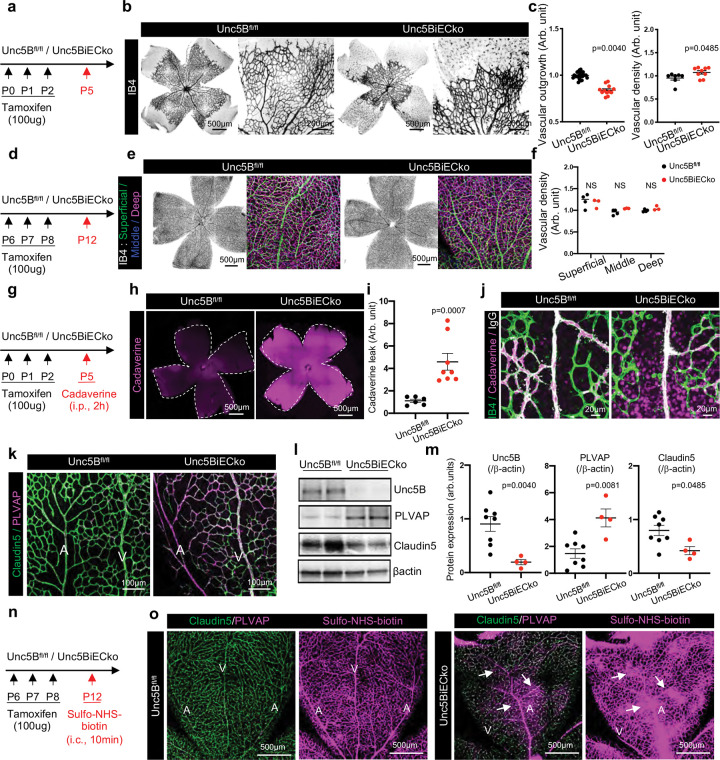
We analyzed Tamoxifen-inducible loss- and gain- of-function alleles of , and in conjunction with tracer injections and biochemical signaling studies.
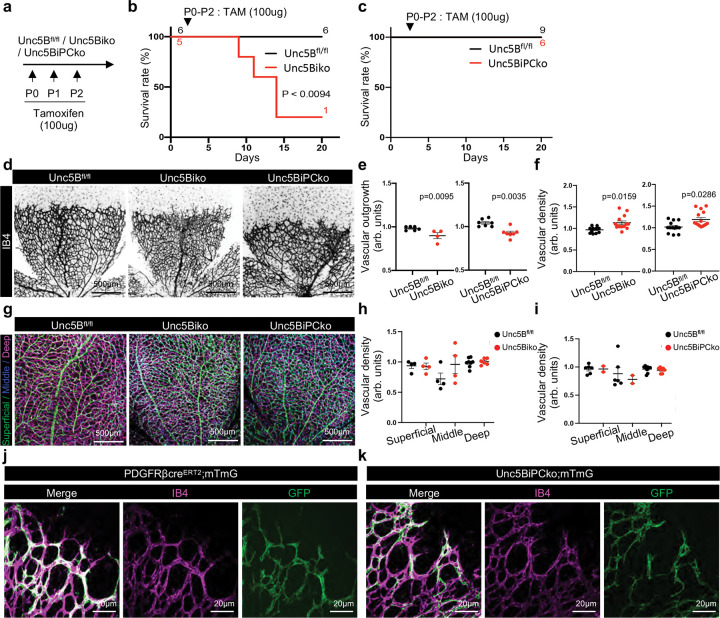
Inducible endothelial deletion, and inducible global deletion in postnatal mice reduced phosphorylation of the Norrin receptor LRP5, leading to reduced β-catenin and LEF1 expression, conversion of retina endothelial cells from a barrier-competent Claudin-5+/PLVAP- state to a Claudin-5-/PLVAP+ leaky phenotype, and extravasation of injected low molecular weight tracers. Inducible gain of function rescued vascular leak in mutants, and overexpression induced BRB tightening. Unc5B expression in pericytes contributed to BRB permeability, via regulation of endothelial Unc5B. Mechanistically, Netrin-1-Unc5B signaling promoted β-catenin dependent BRB signaling by enhancing phosphorylation of the Norrin receptor LRP5 via the Discs large homologue 1 (Dlg1) intracellular scaffolding protein.
The data identify Netrin1-Unc5B as novel regulators of BRB integrity, with implications for diseases associated with BRB disruption.
血脑屏障(BBB)通过严格控制与血液之间的代谢物交换来维持中枢神经系统(CNS)中的神经元功能。在眼睛中,视网膜同样受到血视网膜屏障(BRB)的保护以维持光转导。我们发现,分泌型导向因子Netrin-1通过与内皮细胞上的Unc5B结合并调节BBB基因表达中依赖于β-连环蛋白的经典表达,从而调节BBB的完整性。
在此,我们研究了Netrin-1与内皮细胞Unc5B的结合是否也控制BRB的完整性,以及该过程是否涉及Norrin/β-连环蛋白信号传导,这是已知的BRB发育和维持的主要驱动因素。
我们分析了他莫昔芬诱导的功能缺失和功能获得等位基因,并结合示踪剂注射和生化信号研究。
出生后小鼠中可诱导的内皮细胞Unc5B缺失以及可诱导的全身Unc5B缺失会降低Norrin受体LRP5的磷酸化,导致β-连环蛋白和LEF1表达降低,视网膜内皮细胞从具有屏障功能的Claudin-5+/PLVAP-状态转变为Claudin-5-/PLVAP+渗漏表型,并导致注射的低分子量示踪剂外渗。可诱导的Unc5B功能获得挽救了Unc5B突变体中的血管渗漏,而Unc5B过表达诱导BRB收紧。周细胞中Unc5B的表达通过调节内皮细胞Unc5B来影响BRB的通透性。从机制上讲,Netrin-1-Unc5B信号通过盘状大同源物1(Dlg1)细胞内支架蛋白增强Norrin受体LRP5的磷酸化,从而促进β-连环蛋白依赖性BRB信号传导。
这些数据确定Netrin1-Unc5B是BRB完整性的新型调节因子,对与BRB破坏相关的疾病具有重要意义。