Bosnakovski Darko, Toso Erik A, Ener Elizabeth T, Gearhart Micah D, Yin Lulu, Lüttmann Felipe F, Magli Alessandro, Shi Ke, Kim Johnny, Aihara Hideki, Kyba Michael
Lillehei Heart Institute, University of Minnesota, Minneapolis, MN 55455, USA.
Department of Pediatrics, University of Minnesota, Minneapolis, MN 55455, USA.
bioRxiv. 2023 Jan 22:2023.01.21.524976. doi: 10.1101/2023.01.21.524976.
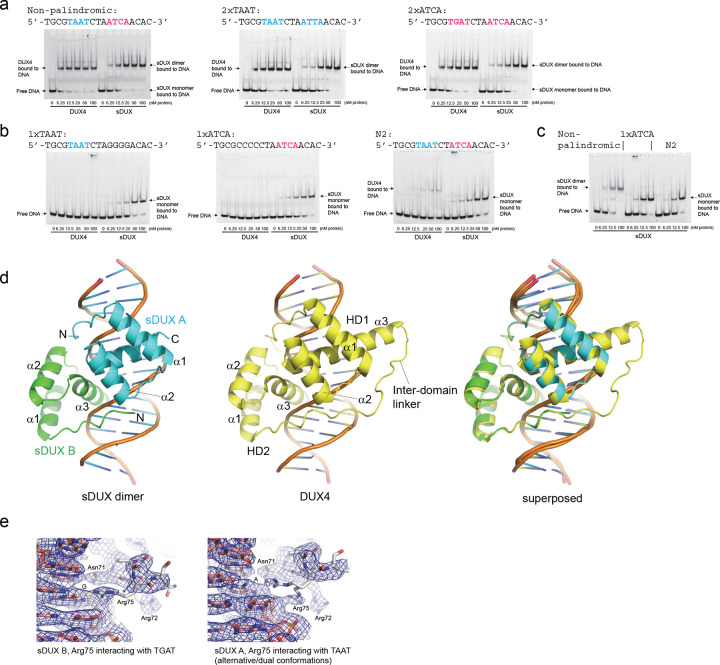
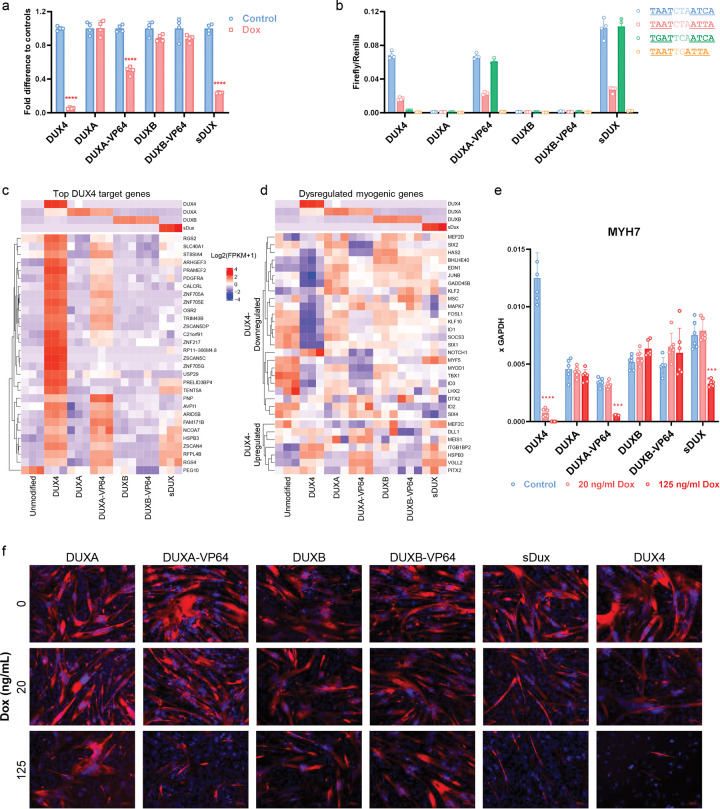
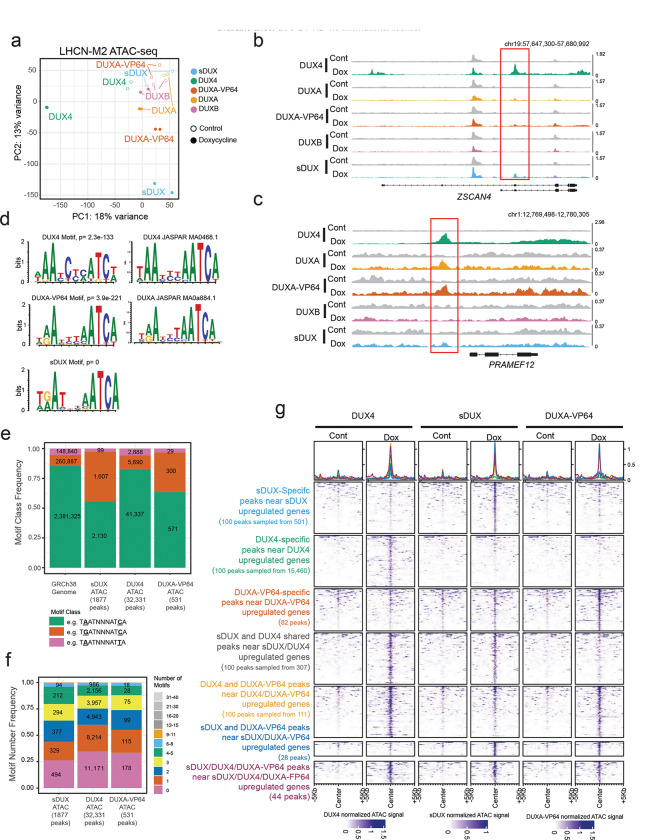
Double homeobox (DUX) genes are unique to eutherian mammals and normally expressed transiently during zygotic genome activation. The canonical member, DUX4, is involved in facioscapulohumeral muscular dystrophy (FSHD) and cancer, when misexpressed in other contexts. We evaluate the 3 human DUX genes and the ancestral single homeobox gene sDUX from the non-eutherian mammal, platypus, and find that DUX4 activities are not shared with DUXA or DUXB, which lack transcriptional activation potential, but surprisingly are shared with platypus sDUX. In human myoblasts, platypus sDUX drives cytotoxicity, inhibits myogenesis, and induces DUX4 target genes, particularly those associated with zygotic genome activation (ZGA), by binding DNA as a homodimer in a way that overlaps the DUX4 homeodomain crystal structure. DUXA lacks transcriptional activity but has DNA-binding and chromatin accessibility overlap with DUX4 and sDUX, including on ZGA genes and LTR elements, and can actually be converted into a DUX4-like cytotoxic factor by fusion to a synthetic transactivation domain. DUXA competition antagonizes the activity of DUX4 on its target genes, including in FSHD patient cells. Since DUXA is an early DUX4 target gene, this activity potentiates feedback inhibition, constraining the window of DUX4 activity. The DUX gene family therefore comprises cross-regulating members of opposing function, with implications for their roles in ZGA, FSHD, and cancer.
Platypus sDUX is toxic and inhibits myogenic differentiation.DUXA targets overlap substantially with those of DUX4.DUXA fused to a synthetic transactivation domain acquires DUX4-like toxicity.DUXA behaves as a competitive inhibitor of DUX4.
双同源盒(DUX)基因是真兽类哺乳动物所特有的,通常在合子基因组激活过程中短暂表达。典型成员DUX4在其他情况下异常表达时,会参与面肩肱型肌营养不良(FSHD)和癌症的发生。我们评估了3个人类DUX基因以及来自非真兽类哺乳动物鸭嘴兽的祖先单同源盒基因sDUX,发现DUX4的活性与缺乏转录激活潜力的DUXA或DUXB不同,但令人惊讶的是,它与鸭嘴兽sDUX相同。在人类成肌细胞中,鸭嘴兽sDUX具有细胞毒性,抑制肌生成,并通过以与DUX4同源结构域晶体结构重叠的方式作为同二聚体结合DNA来诱导DUX4靶基因,特别是那些与合子基因组激活(ZGA)相关的基因。DUXA缺乏转录活性,但在DNA结合和染色质可及性方面与DUX4和sDUX重叠,包括在ZGA基因和LTR元件上,并且通过与合成反式激活结构域融合,实际上可以转化为类似DUX4的细胞毒性因子。DUXA竞争拮抗DUX4对其靶基因的活性,包括在FSHD患者细胞中。由于DUXA是DUX4的早期靶基因,这种活性增强了反馈抑制,限制了DUX4活性的窗口期。因此,DUX基因家族包含功能相反的交叉调节成员,这对它们在ZGA、FSHD和癌症中的作用具有重要意义。
鸭嘴兽sDUX具有毒性并抑制肌源性分化。DUXA的靶点与DUX4的靶点基本重叠。与合成反式激活结构域融合的DUXA具有类似DUX4的毒性。DUXA作为DUX4的竞争性抑制剂发挥作用。