Dong Qiwen, Lin Huaiying, Allen Marie-Maude, Garneau Julian R, Sia Jonathan K, Smith Rita C, Haro Fidel, McMillen Tracy, Pope Rosemary L, Metcalfe Carolyn, Burgo Victoria, Woodson Che, Dylla Nicholas, Kohout Claire, Sundararajan Anitha, Snitkin Evan S, Young Vincent B, Fortier Louis-Charles, Kamboj Mini, Pamer Eric G
Department of Medicine, University of Chicago, Chicago, Illinois, USA.
Duchossois Family Institute, University of Chicago, Chicago, Illinois, USA.
bioRxiv. 2023 Jan 12:2023.01.12.523823. doi: 10.1101/2023.01.12.523823.
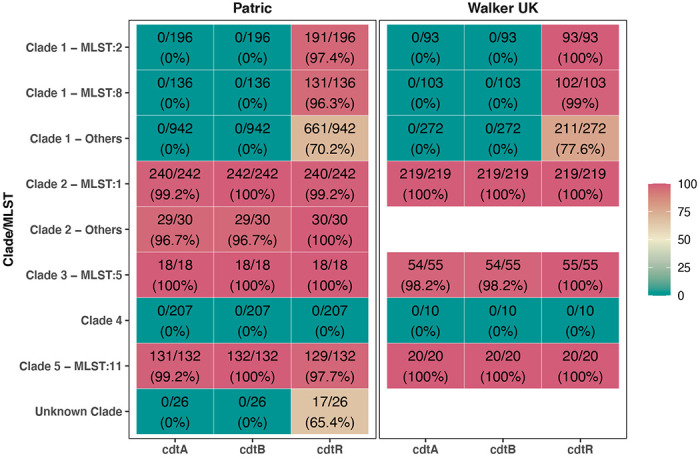
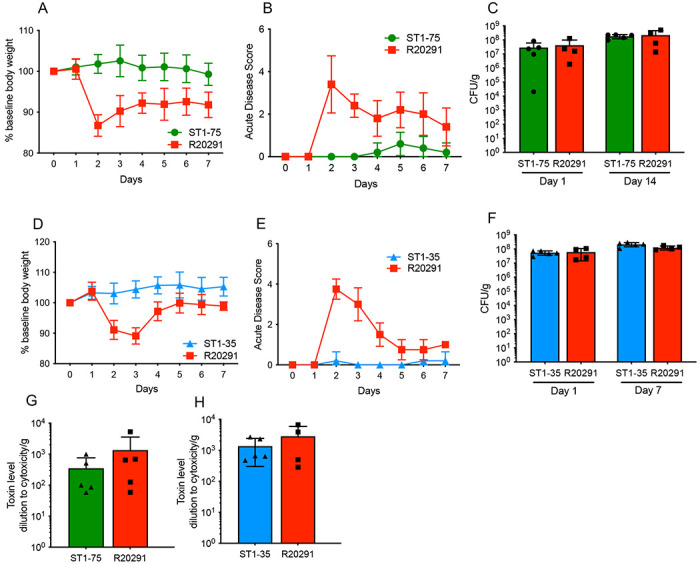
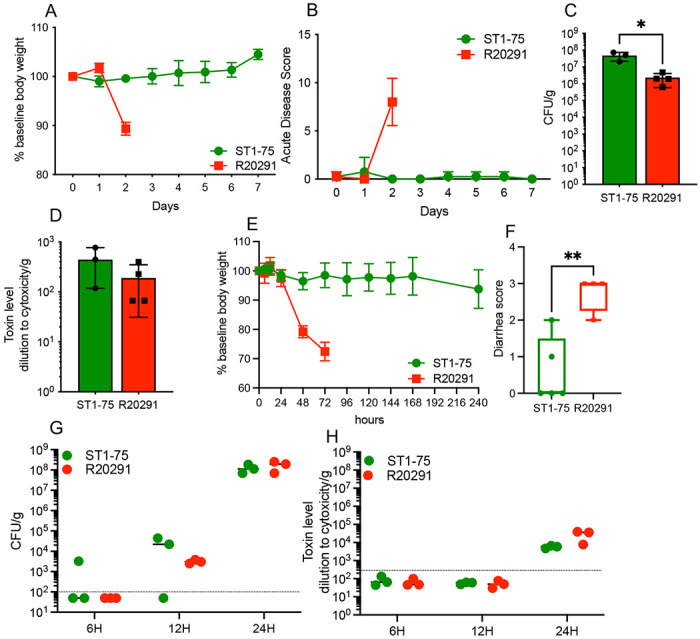
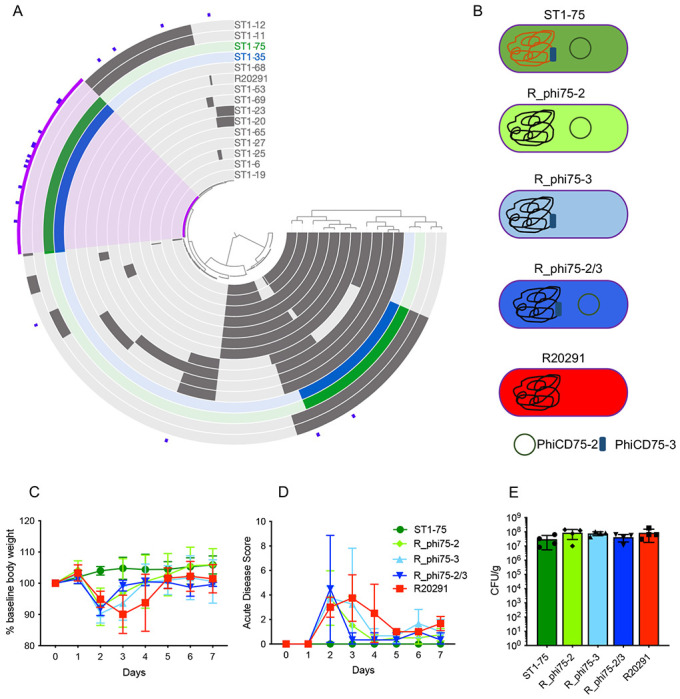
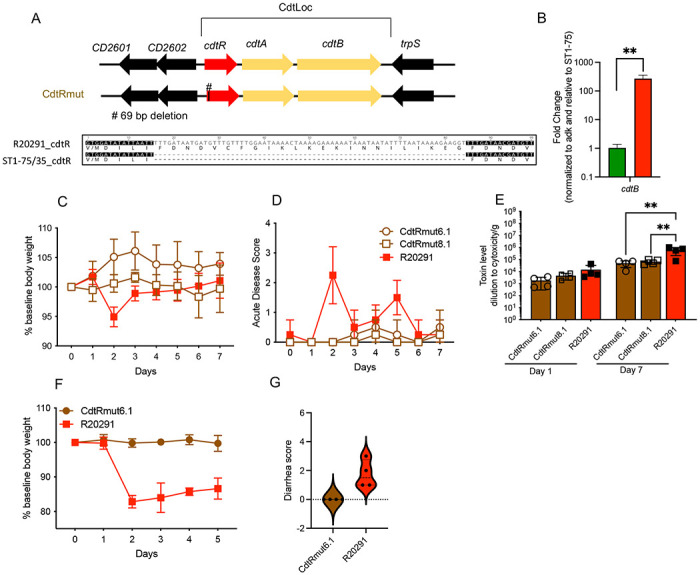
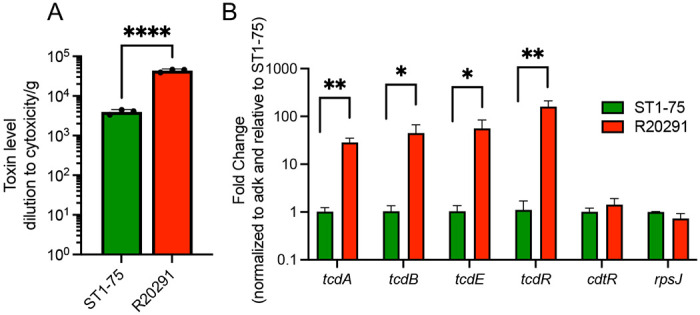
, a leading cause of nosocomial infection, produces toxins that damage the colonic epithelium and results in colitis that varies from mild to fulminant. Variation in disease severity is poorly understood and has been attributed to host factors (age, immune competence and intestinal microbiome composition) and/or virulence differences between strains, with some, such as the epidemic BI/NAP1/027 (MLST1) strain, being associated with greater virulence. We tested 23 MLST1(ST1) clinical isolates for virulence in antibiotic-treated C57BL/6 mice. All isolates encoded a complete Tcd pathogenicity locus and achieved similar colonization densities in mice. Disease severity varied, however, with 5 isolates causing lethal infections, 16 isolates causing a range of moderate infections and 2 isolates resulting in no detectable disease. The avirulent ST1 isolates did not cause disease in highly susceptible Myd88 or germ-free mice. Genomic analysis of the avirulent isolates revealed a 69 base-pair deletion in the N-terminus of the gene, which encodes a response regulator for binary toxin (CDT) expression. Genetic deletion of the 69 base-pair sequence in the highly virulent ST1 R20291 strain rendered it avirulent and reduced toxin gene transcription in cecal contents. Our study demonstrates that a natural deletion within attenuates virulence in the epidemic ST1 strain without reducing colonization and persistence in the gut. Distinguishing strains on the basis of may enhance the specificity of diagnostic tests for colitis.
作为医院感染的主要原因之一,会产生损害结肠上皮的毒素,导致从轻度到暴发性不等的结肠炎。疾病严重程度的差异了解甚少,其原因被归结为宿主因素(年龄、免疫能力和肠道微生物群组成)和/或菌株之间的毒力差异,其中一些菌株,如流行的BI/NAP1/027(MLST1)菌株,与更高的毒力相关。我们测试了23株MLST1(ST1)临床分离株在抗生素处理的C57BL/6小鼠中的毒力。所有分离株都编码完整的Tcd致病位点,并且在小鼠中达到了相似的定植密度。然而,疾病严重程度各不相同,5株分离株导致致命感染,16株分离株导致一系列中度感染,2株分离株未引发可检测到的疾病。无毒力的ST1分离株在高度易感的Myd88缺陷或无菌小鼠中不会引起疾病。对无毒力分离株的基因组分析显示,在编码二元毒素(CDT)表达的反应调节因子的基因的N端有一个69个碱基对的缺失。在高毒力的ST1 R20291菌株中对69个碱基对序列进行基因缺失,使其变得无毒力,并降低了盲肠内容物中毒素基因的转录。我们的研究表明,基因内的自然缺失会减弱流行的ST1菌株的毒力,而不会降低其在肠道中的定植和持久性。基于该基因进行菌株区分可能会提高艰难梭菌结肠炎诊断测试的特异性。