Khalid Waseem, Maggiolino Aristide, Kour Jasmeet, Arshad Muhammad Sajid, Aslam Noman, Afzal Muhammad Faizan, Meghwar Parkash, Zafar Khair-Ul-Wajeeha, De Palo Pasquale, Korma Sameh A
Department of Food Science, Faculty of Life Sciences, Government College University, Faisalabad, Pakistan.
Department of Veterinary Medicine, University of Bari Aldo Moro, Bari, Italy.
Front Nutr. 2023 Jan 11;9:1057457. doi: 10.3389/fnut.2022.1057457. eCollection 2022.
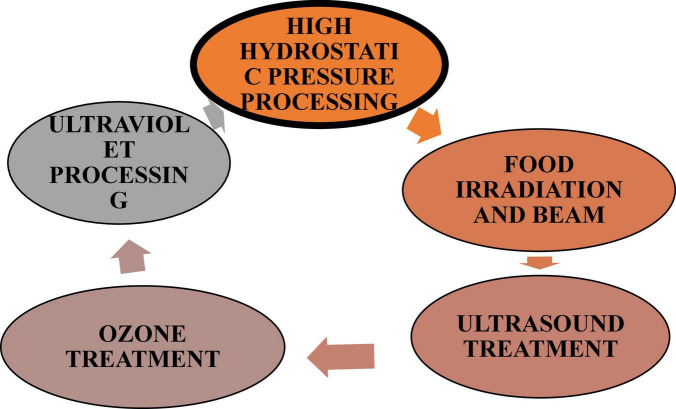
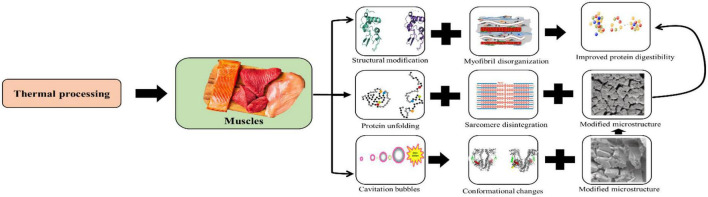
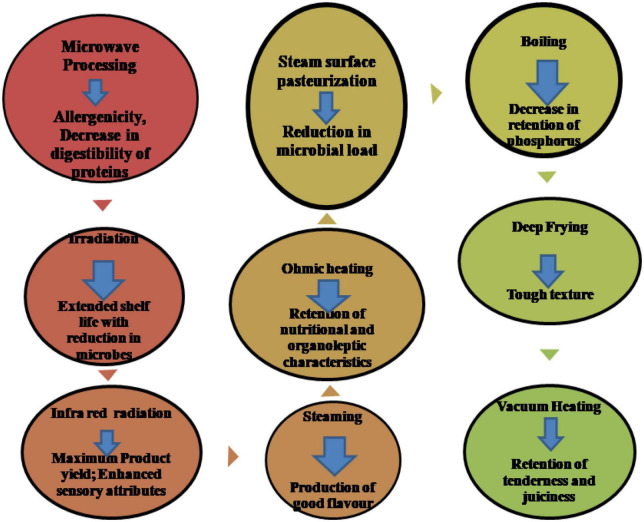
Meat processing represents an inevitable part of meat and meat products preparation for human consumption. Both thermal and non-thermal processing techniques, both commercial and domestic, are able to induce chemical and muscle's proteins modification which can have implication on oxidative and sensory meat characteristics. Consumers' necessity for minimally processed foods has paved a successful way to unprecedented exploration into various novel non-thermal food processing techniques. Processing of meat can have serious implications on its nutritional profile and digestibility of meat proteins in the digestive system. A plethora of food processing techniques can potentially induce alterations in the protein structure, palatability, bioavailability and digestibility various phenomena predominantly denaturation and Maillard reaction. Apart from these, sensory attributes such as color, crispness, hardness, and total acceptance get adversely affected during various thermal treatments in meat. A major incentive in the adoption of non-thermal food processing is its energy efficiency. Considering this, several non-thermal processing techniques have been developed for evading the effects of conventional thermal treatments on food materials with respect to Maillard reactions, color changes, and off-flavor development. Few significant non-thermal processing techniques, such as microwave heating, comminution, and enzyme addition can positively affect protein digestibility as well as enhance the value of the final product. Furthermore, ultrasound, irradiation, high-pressure processing, and pulsed electric fields are other pivotal non-thermal food processing technologies in meat and meat-related products. The present review examines how different thermal and non-thermal processing techniques, such as sous-vide, microwave, stewing, roasting, boiling, frying, grilling, and steam cooking, affect meat proteins, chemical composition, oxidation, and sensory profile.
肉类加工是将肉类及肉制品加工以供人类食用的一个必然环节。无论是商业还是家庭使用的热加工和非热加工技术,都能够引发化学变化以及肌肉蛋白质的改性,这可能会对肉类的氧化特性和感官特性产生影响。消费者对最低限度加工食品的需求为前所未有的各种新型非热食品加工技术探索开辟了成功之路。肉类加工会对其营养成分以及消化系统中肉类蛋白质的消化率产生严重影响。大量的食品加工技术可能会导致蛋白质结构、适口性、生物利用度和消化率发生改变,这些现象主要包括变性和美拉德反应。除此之外,在肉类的各种热处理过程中,诸如颜色、脆度、硬度和总体可接受性等感官属性会受到不利影响。采用非热食品加工的一个主要诱因是其能源效率。考虑到这一点,已经开发出了几种非热加工技术,以避免传统热处理对食品材料在美拉德反应、颜色变化和异味产生方面的影响。一些重要的非热加工技术,如微波加热、粉碎和添加酶,可以对蛋白质消化率产生积极影响,并提高最终产品的价值。此外,超声、辐照、高压处理和脉冲电场是肉类及肉类相关产品中的其他关键非热食品加工技术。本综述探讨了不同的热加工和非热加工技术,如低温长时间烹饪、微波、炖煮、烘焙、煮沸、油炸、烧烤和蒸汽烹饪,如何影响肉类蛋白质、化学成分、氧化以及感官特征。