Montero Lidia, Ballesteros-Vivas Diego, Gonzalez-Barrios Andrés Fernando, Sánchez-Camargo Andrea Del Pilar
Applied Analytical Chemistry Laboratory, University of Duisburg-Essen, Duisburg, Germany.
Teaching and Research Center for Separation, University of Duisburg-Essen, Duisburg, Germany.
Front Nutr. 2023 Jan 11;9:1039180. doi: 10.3389/fnut.2022.1039180. eCollection 2022.
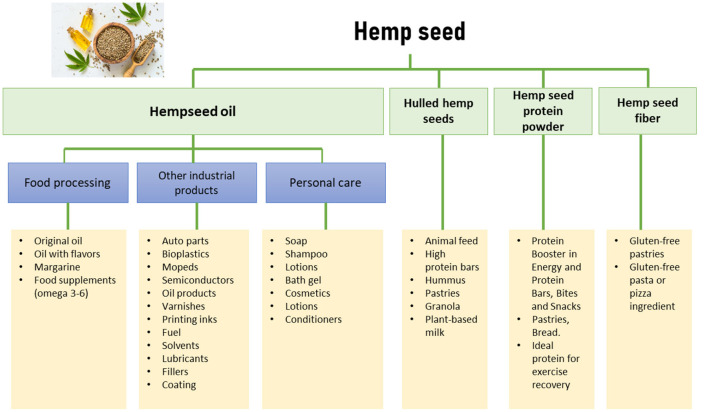
For many years, Colombia was one of the countries with the largest illegal cultivation of cannabis around the world. Currently, it is going through a period of transition with a new government law that recently allows the cultivation, transformation, and commercialization of such plant species. In this sense, the identification of strategies for the valorization of products or by-products from represent a great opportunity to improve the value chain of this crop. One of these products is hemp seeds, which are exceptionally nutritious and rich in healthy lipids (with high content of three polyunsaturated fatty acids: linoleic acid, alpha-linolenic acid, and gamma-linolenic acid), good quality protein, and several minerals. In addition, hemp seeds contain THC (tetrahydrocannabinol) or CBD (cannabidiol) in traces, molecules that are responsible for the psychoactive and therapeutic properties of cannabis. These low terpenophenolic contents make it more attractive for food applications. This fact, together with the constant search for proteins of vegetable origin and natural food ingredients, have aroused an important interest in the study of this biomass. Some bioactivities of phytochemical compounds (polyphenols and terpenoids, mainly) present in hemp seeds have provided antioxidant, antimicrobial, and anti-inflammatory properties. This review summarizes and discusses the context of hemp use in Latin-American and the new opportunities for hemp seeds culture in Colombia considering the valuable nutritional value, main functional bioactivities, and recent advances in food market applications of hemp seeds.
多年来,哥伦比亚一直是全球大麻非法种植面积最大的国家之一。目前,该国正在经历一段转型期,新的政府法律最近允许种植、加工和商业化此类植物品种。从这个意义上说,确定从[未明确的相关事物]中提取产品或副产品增值的策略,是改善这种作物价值链的一个绝佳机会。这些产品之一是大麻籽,它营养异常丰富,富含健康脂质(三种多不饱和脂肪酸含量高:亚油酸、α-亚麻酸和γ-亚麻酸)、优质蛋白质和多种矿物质。此外,大麻籽含有微量的四氢大麻酚(THC)或大麻二酚(CBD),这些分子分别是大麻具有精神活性和治疗特性的原因。这些低萜酚含量使其在食品应用方面更具吸引力。这一事实,加上对植物源蛋白质和天然食品成分的不断探索,引发了对这种生物质研究的重要兴趣。大麻籽中存在的一些植物化学化合物(主要是多酚和萜类化合物)的生物活性具有抗氧化、抗菌和抗炎特性。本综述总结并讨论了拉丁美洲大麻的使用背景,以及考虑到大麻籽宝贵的营养价值、主要功能生物活性和食品市场应用的最新进展,哥伦比亚大麻籽种植的新机遇。