Lu Yayun, Xia Qing, Wu Liangyu, Xie Zhiping
Health Examination Center, Huadong Sanatorium, Wuxi, China.
Front Nutr. 2023 Jan 13;10:1026054. doi: 10.3389/fnut.2023.1026054. eCollection 2023.
Although the association between low muscle mass and the risk of non-alcoholic fatty liver disease is well-known, it has not been explored in viscerally obese populations by gender. Besides, whether low muscle mass still increases the NAFLD risk in subjects with visceral obesity, independent of obesity, is still unknown. The aim of this study was to explore the gender-specific association between low muscle mass and the risk of non-alcoholic fatty liver disease (NAFLD) in subjects with visceral obesity.
Overall, 1,114 participants aged 19-89 years were recruited in this retrospective study. Liver disease was diagnosed by hepatic ultrasound. Skeletal muscle mass was estimated by bioimpedance analysis and defined by the appendicular skeletal muscle index (ASMI). Gender-specific differences in the ASMI value were compared between NAFLD and control groups. Restricted cubic spline and multivariate logistic regression were performed to analyze the association (stratified by gender and age) between the ASMI and the risk of NAFLD, respectively.
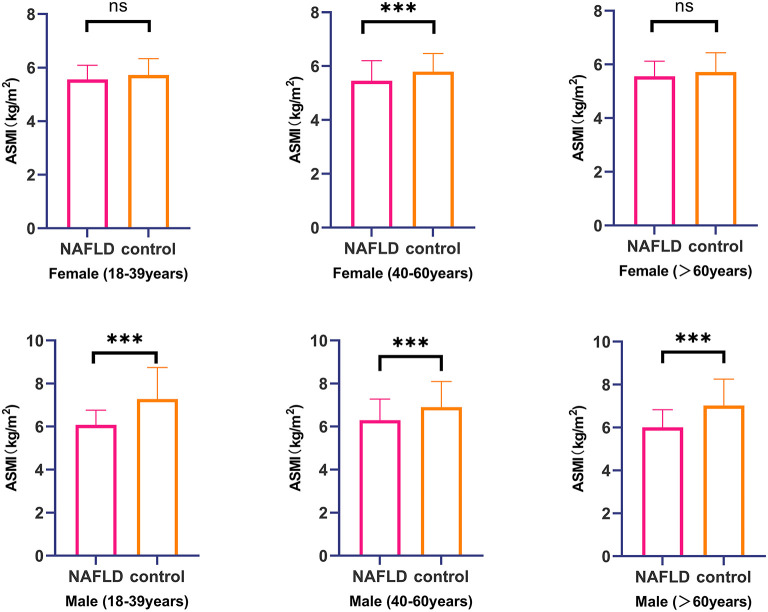
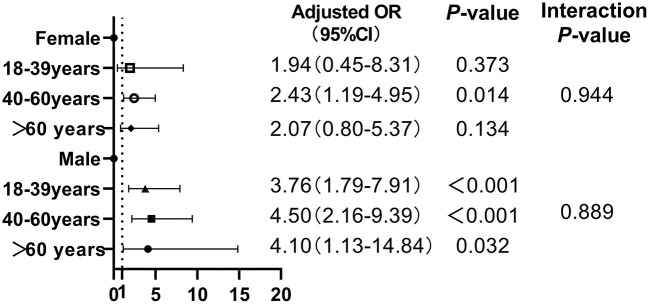
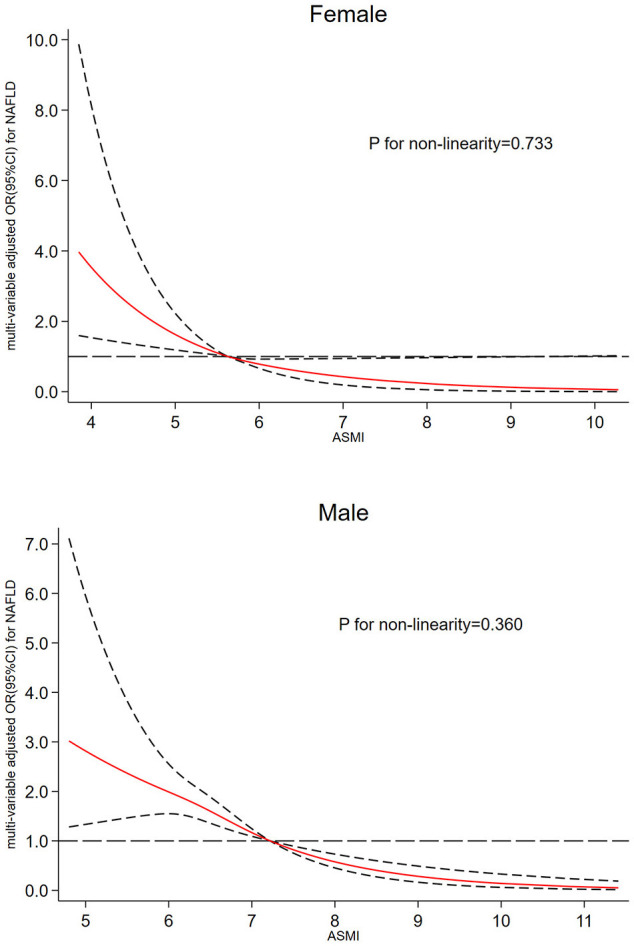
Middle-aged females (40-60 years) and males (of any age) with NAFLD had a significantly lower ASMI compared with controls (-value < 0.05). An inverse linear association was found between the ASMI and risk of NAFLD (all > 0.05). Lower quartiles of the ASMI conferred independent risk of NAFLD compared to higher quartiles (all for trend < 0.001). Low muscle mass conferred a higher risk of NAFLD in middle-aged females (adjusted odds ratio = 2.43, 95% confidence interval: 1.19-4.95) and males [18-39 years: 3.76 (1.79-7.91); 40-60 years: 4.50 (2.16-9.39); and >60 years: 4.10 (1.13-14.84)]. Besides, Low muscle mass and low muscle mass with obesity increase the risk of developing NAFLD, independent of obesity.
Among those with visceral obesity, low muscle mass increased the risk of NAFLD in males of any age, and middle-aged females, this may be explained by the postmenopausal decline in estrogen.
尽管低肌肉量与非酒精性脂肪性肝病风险之间的关联已为人熟知,但尚未按性别在内脏型肥胖人群中进行探讨。此外,低肌肉量在独立于肥胖的情况下,是否仍会增加内脏型肥胖受试者患非酒精性脂肪性肝病的风险尚不清楚。本研究的目的是探讨内脏型肥胖受试者中低肌肉量与非酒精性脂肪性肝病(NAFLD)风险之间的性别特异性关联。
在这项回顾性研究中,共招募了1114名年龄在19 - 89岁的参与者。通过肝脏超声诊断肝脏疾病。通过生物电阻抗分析估算骨骼肌量,并由四肢骨骼肌指数(ASMI)进行定义。比较非酒精性脂肪性肝病组和对照组之间ASMI值的性别特异性差异。分别进行受限立方样条分析和多因素逻辑回归分析(按性别和年龄分层),以分析ASMI与非酒精性脂肪性肝病风险之间的关联。
患有非酒精性脂肪性肝病的中年女性(40 - 60岁)和男性(任何年龄)的ASMI显著低于对照组(P值<0.05)。发现ASMI与非酒精性脂肪性肝病风险之间存在负线性关联(所有P>0.05)。与较高四分位数相比,ASMI的较低四分位数赋予非酒精性脂肪性肝病独立风险(所有趋势P<0.001)。低肌肉量在中年女性(调整后的优势比=2.43,95%置信区间:1.19 - 4.95)和男性中赋予较高的非酒精性脂肪性肝病风险[18 - 39岁:3.76(1.79 - 7.91);40 - 60岁:4.50(2.16 - 9.39);>60岁:4.10(1.13 - 14.84)]。此外,低肌肉量以及伴有肥胖的低肌肉量会增加患非酒精性脂肪性肝病的风险,独立于肥胖因素。
在内脏型肥胖者中,低肌肉量会增加任何年龄男性和中年女性患非酒精性脂肪性肝病的风险,这可能是由于绝经后雌激素水平下降所致。