Cour Martin, Guérin Claude, Degivry Florian, Argaud Laurent, Louis Bruno
Service de Médecine Intensive-Réanimation, Hospices Civils de Lyon, Hôpital Edouard Herriot, Lyon, France.
Faculté de Médecine Lyon-Est, Université de Lyon, Université Claude Bernard Lyon 1, Lyon, France.
Front Med (Lausanne). 2023 Jan 12;9:1068428. doi: 10.3389/fmed.2022.1068428. eCollection 2022.
The use of high flow oxygen therapy (HFOT) has significantly escalated during the COVID-19 pandemic. HFOT can be delivered through both dedicated devices and ICU ventilators. HFOT can be administered to a patient a nasal cannula (NC). In intubated patients, a tracheal cannula (TC) is used instead. In this study, we aim to compare the work of breathing (WOB) using a TC or NC and to explore whether differences exist among HFOT devices.
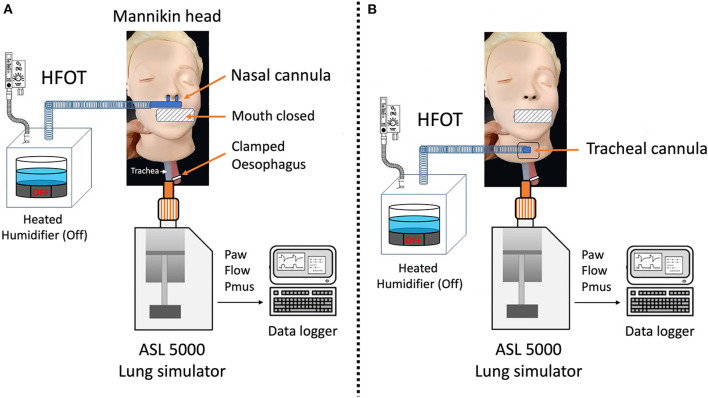
Seven HFOT devices (three dedicated and four ICU ventilators) were connected to a manikin head (Laerdal Medical) through a NC (Optiflow 3S, large size, Fisher and Paykel Healthcare) or a TC (OPT 970 Optiflow+, Fisher and Paykel Healthcare). Each device was also attached to a manikin head that was connected to a lung simulator (ASL5000, Ingmar Medical), set at 40 ml/cmHO compliance, 10 cmHO/L/s resistance, and sinusoidal inspiratory effort (muscular pressure 10 cmHO, rate 30 breaths/min). HFOT was delivered at 40 L/min and at 21% inspired oxygen fraction. The total WOB per breath and its resistive and elastic components were automatically analyzed breath by breath over the last 20 breaths by using Campbell's diagram.
The WOB and its resistive and elastic components were significantly lower with the TC than with the NC for every device, and systematically lower with the reference device than with others. These differences were, however, very small and may be not clinically relevant.
The WOB is lower with the TC than with the NC and with the reference device, compared with the most recent devices.
在新冠疫情期间,高流量氧疗(HFOT)的使用显著增加。HFOT可通过专用设备和重症监护室(ICU)呼吸机进行。HFOT可通过鼻导管(NC)给予患者。对于插管患者,则使用气管导管(TC)。在本研究中,我们旨在比较使用TC或NC时的呼吸功(WOB),并探讨不同HFOT设备之间是否存在差异。
七台HFOT设备(三台专用设备和四台ICU呼吸机)通过NC(Optiflow 3S,大尺寸,费雪派克医疗保健公司)或TC(OPT 970 Optiflow+,费雪派克医疗保健公司)连接到一个人体模型头部(Laerdal Medical)。每个设备还连接到一个与肺模拟器(ASL5000,英格玛医疗)相连的人体模型头部,肺模拟器设置为顺应性40 ml/cmH₂O、阻力10 cmH₂O/L/s,并进行正弦吸气努力(肌肉压力10 cmH₂O,频率30次/分钟)。以40 L/分钟的流量和21%的吸入氧分数进行HFOT。使用坎贝尔图在最后20次呼吸中逐次自动分析每次呼吸的总WOB及其阻力和弹性成分。
对于每台设备,使用TC时的WOB及其阻力和弹性成分均显著低于使用NC时,且与参考设备相比,其他设备的WOB系统地更低。然而,这些差异非常小,可能不具有临床相关性。
与最新设备相比,使用TC时的WOB低于使用NC时,且低于参考设备。